

What’s Really Causing Your Steering Wheel to Shake at High Speeds?
Steering wheel shaking at high speeds is almost always caused by one of a handful of mechanical problems — most of which are fixable without breaking the bank.
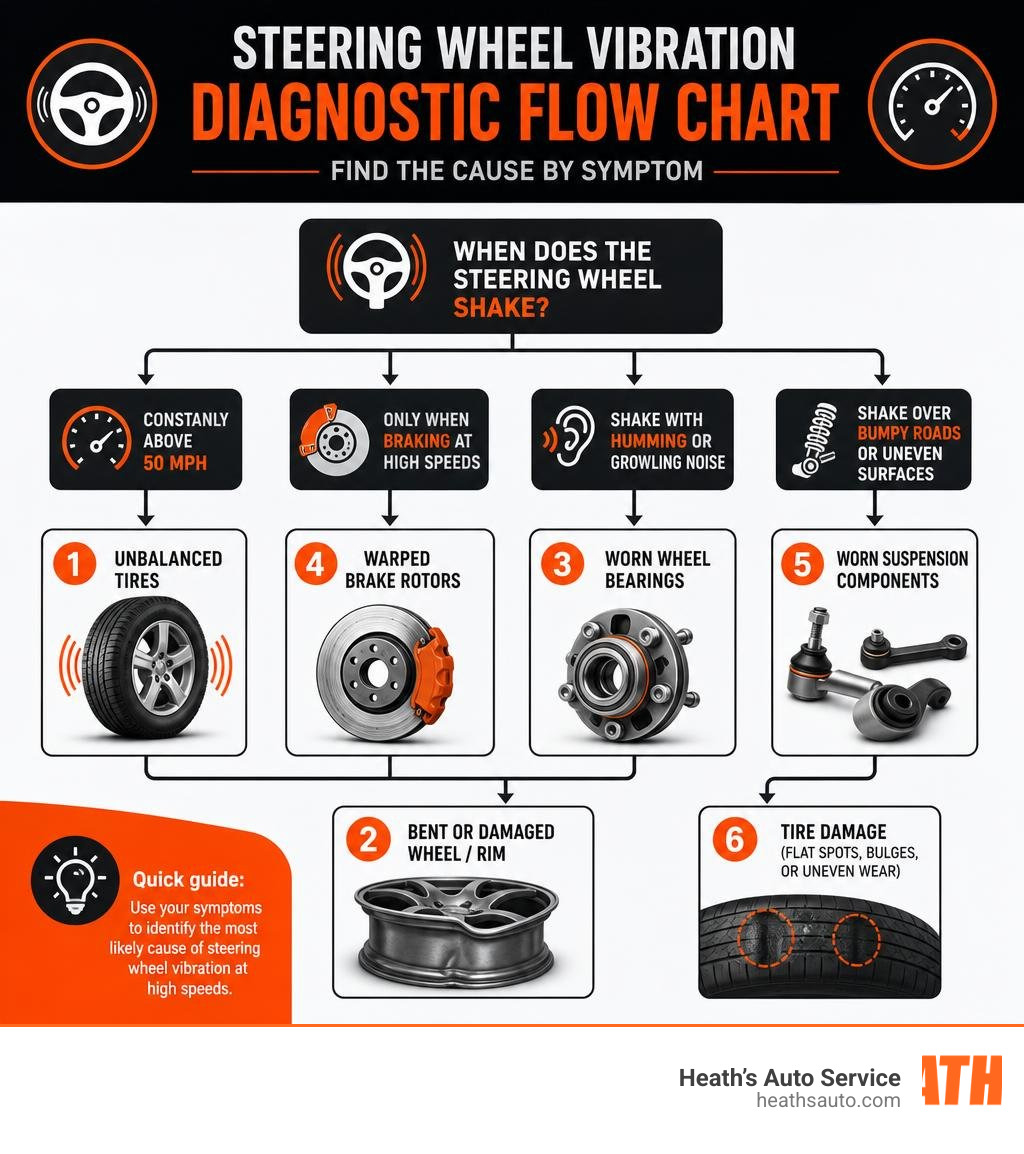
Here are the most common causes, ranked by likelihood:
- Unbalanced tires — the #1 cause; vibration typically kicks in between 50–70 mph
- Bent or damaged wheel/rim — causes a speed-dependent wobble that worsens over time
- Worn wheel bearings — produces a humming noise alongside the shake
- Warped brake rotors — shake appears specifically when braking at highway speeds
- Worn suspension components — ball joints, tie rods, or control arm bushings
- Tire damage — flat spots, bulges, or uneven tread wear
Quick answer: If your steering wheel only shakes while braking, suspect warped rotors. If it shakes constantly above 50 mph, start with tire balance.
That strange wobble through the steering wheel at highway speeds is easy to ignore at first — you turn up the radio, grip the wheel tighter, and tell yourself it’s probably nothing. But it rarely stays “nothing” for long. What starts as a minor annoyance can quietly wear down your tires, stress your suspension, and in serious cases, compromise your ability to control the car.
Basic steering wheel shaking at high speeds vocab:
Common Causes of a Steering Wheel Shaking at High Speeds
When you are cruising down the Loop 101 in Scottsdale or heading up the steep climbs toward Flagstaff, your vehicle is subjected to intense rotational forces. At 60 or 70 mph, any minor imperfection in your rotating assemblies is multiplied exponentially. Let’s dive deep into the primary culprits behind this unsettling experience.
1. Tire Imbalance (The Most Common Culprit)
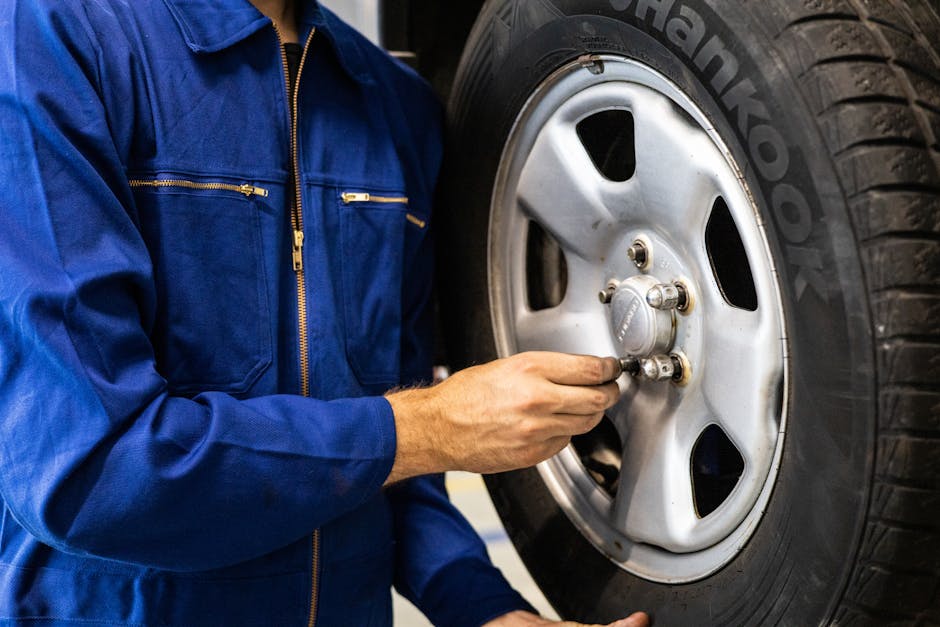
By far, the most common reason for a steering wheel to shake between 50 and 70 mph is an out-of-balance tire. When tires are mounted onto wheels, they are never perfectly uniform. There are always microscopic heavy and light spots in both the rubber and the metal wheel.
To correct this, mechanics use a spin balancer to find these spots and apply small lead or zinc weights to the rim. It doesn’t take much to cause a violent shake. A mere 0.25 to 1.5 ounces of weight discrepancy can generate a rhythmic, high-frequency vibration once centrifugal force kicks in at highway speeds.
According to The Motor Guy’s analysis on highway vibrations, standard spin balancing is usually the first step to resolving this issue. However, standard balancing only spins the tire in the air. For persistent vibrations, we often recommend “Road Force Balancing.” This advanced diagnostic method presses a large roller against the rotating tire to simulate the weight of the vehicle, detecting stiff spots in the tire’s sidewall and subtle wheel runout that standard balancers miss.
2. Out-of-Round Tires and Tire Damage
Tires are not always perfectly round, and over time, they can develop defects. If a vehicle sits parked in the hot Arizona sun for weeks, the tires can develop temporary or permanent flat spots. Furthermore, hitting a curb or a deep pothole can cause “belt separation” inside the tire carcass. This means the internal steel belts have detached from the rubber, creating a localized bubble or distortion in the tread.
If you notice a sudden onset of vibration after hitting a pothole, or if you visually inspect your tire and notice a bulge in the sidewall, you need to address it immediately. For more detailed troubleshooting, check out these more tips on stopping steering wheel shakes.
3. Bent Rims or Wheels
Alloy wheels look fantastic, but they can bend relatively easily when subjected to hard impacts. If you hit a pothole or curb in Prescott or Cottonwood, the inner or outer lip of your wheel can warp. Even a slight bend—measured as “lateral” or “radial” runout exceeding 0.040 to 0.060 inches—will prevent the tire from tracking straight, creating a persistent wobble that balancing weights cannot entirely fix.
4. Worn Wheel Bearings
Your wheel bearings allow your wheels to spin freely with minimal friction. When a wheel bearing begins to fail, it develops internal “play” or looseness. Unlike tire imbalance, which is usually a pure vibration, a failing wheel bearing is almost always accompanied by a distinct, low-pitched growling or humming noise (similar to driving over rumble strips) that changes in pitch when you gently swerve or steer the vehicle from side to side.
Here is a quick reference table to help you distinguish between these three common wheel-end issues:
| Issue | Typical Speed Range | Accompanying Noise? | Behavior |
|---|---|---|---|
| Tire Imbalance | 50 – 75 mph | None (pure vibration) | Peaks at specific speeds, may disappear above 75 mph |
| Bent Rim | All speeds (worsens with speed) | None, unless rubbing | Constant wobble, felt through the floorboard or steering wheel |
| Worn Wheel Bearing | 30+ mph (worsens with speed) | Growling, humming, or roaring | Noise changes pitch when gently steering left or right |
5. Suspension Damping Failure and Worn Steering Components
Your suspension is designed to absorb road imperfections and keep your tires firmly planted on the pavement. However, as shocks, struts, control arm bushings, tie rod ends, or ball joints wear out (which becomes much more common after 80,000 miles), they lose their ability to damp vibrations.
If your tie rod ends or ball joints have excessive play, the wheels can oscillate side-to-side independently of your steering input. This is especially true on rough road surfaces. In heavy-duty trucks with solid front axles (such as Jeeps or Ram trucks), worn suspension components can trigger a violent, uncontrollable shaking known as the “Death Wobble” when hitting a bump at speed. To learn more about how these mechanical failures interact, refer to CarBuzz’s guide on steering wheel vibration.
Differentiating Speed-Related Shaking from Braking Vibrations
One of the most important diagnostic clues you can provide to a mechanic is when the shaking occurs. Is the vibration constant while cruising at 60 mph, or does it only happen when you step on the brake pedal?

Warped Brake Rotors and Thermal Stress
If your steering wheel is perfectly smooth while cruising at 60 mph, but begins to shake violently the moment you press the brakes to slow down, you are almost certainly dealing with a brake system issue.
The primary cause is warped brake rotors. Your brake rotors are metal discs that spin along with your wheels. When you step on the brakes, the brake calipers squeeze the brake pads against these spinning discs to slow you down.
In Arizona, our extreme summer temperatures combined with heavy braking—such as descending the steep, winding mountain passes from Flagstaff down to Sedona—can subject your rotors to immense thermal stress. When rotors get extremely hot and then cool unevenly, they can warp.
Additionally, prolonged high heat can cause brake pad material to transfer unevenly onto the rotor surface, creating microscopic hard spots known as “cementite.” When your brake pads squeeze against a rotor with uneven thickness or cementite spots, the pads bounce rapidly over the high and low spots. This rapid pulsing is transmitted directly up through the steering gear, causing the steering wheel to shake.
To dive deeper into this specific safety concern, read our guide on understanding why steering shakes when braking.
Sticking Calipers and Sticking Pins
Another brake-related issue that can cause a high-speed shake is a sticking brake caliper. If the caliper’s internal piston or slide pins become seized, the brake pad may remain lightly pressed against the rotor even when you aren’t touching the brake pedal. This constant friction generates extreme heat, warping the rotor rapidly and creating a severe speed-specific vibration that may come and go. If you notice a burning smell or a wheel that feels incredibly hot to the touch after driving, a sticking caliper is the prime suspect.
For a complete overview of the differences between speed-dependent steering shakes and brake-related vibrations, check out our comprehensive Guide to steering wheel shaking in 2026.
How to Diagnose Steering Wheel Shaking at Home
While resolving most steering and suspension issues requires professional equipment, you can perform several simple diagnostic steps at home to narrow down the cause before bringing your vehicle to one of our Arizona shops.
Step 1: Check Your Tire Pressure
Before doing anything else, grab a reliable tire pressure gauge and check all four tires when they are cold. Ensure they are inflated to the exact PSI listed on the placard inside your driver’s side door jamb (do not use the maximum PSI listed on the tire sidewall).
Extreme under-inflation or heavily uneven tire pressure across an axle can cause the tire tread to deform, creating a subtle shimmy or wallow at high speeds. Proper inflation is the foundation of all tire services and maintenance.
Step 2: Perform a Thorough Visual Inspection
Safely park your vehicle on a flat surface, engage the parking brake, and inspect your front and rear tires. Look for:
- Uneven Tread Wear: Run your hand across the tread. Do you feel “cupping” (scalloped dips in the tread) or feathering? This indicates worn shocks or an alignment issue.
- Sidewall Bulges or Bubbles: Any bubble in the sidewall means the tire’s internal structure is compromised. This tire is a blowout risk and must be replaced immediately.
- Missing Wheel Weights: Look along the outer and inner edges of your rims. If you see a clean spot where a stick-on adhesive weight used to be, you may have lost a wheel weight, which immediately throws the tire out of balance.
- Mud or Debris: Sometimes, caked-on mud, snow, or road debris stuck to the inside of the rim can mimic a tire imbalance. Clean your wheels thoroughly to see if the shake disappears.
Step 3: The Suspension Bounce Test
Walk to each corner of your vehicle and push down firmly on the bumper or fender several times, then let go. The vehicle should rebound and settle immediately. If the vehicle continues to bounce or rock more than once or twice, your shocks or struts are worn out and are no longer damping road vibrations effectively.
Step 4: Verify Lug Nut Torque
If you recently had a tire rotation, brake job, or flat repair, your wheel lug nuts might not be torqued correctly. Loose lug nuts can cause a terrifying wheel wobble at high speeds.
Using a torque wrench, verify that all lug nuts are tightened in a star pattern to your vehicle manufacturer’s exact torque specifications. Never drive on a vehicle if you suspect the wheels are loose. For more detailed safety steps, read our advice on how to handle high-speed steering issues.
Frequently Asked Questions About High-Speed Wobbles
What causes steering wheel shaking at high speeds compared to low speeds?
The difference comes down to physics—specifically harmonic frequency and centrifugal force. At low speeds (under 40 mph), minor tire imbalances do not spin fast enough to generate enough centrifugal force to overcome the weight and dampening of your car’s suspension.
However, as you accelerate toward 60 mph, the rotation of the wheel matches the natural resonant frequency of your front suspension. This “harmony” amplifies the tiny imbalance, turning a microscopic wobble into a violent shaking that you can easily feel through the steering wheel.
Conversely, shaking at very low speeds (such as 10 to 20 mph) is rarely a balancing issue. Instead, low-speed wobbles typically point to a severely bent wheel, a broken tire belt (causing the tire to walk in an S-shape), temporary tire flat-spotting from cold weather, or a loose steering rack. To explore this lower-speed phenomenon in detail, see our guide on why steering wheels shake at low speeds.
Is it safe to drive with a steering wheel shaking at high speeds?
In short: No, it is not safe to ignore. While a minor tire imbalance might feel like a simple nuisance, driving with a vibrating steering wheel introduces significant safety risks.
First, constant vibration places immense structural stress on other critical steering and suspension components. Over time, this shaking will accelerate wear on your wheel bearings, tie rod ends, ball joints, and steering rack. What could have been a simple $50 tire balance can easily turn into a $1,000 suspension overhaul.
Second, if the vibration is caused by a tire belt separation or a structural bulge, continuing to drive at highway speeds dramatically increases your risk of a catastrophic tire blowout, which can lead to a complete loss of control.
Will a wheel alignment fix my shaking steering wheel?
This is one of the most common misconceptions in auto repair. A standard wheel alignment will not fix a shaking steering wheel.
Wheel alignment refers to adjusting the angles of your wheels (caster, camber, and toe) so that they are parallel to each other and perpendicular to the road. The primary symptoms of bad alignment are your car pulling to one side, an off-center steering wheel, or rapid, uneven tire wear.
However, there is a catch: if your vehicle has been out of alignment for a long time, it will cause uneven tire wear patterns like “cupping” or feathering. These damaged tread patterns will cause a high-speed vibration. In this scenario, you will need to replace or balance the tires and perform an alignment to prevent the new tires from wearing out the same way. You can learn more about these associated costs in our breakdown of understanding wheel alignment costs.
Conclusion: Restoring Your Smooth Ride
A shaking steering wheel at high speeds is your vehicle’s way of telling you that something in its rotating assembly or suspension is out of harmony. Whether it is a simple lost wheel weight, a warped brake rotor from descending mountain roads, or worn suspension components, addressing the issue early is the key to preserving your vehicle’s safety, tire life, and your peace of mind.
Regular preventative maintenance—including tire rotations and balances every 5,000 to 7,500 miles—is your best defense against high-speed wobbles.
Heath’s Auto Service In Gilbert, AZ
We stand behind our work with a 3-year/36,000-mile nationwide warranty and offer free second opinions if you’ve been told you need a major repair elsewhere. Don’t spend another day melting in traffic.
At Heath’s Auto Service, our comprehensive range of services covers everything from routine maintenance to complex repairs. Our certified technicians are skilled in handling brake inspections, tire rotations, and much more. Whether it’s a minor tune-up or a major overhaul, trust us to get you back on the road with confidence. Contact our team at Heath’s Auto Service today!