

If your car shakes when braking, here are the most likely causes at a glance:
| What You Feel | Most Likely Cause |
|---|---|
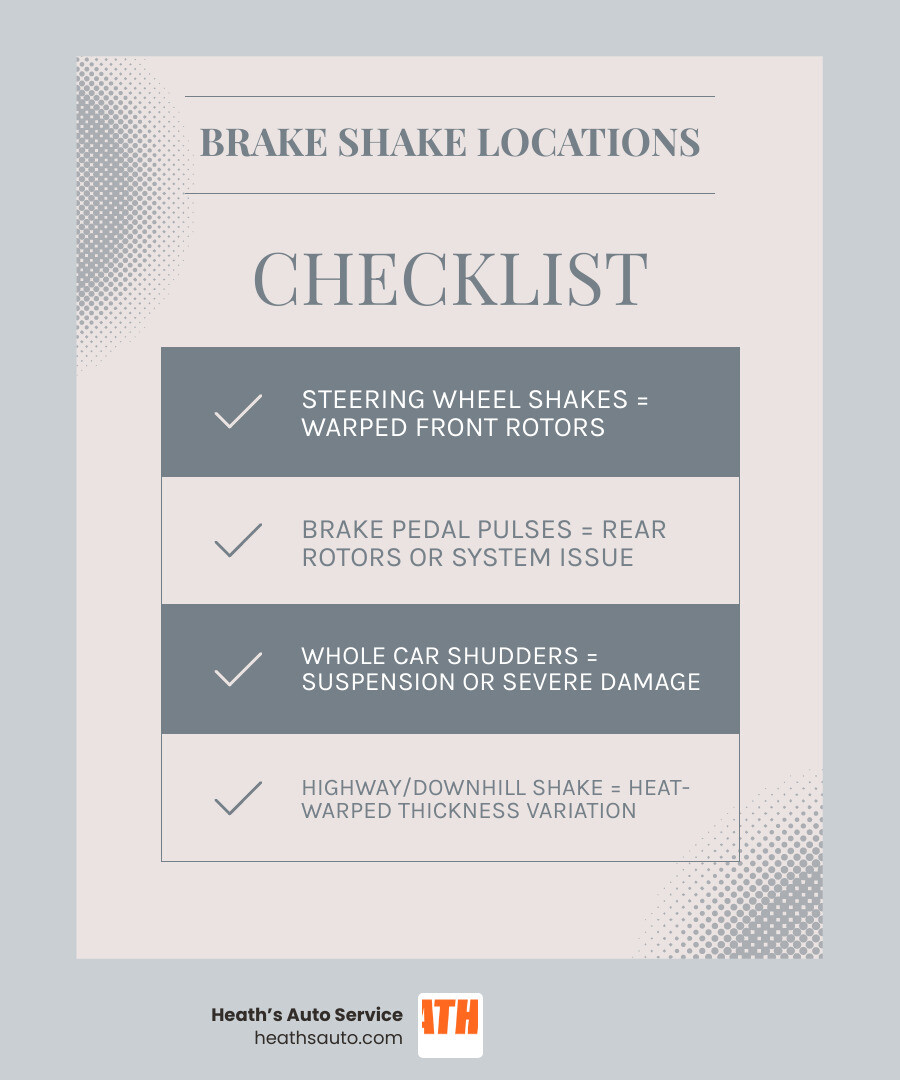
| Steering wheel shakes when slowing down | Warped or uneven front brake rotors |
| Brake pedal pulses without steering shake | Rear rotor issue or brake system problem |
| Whole car shudders under braking | Suspension wear or severe rotor damage |
| Shake only at highway speeds | Rotor thickness variation amplified by speed |
| Vibration only on long downhill roads | Heat buildup warping rotors |
| Shake while stopped with foot on brake | Brake booster or engine issue — not the rotors |
That shudder in your steering wheel is not just annoying. It is your car flagging a real problem — one that can increase your stopping distance and put you at risk in an emergency.
The good news? Most causes are straightforward to diagnose once you know what to look for.
In this guide, we break down exactly what is happening, how urgent it is, and what it costs to fix — so you can make a confident decision without overpaying.
Car Shakes When Braking: What the Symptom Pattern Usually Means
When a car shakes under braking, the pattern tells us a lot. Where you feel it, when it happens, and whether it changes with speed helps narrow the problem quickly.
A few common clues:
- Steering wheel shake usually points to the front brakes or front suspension
- Brake pedal pulsation often points to rotor thickness variation or rear brake issues
- Seat or floor vibration can suggest rear brake, wheel, or suspension problems
- Shaking only downhill usually means heat buildup
- Vibration while stopped with the brake pressed usually is not a rotor problem at all

When the steering wheel shakes vs the brake pedal pulses
If the steering wheel wiggles when you slow down, we usually suspect the front rotors first. The front brakes do most of the stopping, so uneven front rotor surfaces transfer vibration right into the steering system.
If the brake pedal pulses but the steering wheel stays mostly calm, the issue may be farther back in the system:
- Rear rotors
- Brake hardware
- Rotor thickness variation
- Sometimes ABS activity
If the whole vehicle shudders, we widen the search. Severe rotor issues can do that, but so can loose control arm bushings, worn tie rods, or bad wheel bearings. Braking throws weight forward, and any looseness up front gets exposed fast.
For a broader look at brake system basics, see more info about Brakes and Brake Repairs.
Why car shakes when braking at high speeds, downhill, or only lightly
Speed matters. A small rotor flaw that feels minor at 30 mph can feel dramatic at 60 mph because the wheel and rotor are rotating much faster. That is why many drivers say, “It only shakes when I brake on the freeway.”
Downhill braking is another big clue, especially in Arizona. In places like Flagstaff, Prescott, and mountain routes around Cottonwood, long descents build a lot of heat. That heat can create:
- Rotor hot spots
- Uneven pad deposits
- Rotor thickness variation
- Brake fade
- Caliper drag problems that get worse when hot
If shaking happens only under light braking, that often points to mild rotor unevenness or pad deposits. Hard braking may temporarily mask it because the pads clamp more firmly, but the issue is still there.
A smart habit on long grades is using engine braking or downshifting instead of riding the brakes all the way down. Your rotors will thank you.
If the car shakes when stopped or idling with the brake pressed
If the vehicle vibrates while sitting still at a light with your foot on the brake, the rotors are not the problem. The wheels are not turning, so a warped rotor cannot be causing a brake shake.
In that case, we think about:
- Rough idle
- Vacuum leak
- Brake booster issues
- Weak engine mounts
- Misfire or engine performance problems
Some vehicles can idle rough when the brake booster adds load or if there is a vacuum leak in the booster system. If that sounds familiar, read more info about Why Does My Car Shake When Stopped.
The Most Common Causes of a Car Shaking When Braking
The most common cause is still rotor-related, but it is not the only possibility. Here are the usual suspects:
- Uneven or “warped” brake rotors
- Pad material deposits on the rotors
- Worn or glazed brake pads
- Sticking calipers or seized slide pins
- Wheel bearing play
- Tire balance issues
- Bent wheels
- Worn control arm bushings
- Loose tie rods or ball joints
- Weak struts or shocks
- Improper lug nut torque after wheel service

How warped brake rotors really cause vibration
Most drivers call them warped rotors, and that is fine in everyday conversation. Technically, the shake is often caused by rotor runout, hot spots, or uneven thickness rather than a rotor bending like a potato chip.
Here is what happens:
- The rotor surface becomes uneven from heat, deposits, or wear.
- As it spins, the brake pad grabs harder in some spots than others.
- That uneven contact sends a pulse through the pedal, steering wheel, or chassis.
Common reasons this happens:
- Repeated hard stops
- Riding the brakes downhill
- Holding the brake pedal firmly after a very hot stop
- Rust or corrosion between the rotor and hub
- Lug nuts tightened unevenly or over-torqued
That last one surprises people. We see it after tire service sometimes. If lug nuts are hammered on unevenly with an impact gun, the rotor can distort slightly and start a pulsation issue.
For a deeper dive, see more info about How Do I Know If My Rotors Are Warped.
The role of worn brake pads, calipers, and hardware
Pads, calipers, and hardware can absolutely cause brake vibration or make a rotor issue worse.
Watch for:
- Glazed pads from overheating
- Tapered pad wear from a sticking caliper
- Seized caliper slide pins
- A caliper piston not releasing fully
- Uneven clamping force side to side
Symptoms that often go with caliper trouble include:
- Pulling to one side during braking
- Burning smell after a drive
- One wheel noticeably hotter than the others
- Excessive brake dust on one wheel
- Faster pad wear on one side
A sticking caliper can overheat a rotor and create blue spots or hot spots. Then you end up replacing more parts than if the issue had been caught early.
Suspension, tires, and wheel issues that mimic brake problems
Not every brake shake is truly a brake problem. Braking loads the suspension hard, so worn front-end parts may only show up under deceleration.
Possible look-alikes include:
- Worn ball joints
- Cracked control arm bushings
- Loose tie rod ends
- Failing wheel bearings
- Unbalanced wheels
- Tire cupping
- Broken tire belts
- Bent rims
- Alignment issues
A simple rule: if the car also shakes at cruising speed, even without braking, tires or wheels move higher on the suspect list. If it only shakes under braking, brakes remain more likely.
If you are also noticing vibration at lower speeds, see more info about Why Your Steering Wheel Shakes At Low Speeds.
How to Tell if Your Car Shakes When Braking Because of Rotors
Rotors usually leave a recognizable pattern.
Signs the rotors are the problem
Rotor-related vibration often shows up like this:
- Steering wheel shake during braking from 50 mph and up
- Pulsing brake pedal on normal dry pavement
- Worse shudder after long downhill braking
- Vibration that fades as the vehicle slows
- Blue heat spots on rotor surfaces
- Grooves, ridges, or a rusty lip on the rotor edge
Here is a quick comparison:
| Symptom Pattern | Most Likely Issue |
|---|---|
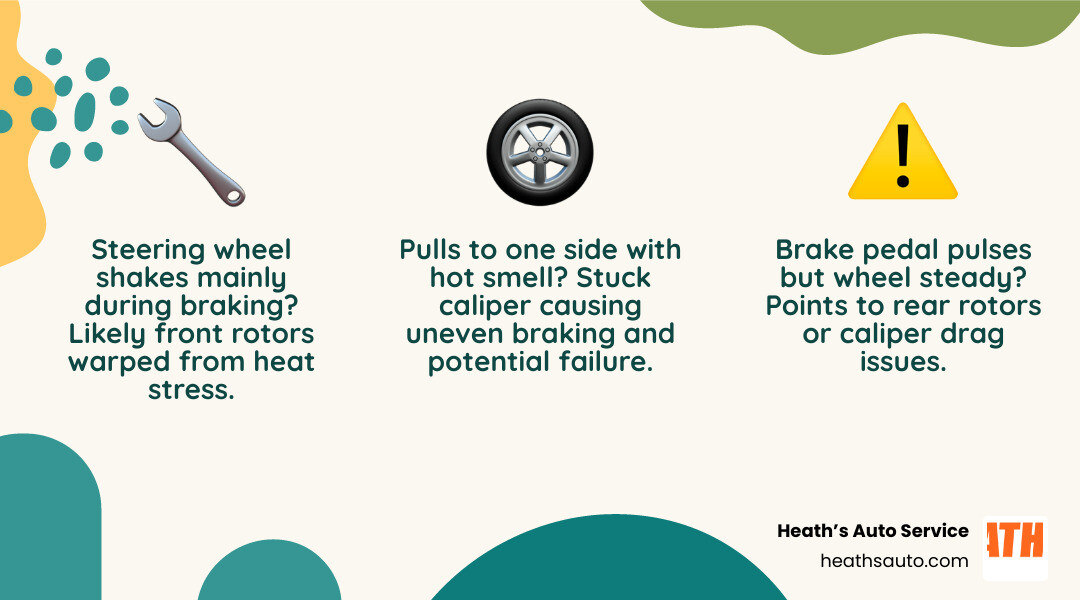
| Steering wheel shakes mainly during braking | Front rotor problem |
| Pedal pulses but wheel is steady | Rear rotor or brake system issue |
| Pulls to one side and smells hot | Sticking caliper |
| Shakes at speed even off the brakes | Tire, wheel, or balance problem |
| Clunk plus shake during stops | Suspension or steering wear |
| Pulses only in panic stop on slick road | Normal ABS activation |
Simple at-home checks before you book an inspection
You do not need a full shop setup to gather useful clues. Safe driveway checks include:
- Check tire pressures against the driver door sticker
- Look for uneven tire wear, cupping, or sidewall damage
- Inspect visible rotor surfaces for grooves or blue spots
- Notice whether one wheel is much hotter after a short drive
- Pay attention to whether the steering wheel, pedal, or seat shakes most
- If safe and you know how, check for wheel play by rocking the tire gently
Also write down:
- The speed where vibration starts
- Whether it is worse downhill
- Whether the car pulls left or right
- Whether there is noise, smell, or a warning light
These notes make diagnosis faster and cheaper because we spend less time chasing ghosts.
When it is probably not the rotors
Sometimes the symptom sounds like warped rotors, but the timing says otherwise.
It is probably not rotors if:
- The vibration happens while idling at a stop
- The shake is present even when not braking
- You hear a suspension clunk over bumps and during stops
- There is wheel bearing growl or humming
- The pedal only pulses during ABS engagement on slippery pavement
ABS deserves a special mention. In a hard stop on gravel, snow, or wet pavement, a pulsing pedal is normal. That is the system doing its job. But pulsing during light braking on dry roads is not normal and should be checked.
Is It Dangerous to Drive if the Car Shakes When Braking?
Usually, yes, it is a safety issue. Mild pulsation may not mean instant failure, but it does mean your braking system is not operating as smoothly or predictably as it should.
Problems can include:
- Longer stopping distances
- Uneven braking force
- Reduced control in emergency maneuvers
- Heat damage spreading to pads or calipers
- Wear to suspension parts from repeated vibration
How urgent the repair is based on the symptoms
We break urgency into three rough levels.
Mild:
- Light pulsation only at highway speeds
- No pull, noise, smell, or warning lights
Schedule it soon. Do not ignore it for months.
Moderate:
- Steering wheel shimmy during everyday stops
- Vibration getting worse
- Visible rotor damage or uneven pad wear
Have it inspected as soon as possible.
Severe:
- Hard shaking
- Pulling to one side
- Grinding or metal-on-metal noise
- Burning smell or smoke
- ABS or brake warning light
- Brake pedal feels weak or inconsistent
At that point, stop driving if you can safely do so and have it towed.
Brake shudder repair costs in 2026
Repair cost depends on the cause. In 2026, a typical brake shake repair in Arizona can range from relatively manageable to “well, there goes the weekend budget.”
Common ranges include:
- Pads only: often around $150 to $350 per axle
- Pads and rotors: often around $250 to $600 per axle
- Caliper replacement: often around $150 to $400 per caliper
- Wheel bearing or hub: often around $250 to $650 per wheel
- Suspension repairs: often around $200 to $1,000 depending on parts
- Alignment: often around $100 to $160
Broader industry research also shows brake-related repairs can range from about £100 to £1,000 depending on severity, which lines up with how wide the repair spread can be when the cause is unclear at first.
For local pricing context, see more info about Brake Pad Replacement Costs In Cottonwood Az 2026 and more info about Brake Fluid Change Costs 2026.
How a Mechanic Diagnoses and Fixes Car Shakes When Braking
A good diagnosis is not “throw pads and rotors at it and hope.” We follow a process.
Step-by-step professional diagnosis
A proper brake vibration diagnosis usually includes:
- Road test the vehicle
- We note speed, braking force, and where the vibration is felt
- Check whether the shake is in the steering wheel, pedal, seat, or body
- This helps separate front, rear, and chassis-related problems
- Inspect pads and rotors
- We look for hot spots, grooves, rust buildup, glazing, and uneven wear
- Measure rotor runout and thickness variation
- This is how we confirm whether the rotor is actually out of spec
- Inspect calipers and slide pins
- We check for sticking pistons, seized slides, and uneven release
- Check hub faces and wheel mounting
- Rust between the hub and rotor can create runout even with new parts
- Inspect suspension and steering components
- Bushings, tie rods, ball joints, wheel bearings, and struts all matter
- Evaluate tire and wheel condition
- Balance, belt separation, bent wheels, and cupping can all contribute
- Scan for ABS faults if needed
- Especially if pulsation or warning lights do not match the mechanical findings
This matters because brakes, tires, and suspension can overlap. A rushed diagnosis misses that.
When to replace brake rotors and pads together vs separately
This is one of the most common questions we get.
Replace pads and rotors together when:
- The rotors are below minimum thickness
- The rotors are grooved, heat-spotted, or out of spec
- There is existing vibration
- Pad wear is uneven
- A caliper issue has overheated the brake set
Pads only may be reasonable when:
- Rotors are smooth
- Rotor thickness is within spec
- Runout is within spec
- There is no pulsation
- Pad wear has been even
In real life, if your car shakes when braking, replacing only the pads is often false economy. New pads on bad rotors tend to wear unevenly fast and the shake comes right back.
For maintenance timing, see more info about How Often To Replace Brake Pads and more info about How Often Should My Brakes Be Replaced.
Proper repair and break-in to prevent the shake from coming back
A correct repair is about more than installing parts.
Best practices include:
- Clean the hub face before rotor installation
- Measure runout instead of guessing
- Use quality pads and rotors
- Lubricate slide pins and contact points correctly
- Torque lug nuts evenly to spec with a torque wrench
- Road test after the repair
Then comes the break-in, also called bedding. A common bedding approach is a series of moderate slowdowns followed by a few firmer stops, then a cool-down drive without dragging the brakes. This helps transfer friction material evenly and reduces the chance of future vibration.
For more on doing the job right, see more info about Brake Repair Essentials Ensuring Safety And Performance.
How to Prevent Brake Vibration in the Future
You cannot prevent every brake problem, but you can greatly lower the odds.
Maintenance habits that protect rotors, pads, and suspension
Good habits include:
- Annual brake inspections
- Regular brake fluid service
- Tire rotation every 6,000 to 8,000 miles
- Alignment checks after pothole hits or suspension work
- Caliper hardware service during brake jobs
- Correct wheel torque after tire or brake service
Arizona roads and temperatures can be hard on vehicles. Heat, mountain descents, and potholes all add stress.
Driving techniques that reduce heat and rotor damage
A few habits make a big difference:
- Leave more following distance so you brake gradually
- Avoid repeated late, hard stops
- Downshift on long hills
- Do not ride the brakes downhill
- After a hard stop, avoid sitting with maximum pedal pressure on very hot brakes if possible
- Give brakes a short cool-down after heavy use
In Arizona mountain driving, engine braking is your friend. It saves your brakes from having to do all the work alone.
Helpful resources for deeper brake troubleshooting
If you want extra reading on brake vibration and general troubleshooting, these guides are useful:
Frequently Asked Questions About Car Shakes When Braking
Can I replace just the pads if my car shakes when braking?
Sometimes, but usually not if vibration is already present. If the rotors are uneven, grooved, thin, or heat-damaged, new pads alone will not fix the root cause. In many cases, replacing pads only is the cheapest way to pay twice.
Why does my car shakes when braking mostly on long downhill roads?
That pattern usually points to heat. Long descents build rotor temperature, and if you are riding the brakes, minor rotor issues or pad deposits become much more obvious. Downshifting and engine braking help reduce heat load.
Can bad tires or wheel balance make car shakes when braking feel worse?
Yes. Tire defects, poor balance, bent rims, and worn suspension parts can all amplify braking vibration. Braking transfers weight forward, so weak or uneven parts show themselves more clearly during stops.
Conclusion
If your car shakes when braking, do not brush it off as a harmless quirk. The pattern of the shake tells a story, and the most common chapters are rotor problems, caliper issues, or worn front-end parts.
The sooner you catch it, the better your odds of keeping the repair smaller, safer, and less expensive.
Heath’s Auto Service In Flagstaff, AZ
At Heath’s Auto Service, our comprehensive range of services covers everything from routine maintenance to complex repairs. Our certified technicians are skilled in handling oil changes, brake inspections, engine diagnostics, tire rotations, and much more. Whether it’s a minor tune-up or a major overhaul, trust us to get you back on the road with confidence. Contact our team at Heath’s Auto Service today!