

When Your Steering Wheel Shakes at High Speed, Don’t Ignore It
Steering wheel shaking at high speed is one of the most common — and most misdiagnosed — problems drivers face on the highway. The good news? Most causes are fixable, and knowing what to look for can save you hundreds of dollars.
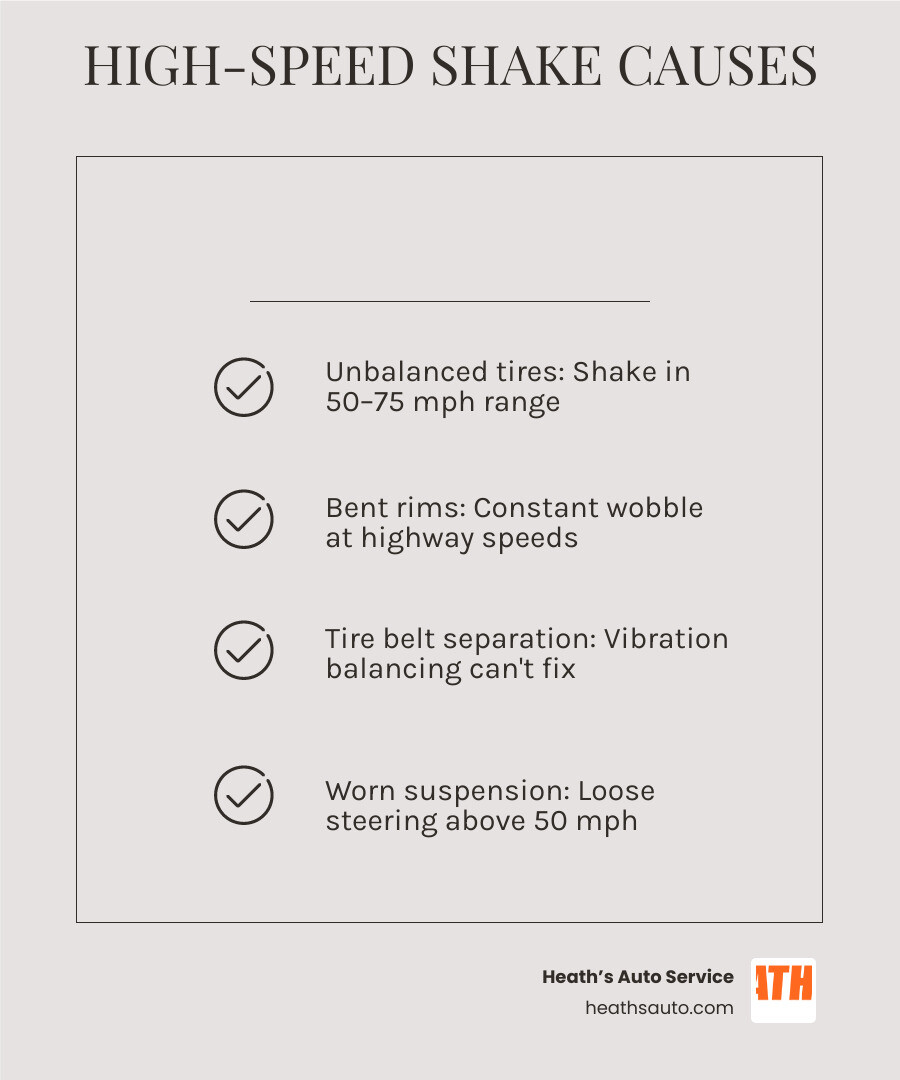
The most common causes of steering wheel shaking at high speeds:
| Cause | Typical Speed Range | Key Symptom |
|---|---|---|
| Unbalanced tires | 50–75 mph | Shake in a narrow speed window |
| Bent or damaged rim | 50–75 mph | Constant wobble at speed |
| Tire belt separation | 55–75 mph | Shaking that balancing won’t fix |
| Worn tie rods or ball joints | 50+ mph | Loose or wandering steering |
| Warped brake rotors | Any highway speed | Shaking only when braking |
| CV joint failure | Variable | Worse during acceleration |
| Worn control arm bushings | 50–60 mph | Worse under braking transitions |
| “Death wobble” (solid-axle trucks/Jeeps) | 45–55 mph | Violent, sudden oscillation |
In most cases, the vibration becomes noticeable between 50 and 75 mph — that’s when centrifugal force turns a tiny imbalance into a shake you can feel in your hands. Below that speed, the same problem can be completely invisible.
A shaking wheel isn’t just annoying. It can signal a serious safety issue — from a tire on the verge of blowout to worn steering components that reduce your control in an emergency.
Why is My Steering Wheel Shaking at High Speed?
When you’re cruising down the I-17 or the Loop 101 and your steering wheel starts trembling like it’s had one too many espressos, your car is trying to tell you something. Usually, it’s saying that one of its spinning parts isn’t spinning quite right.
The number one culprit for steering wheel shaking at high speed is tire balance. Think of your tire and wheel as a spinning top; if one side is even a fraction of an ounce heavier than the other, it won’t spin smoothly. As you accelerate, centrifugal force multiplies that tiny weight difference. By the time you hit 60 mph, that half-ounce imbalance can feel like a sledgehammer hitting your steering column. There are often 8 Causes of Steering Wheel Shaking that mechanics look for during a diagnostic.
This is why many drivers notice the shake only in a specific “window”—say, between 55 and 65 mph. Once you go faster or slower, you move out of the harmonic frequency of that imbalance, and the shake might seemingly disappear. However, just because you can’t feel it doesn’t mean the damage isn’t being done to your suspension.
Beyond simple balance, we often see issues with:
- Missing Weights: Sometimes the adhesive weights used during Tire Services simply fall off after hitting a Arizona pothole or a curb.
- Bent Rims: If you’ve recently “kerbed” your wheel or hit a deep crater in the road, the rim itself might be slightly out-of-round.
- Out-of-Round Tires: Not all tires are created equal. Lower-quality tires can sometimes have manufacturing defects where they aren’t perfectly circular, a condition called “runout.”
Identifying Steering Wheel Shaking at High Speed from Tire Damage
Sometimes the problem isn’t the weight of the tire, but the structural integrity of the tire itself. In May 2026, with the Arizona heat already climbing, tire stress is a major factor.
Internal belt separation is a terrifying cause of vibration. This happens when the steel belts inside the tire begin to pull away from the rubber. It often creates a “wobble” at low speeds that turns into a violent shake at high speeds. If you ignore this, a blowout is almost inevitable.
You should also look for “tire cupping.” These are uneven dips and high spots in the tread. If your shocks or struts are worn out, the tire literally bounces down the road, creating a scalloped wear pattern. This leads to a rhythmic thumping or vibration that matches your speed. You can learn more about this in our guide on things that cause uneven tire tread wear.
Other tire-related red flags include:
- Sidewall Bubbles: A sign of internal structural failure.
- Flat Spots: If your car sat in the driveway for a few weeks, the weight of the vehicle can flatten the bottom of the tires temporarily (or permanently in older tires).
- Internal Defects: Sometimes a tire has a “stiff spot” that balancing won’t fix.
The Role of Wheel Alignment and Rim Integrity
We hear it all the time: “My wheel is shaking, I must need an alignment!” While we love performing alignments, they are rarely the direct cause of a shake. However, they are often the indirect cause.
Why is wheel alignment important? Because if your wheels are pointing in different directions, they fight each other. This creates rapid, uneven tire wear. That uneven wear then causes the vibration. So, while an alignment might not stop the shake today, it prevents the tire damage that causes the shake tomorrow.
Rim integrity is another big one. Modern aluminum alloy wheels look great, but they are more brittle than old-school steel wheels. A hard impact can easily bend the inner lip of the rim. We use runout testing to see if the wheel is wobbling as it spins. We also check for “hub-centric” fitment—if you have aftermarket wheels, they must sit perfectly flush against the hub, or they will never spin truly straight.
Suspension and Drivetrain: The Hidden Vibrations
If your tires are perfectly balanced and round, but the wheel still shakes, we start looking at the “skeleton” of your car. Your suspension and steering components are designed to be tight. When they wear out, they develop “play” or looseness.
Common culprits include:
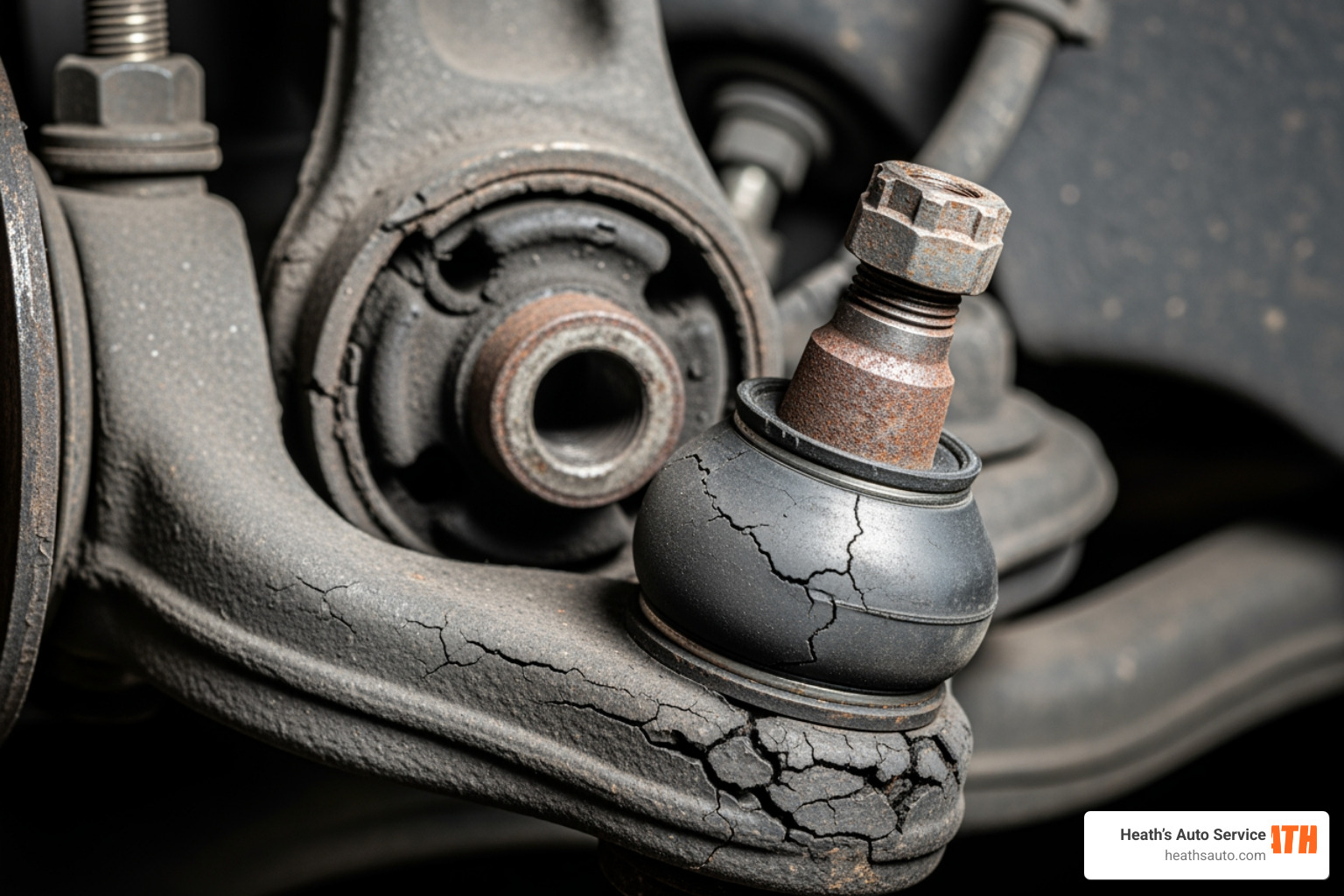
- Tie Rod Ends: These connect your steering rack to the wheels. If they are loose, the wheel can shimmy back and forth independently of your steering input.
- Ball Joints: Think of these as the “sockets” in your car’s joints. When they wear out, the entire wheel assembly can lean or vibrate.
- Control Arm Bushings: These rubber parts cushion the suspension. When they rot or tear, the wheel can shift forward and backward during acceleration or braking, leading to a “wandering” feeling.
Don’t forget the drivetrain. In front-wheel-drive cars, CV joints (Constant Velocity joints) transfer power to the wheels. If the inner CV joint fails, it usually causes a heavy vibration specifically during acceleration. It might feel smooth while coasting but shake your teeth loose the moment you hit the gas.
The driveshaft can also be a source of grief. If a support bearing fails or a balance weight falls off the driveshaft, the vibration will usually be felt more in the floor or the seat, but it can definitely travel up to the steering wheel. For more on this, check out everything you need to know about suspension repair shocks and struts. Our steering and suspension service is designed to catch these “hidden” issues before they leave you stranded.
Braking Issues vs. Speed-Specific Shaking
How do you tell if your shake is a tire issue or a brake issue? It’s all about when it happens. When asking why does my steering wheel shake at high speeds?, the most important clue is whether the vibration is constant or only occurs when you step on the brake pedal.
If your steering wheel shaking at high speed only occurs when you step on the brake pedal, you almost certainly have warped brake rotors. This is technically known as “rotor thickness variation.”
When rotors get extremely hot—say, from braking hard while coming down a steep grade in Flagstaff or Prescott—and then hit a cold puddle or sit with the pads clamped in one spot, they can warp. The rotor surface becomes uneven. When you brake, the pads “gallop” over these high and low spots, sending a pulsing sensation through the pedal and a shake through the steering wheel.
Thermal stress is the enemy here. We often see rotors warp because of:
- Excessive Heat: Heavy braking in stop-and-go Phoenix traffic.
- Pad Deposits: If you get the brakes hot and then stop completely, a layer of pad material can “cook” onto the rotor, creating a high spot.
- Caliper Sticking: If a brake caliper doesn’t retract fully, it keeps the rotor hot constantly, leading to premature warping.
The “Death Wobble” and Solid-Axle Stability
If you drive a Jeep Wrangler, a Ram 2500/3500, or a Ford Super Duty, you might experience something far more violent than a simple “shake.” It’s called the Death Wobble.
The Death Wobble is a rapid, self-sustaining oscillation of the front steering components. It usually starts when you hit a bump or a highway expansion joint at about 45–55 mph. The steering wheel will jerk violently from side to side, often so hard it feels like the car is going to shake itself apart.
This happens because these vehicles use a “solid front axle.” If one component, like the track bar or the steering damper, has even a tiny bit of play, it can trigger a harmonic reaction that involves the entire front end. It is a serious car suspension problem that requires immediate professional attention. It’s not just a nuisance; it’s a loss of control.
How to Fix Steering Wheel Shaking at High Speed and Prevent Future Issues
The fix depends on the “fingerprint” of the vibration. At Heath’s Auto Service, we don’t just guess; we use advanced diagnostics to find the root cause.
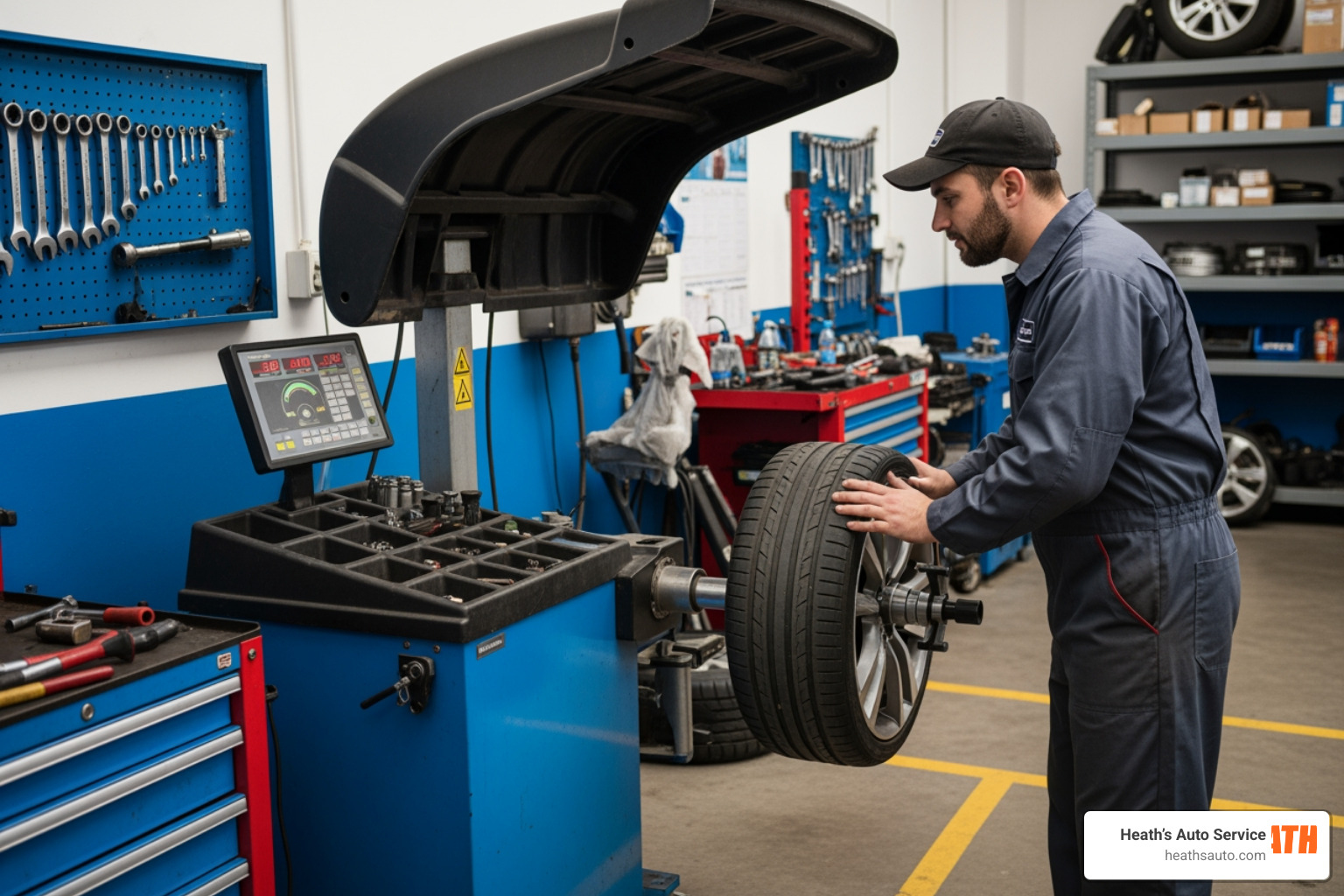
One of the most effective tools we use is Road Force Balancing. A standard balancer just spins the wheel in the air. A Road Force balancer presses a large roller against the tire to simulate the weight of the vehicle. This allows us to find “stiff spots” in the tire or “runout” in the rim that a normal balancer would miss.
| Repair Service | Estimated Time | Why It’s Needed |
|---|---|---|
| Standard Wheel Balance | 30–45 mins | Fixes basic weight imbalances |
| Road Force Balance | 1 hour | Fixes “invisible” tire/rim defects |
| Wheel Alignment | 1–1.5 hours | Corrects geometry and prevents tire wear |
| Rotor Replacement | 1.5–2 hours | Fixes shaking that occurs during braking |
| Suspension Repair | 2–4 hours | Fixes loose joints and bushings |
The benefits of wheel alignment extend far beyond just a smooth ride—it protects your investment in new tires. We also emphasize proper lug nut torque. If lug nuts are tightened unevenly, it can actually warp the brake rotor or cause the wheel to sit slightly crooked on the hub.
To prevent steering wheel shaking at high speed in the future:
- Rotate your tires every 5,000 to 7,000 miles.
- Monitor tire pressure monthly. What is tire pressure and why is it important? It ensures the tire maintains its intended shape and contact patch.
- Avoid road hazards like potholes and curbs whenever possible.
- Check for debris. Sometimes, “shaking” is just a clump of dried Arizona mud stuck to the inside of your rim!
If you’re curious about the financial side, we’ve broken down wheel alignment costs to help you budget for maintenance.
Frequently Asked Questions
Is it safe to continue driving with a shaking steering wheel?
In a word: No. While a tiny vibration might just be an annoying balance issue, a significant shake is a safety risk. Vibrations put immense stress on your wheel bearings, tie rods, and steering rack. More importantly, if the shake is caused by tire belt separation, you are at high risk for a catastrophic blowout at highway speeds. If your car feels “sketchy,” it probably is.
Why does my steering wheel shake at 60 mph but not at lower speeds?
This is due to harmonic frequency. Every object has a frequency at which it naturally wants to vibrate. At lower speeds, the centrifugal force of an imbalanced tire isn’t strong enough to overcome the dampening of your suspension. Once you hit that “sweet spot” (usually between 55 and 75 mph), the imbalance syncs up with the suspension’s natural movement, amplifying the shake until you can feel it in your hands.
Will a wheel alignment fix my steering wheel vibration?
Usually, no. An alignment adjusts the angles of the wheels, not the balance of the wheels. However, if your alignment is so far out that it has caused “cupping” or uneven wear on your tires, the tires themselves are now the cause of the shake. In that case, you’ll need new tires and an alignment to fix the root problem. How long does an alignment take? Usually about an hour, and it’s the best insurance policy for your tires.
Conclusion
Every vibration has a “fingerprint.” Whether it’s a high-speed shimmer, a braking pulse, or a violent truck wobble, identifying the pattern is the first step toward a smooth ride.
Heath’s Auto Service In Flagstaff, AZ
At Heath’s Auto Service, our comprehensive range of services covers everything from routine maintenance to complex repairs. Our certified technicians are skilled in handling oil changes, brake inspections, engine diagnostics, tire rotations, and much more. Whether it’s a minor tune-up or a major overhaul, trust us to get you back on the road with confidence. Contact our team at Heath’s Auto Service today!
We stand behind our work with a 3-year/36,000-mile nationwide warranty, ensuring that once we fix your steering wheel shaking at high speed, it stays fixed. Don’t let a shaky ride ruin your commute or your road trip.