
Why a Vacuum Leak in a Car Is a Problem You Shouldn’t Ignore
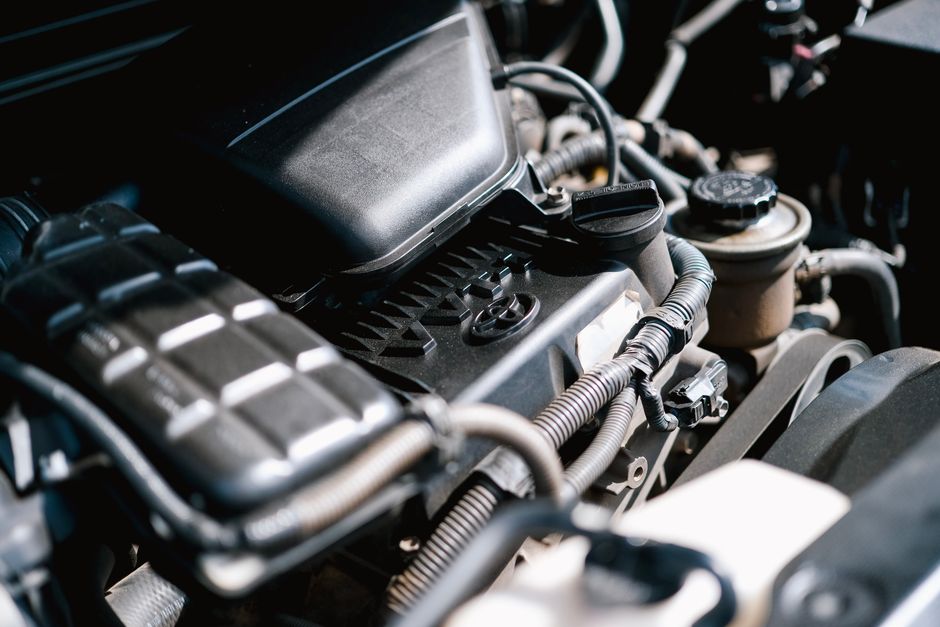
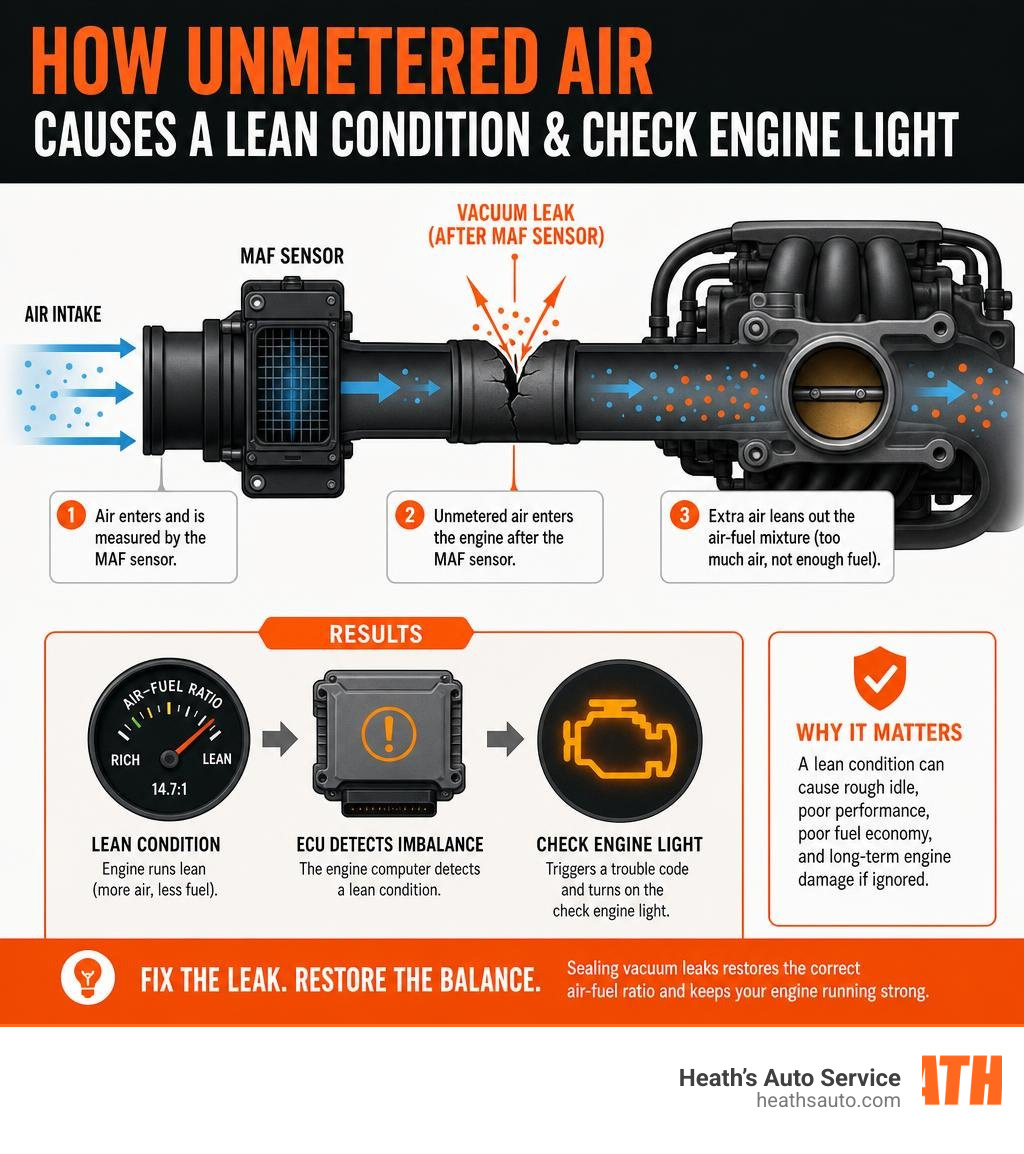
A vacuum leak in a car is one of the most common — and most overlooked — causes of rough idling, poor fuel economy, and a lit-up check engine light. In simple terms, it means unmetered air is sneaking into your engine where it shouldn’t be, throwing off the precise air-fuel mixture your engine needs to run properly.
Here’s a quick summary of what you need to know:
- What it is: An unintended gap or crack in a hose, gasket, or intake component that lets extra air into the engine after the mass airflow (MAF) sensor
- Common symptoms: Rough idle, engine stalling, hissing sounds, check engine light, poor fuel economy, hesitation when accelerating
- Common causes: Cracked vacuum hoses, failed intake manifold gaskets, faulty PCV or EGR valves, brake booster diaphragm failure
- Can you drive? For a short time — but it’s not recommended; long-term driving risks serious engine damage
- Repair cost: Typically $150–$1,000 depending on the location and parts involved
Your engine needs a very specific air-to-fuel ratio of 14.7:1 to burn fuel cleanly and efficiently. Even a tiny leak as small as 0.020 inches can upset that balance, forcing your engine’s computer to compensate — and over time, that strain adds up.
In Arizona’s extreme heat, rubber hoses and gaskets age twice as fast as they do in cooler climates, making vacuum leaks a particularly common issue for local drivers.
Similar topics to vacuum leak in car:
- how to find a vacuum leak without a smoke machine
- smoke machine for car vacuum leaks
- vacuum leak repair price
What is a Vacuum Leak in a Car and How Does It Affect Performance?
To understand how a vacuum leak in a car disrupts performance, it helps to think of your engine as a giant, highly controlled air pump. During the piston’s downstroke, a vacuum (negative air pressure) is created inside the intake manifold.
Under normal operating conditions, all air entering the combustion chambers must pass through the air filter and the throttle body, where it is measured by the Mass Airflow (MAF) sensor. The engine’s computer, or Powertrain Control Module (PCM), reads this data and injects the perfect amount of fuel to achieve the stoichiometric ratio of 14.7 parts of air to 1 part of fuel.
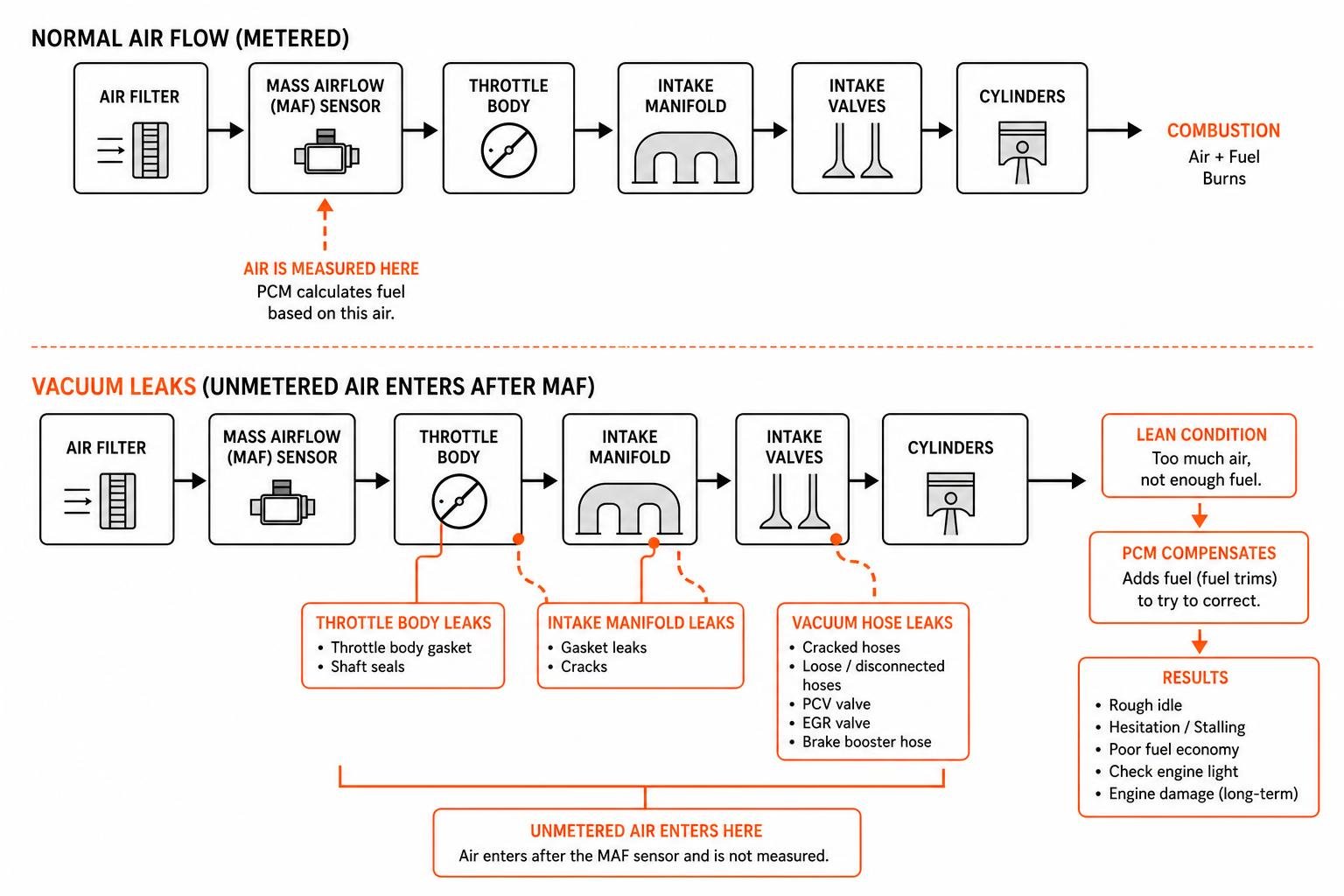
When you have a vacuum leak, unmetered air enters the system downstream of the MAF sensor. Because the PCM didn’t measure this extra air, it doesn’t inject the corresponding amount of fuel. This results in a lean running condition—meaning there is too much air and too little fuel in the combustion chamber.
To prevent engine damage, the PCM monitors the oxygen sensors in the exhaust and notices the lean mixture. It immediately tries to correct this by adjusting its “fuel trims” (injecting extra fuel). While this compensation can keep the car running, it causes a host of performance issues. You will likely notice a rough, shaking idle, engine hesitation when accelerating, random stalling at stoplights, and a significant drop in fuel economy of up to 30%.
Over time, this imbalance triggers the check engine light and can lead to more severe signs of an engine vacuum leak like engine misfires and overheating.
Common Causes of a Vacuum Leak in a Car
Vacuum leaks can develop in several areas of the engine bay, but they almost always stem from components that have degraded due to heat, friction, or age. In our hot Arizona climate, the life expectancy of rubber and soft plastic under the hood is cut drastically.
The most common culprits behind a vacuum leak include:
- Dry-Rotted or Cracked Vacuum Hoses: These thin rubber or plastic lines route vacuum pressure to various actuators, valves, and sensors. Over time, they harden, split, or slip off their fittings.
- Failed Intake Manifold Gaskets: The intake manifold directs the air-fuel mixture into the engine cylinders. The gaskets sealing the manifold to the engine block can dry out, shrink, or crack, allowing air to bypass the throttle body entirely.
- Ruptured Brake Booster Diaphragm: Your power brakes rely on engine vacuum to make the brake pedal easy to press. If the internal rubber diaphragm inside the brake booster tears, it creates a massive, hidden vacuum leak every time you apply the brakes.
- Faulty PCV (Positive Crankcase Ventilation) Valve or Hoses: The PCV system routes crankcase gases back into the intake. A stuck-open PCV valve or a split PCV hose behaves exactly like a vacuum leak.
- Worn EGR (Exhaust Gas Recirculation) Gaskets: If the EGR valve or its mounting gaskets fail, exhaust gases or outside air can leak into the intake tract.
- Failing Throttle Body Gaskets: The seal between the throttle body and the intake manifold can degrade, especially if the throttle body was recently removed for cleaning and reinstalled with an old gasket.
- Turbocharged System Issues: If your vehicle is turbocharged, vacuum lines control the wastegate and bypass valves. A leak here can cause erratic boost behavior and ruin your acceleration. For more on this, check out our guide on how to avoid letting turbocharger vacuum issues spoil your daily commute.
The Risks of Driving with a Vacuum Leak in a Car
While a car with a minor vacuum leak may still be drivable, continuing to drive it for an extended period carries serious risks to both your safety and your wallet.
First and foremost, a lean fuel mixture burns much hotter than a balanced mixture. This elevated combustion temperature places extreme thermal stress on your engine’s internal components. Over time, these high temperatures can cause catastrophic damage, including warped valves, damaged pistons, and accelerated bearing wear.
Additionally, when the engine runs lean, it often misfires. These misfires allow raw, unburned fuel to pass into the exhaust system, where it reaches the catalytic converter. The catalytic converter will attempt to burn off this excess fuel, causing it to overheat and melt internally. Replacing a catalytic converter is an incredibly expensive repair that could easily be avoided by addressing the vacuum leak early.
From a safety standpoint, a severe vacuum leak can cause your vehicle to stall unexpectedly while idling at intersections or when merging onto busy Arizona freeways. Furthermore, if the leak is located within the brake booster system, you will experience a hard brake pedal and a dangerous loss of stopping power.
How to Diagnose a Vacuum Leak in 5 Simple Steps
Diagnosing a vacuum leak doesn’t have to be a guessing game. By following a systematic, step-by-step diagnostic process, you can pinpoint the exact location of the leak.
If you want to try tracking it down at home first, you can read our DIY vacuum leak detection guide for tips on using simple household items, or follow our five-step professional methodology below.
Step 1: Perform a Thorough Visual Inspection
Before grabbing any diagnostic tools, park your car in a well-lit, quiet area, pop the hood, and grab a bright flashlight. A huge percentage of vacuum leaks can be found simply by looking closely at the engine bay.
With the engine off, trace every single rubber and plastic hose you can see. Look for:
- Hoses that have become brittle, hardened, or mushy to the touch.
- Visible cracks, splits, or dry rot, especially near connection points and bends.
- Hoses that have disconnected from their plastic fittings or T-connectors.
- Cracks in the large plastic air intake boot that connects the air filter box to the throttle body.
If you aren’t sure where all the hoses go, look for the vacuum schematic diagram, which is typically printed on a decal located on the underside of your hood or on the radiator shroud. Gently wiggle the connections to ensure they are snug and secure.
Step 2: Listen for Hissing or Whistling Sounds
Because vacuum represents negative pressure, a leak acts like a miniature vacuum cleaner, sucking outside air into the engine. This suction often produces a distinct hissing, whistling, or sucking sound while the engine is running.
To safely perform this test:
- Start the engine and let it idle. Make sure the vehicle is in Park (or Neutral with the parking brake firmly engaged).
- Open the hood and listen carefully. If the engine fan or belt noise is too loud, you can use a makeshift stethoscope to isolate the sound.
- Take a two-foot length of clean rubber hose (like an old garden hose or vacuum line).
- Hold one end of the hose securely to your ear and sweep the other end slowly around the intake manifold, throttle body, vacuum lines, and brake booster.
The hose will amplify any localized hissing sounds, helping you home in on the exact location of the leak. For more tips on this classic mechanic trick, you can check out the Family Handyman guide to finding vacuum leaks.
Step 3: Monitor Fuel Trims with an OBD-II Scanner
If a visual and audible inspection doesn’t reveal the leak, it’s time to leverage your car’s onboard computer using an OBD-II diagnostic scanner.
When a vacuum leak is present, the PCM will generate specific diagnostic trouble codes (DTCs), most commonly P0171 (System Too Lean – Bank 1) and P0174 (System Too Lean – Bank 2). If you see these codes alongside random misfire codes (P0300), you are likely dealing with unmetered air.
To confirm the leak using live data:
- Plug your scanner into the OBD-II port under your dashboard and navigate to the live data stream.
- Look for Short Term Fuel Trim (STFT) and Long Term Fuel Trim (LTFT).
- At a normal idle, a car with a vacuum leak will show highly positive fuel trims (often +15% to +25%), meaning the computer is dumping extra fuel to compensate for the leak.
- Now, press the gas pedal to raise the engine speed to around 2,500 RPM and hold it there.
The Golden Rule of Vacuum Leak Diagnosis: If the fuel trims quickly drop back down toward normal (between 0% and +5%) at higher RPMs, you have a vacuum leak. This happens because at higher engine speeds, the throttle plate opens wide, letting in a massive volume of metered air. The tiny amount of air entering through the leak becomes insignificant compared to the total air volume, allowing the air-fuel mixture to normalize.
Step 4: Use the Soapy Water or Propane Spray Method
If your fuel trims confirmed a leak, you can use a targeted spray to find the physical opening. There are two common DIY spray methods:
The Soapy Water Method (Safest)
Fill a spray bottle with water and a few drops of liquid dish soap. With the engine idling, spray a fine mist onto suspected vacuum hoses, gasket mating surfaces, and connections. If you spray the soapy water over a leak, the liquid will temporarily seal the gap. You will hear the engine idle smooth out for a brief second, and your live fuel trim numbers on your scanner will instantly drop.
The Propane Method (For Experienced DIYers)
This method involves using an unlit propane plumbing torch attached to a small hose. With the engine idling, slowly sweep the unlit propane gas around the intake gaskets and vacuum lines. If there is a leak, the engine will suck in the propane (which acts as an enriched fuel source). You will hear the engine RPM rise slightly, and your fuel trims will immediately drop.
Safety Warning: Propane is highly flammable. Always keep a working fire extinguisher nearby, work in a well-ventilated area, and never perform this test near spark plug wires, hot exhaust manifolds, or open flames. Never use highly flammable brake cleaner or starting fluid, as these can easily ignite on a hot engine.
Step 5: Perform a Professional Smoke Test
The absolute gold standard for finding a vacuum leak in a car is a professional smoke test. It is safe, incredibly fast, and boasts a 95% accuracy rate.

A professional smoke machine vaporizes a specialized mineral oil (often mixed with a UV dye) to create a thick, dense smoke.
- With the engine completely off, the technician seals the engine’s air intake duct.
- The smoke machine hose is connected to a vacuum port on the intake manifold.
- The machine pumps the smoke into the intake system under very low pressure (typically 0.5 to 1.0 psi to prevent damaging delicate seals).
- Within minutes, smoke will begin billow out of the exact crack, hole, or failed gasket causing the leak.
If the leak is hidden deep under the intake manifold or behind the engine block, the technician can use a UV light to trace the dye left behind by the escaping smoke. This method completely eliminates the guesswork. To see this process in action, take a look at the Popular Mechanics guide on smoking out leaks.
How Much Does It Cost to Repair a Vacuum Leak?
The cost to fix a vacuum leak in a car varies widely depending on which component has failed. A simple cracked vacuum hose is a quick, inexpensive fix, while a failed intake manifold gasket or a ruptured brake booster requires hours of intensive labor.
At Heath’s Auto Service, we believe in complete transparency. Below is an estimated cost breakdown for common vacuum leak repairs, including parts and labor:
| Failed Component | Average Parts Cost | Average Labor Cost | Total Estimated Cost |
|---|---|---|---|
| Simple Vacuum Hose | $10 – $40 | $90 – $150 | $100 – $190 |
| PCV Valve & Hoses | $40 – $100 | $110 – $200 | $150 – $300 |
| EGR Valve / Gasket | $150 – $300 | $150 – $250 | $300 – $550 |
| Intake Manifold Gasket | $50 – $120 | $400 – $800 | $450 – $920 |
| Brake Booster Assembly | $150 – $350 | $250 – $500 | $400 – $850 |
Most professional shops will charge a standard diagnostic fee (usually equivalent to one hour of labor, ranging from $100 to $150) to hook up diagnostic equipment and perform a smoke test. At Heath’s Auto Service, we offer free second opinions to ensure you never pay for a repair you don’t actually need. If you suspect your vehicle is suffering from an air leak, read our guide on professional vacuum leak repair to learn how we approach these fixes.
Frequently Asked Questions About Vacuum Leaks
Can a vacuum leak cause transmission problems?
Yes, absolutely—especially on older vehicles. Many classic automatic transmissions rely on a component called a vacuum modulator to determine when to shift gears. The modulator reads engine vacuum to gauge how hard the engine is working.
If there is a vacuum leak in the line leading to the modulator, the transmission will receive an incorrect signal, leading to delayed shifts, harsh or clunky gear engagements, or a refusal to shift into higher gears. On modern vehicles with electronic transmissions, a severe vacuum leak can still cause shift issues indirectly by confusing the engine computer, which shares throttle and load data with the transmission control module.
Will a vacuum leak cause a car to fail emissions?
Yes, a vacuum leak is a guaranteed ticket to a failed emissions test. Because a vacuum leak causes the engine to run lean, the combustion temperatures inside the cylinders spike. These extreme temperatures cause a massive increase in harmful Nitrogen Oxide (NOx) emissions.
Furthermore, the check engine light triggered by codes like P0171 or P0174 will cause an automatic failure in states that require OBD-II plug-in testing. The lean condition also prevents crucial internal monitor checks—like the catalyst efficiency and fuel system readiness monitors—from completing their self-tests. To protect your vehicle and ensure you pass your next vehicle inspection, read our detailed breakdown on emissions test failure risks.
Can a vacuum leak cause an engine misfire?
Yes, a large vacuum leak is a very common cause of engine misfires, particularly at idle. When unmetered air dilutes the air-fuel mixture, it can become so lean that the spark plug fails to ignite the mixture. This is known as a “lean misfire.”
These misfires typically trigger a P0300 (random/multiple cylinder misfire) code, or specific cylinder codes like P0301 or P0302 if the leak is located near a single intake runner gasket. If you are experiencing rough performance alongside misfire codes, refer to the AutoDTCs diagnostic guide to see how these issues intersect.
Conclusion
A vacuum leak in a car might start out as a minor annoyance—a slightly rough idle or a drop in gas mileage—but leaving it unaddressed is a recipe for expensive engine and catalytic converter damage. Identifying the issue early using basic visual checks, fuel trim analysis, or a professional smoke test will save you time, stress, and money.
If you suspect your car has a vacuum leak but aren’t comfortable diagnosing it yourself under the hot Arizona sun, we are here to help. At Heath’s Auto Service, our ASE-certified team has the advanced diagnostic tools, including professional smoke machines and acoustic imaging equipment, to find and fix any leak quickly and accurately.
Heath’s Auto Service In Prescott, AZ
At Heath’s Auto Service, we take pride in being your one-stop destination for full-service auto and truck repair in Prescott, AZ. Our team of skilled technicians possesses a wealth of experience and knowledge, allowing us to confidently handle domestic, Asian, and European vehicles with precision and expertise. Contact our team today!