
What Does It Cost to Replace a Car Battery? (Quick Answer)
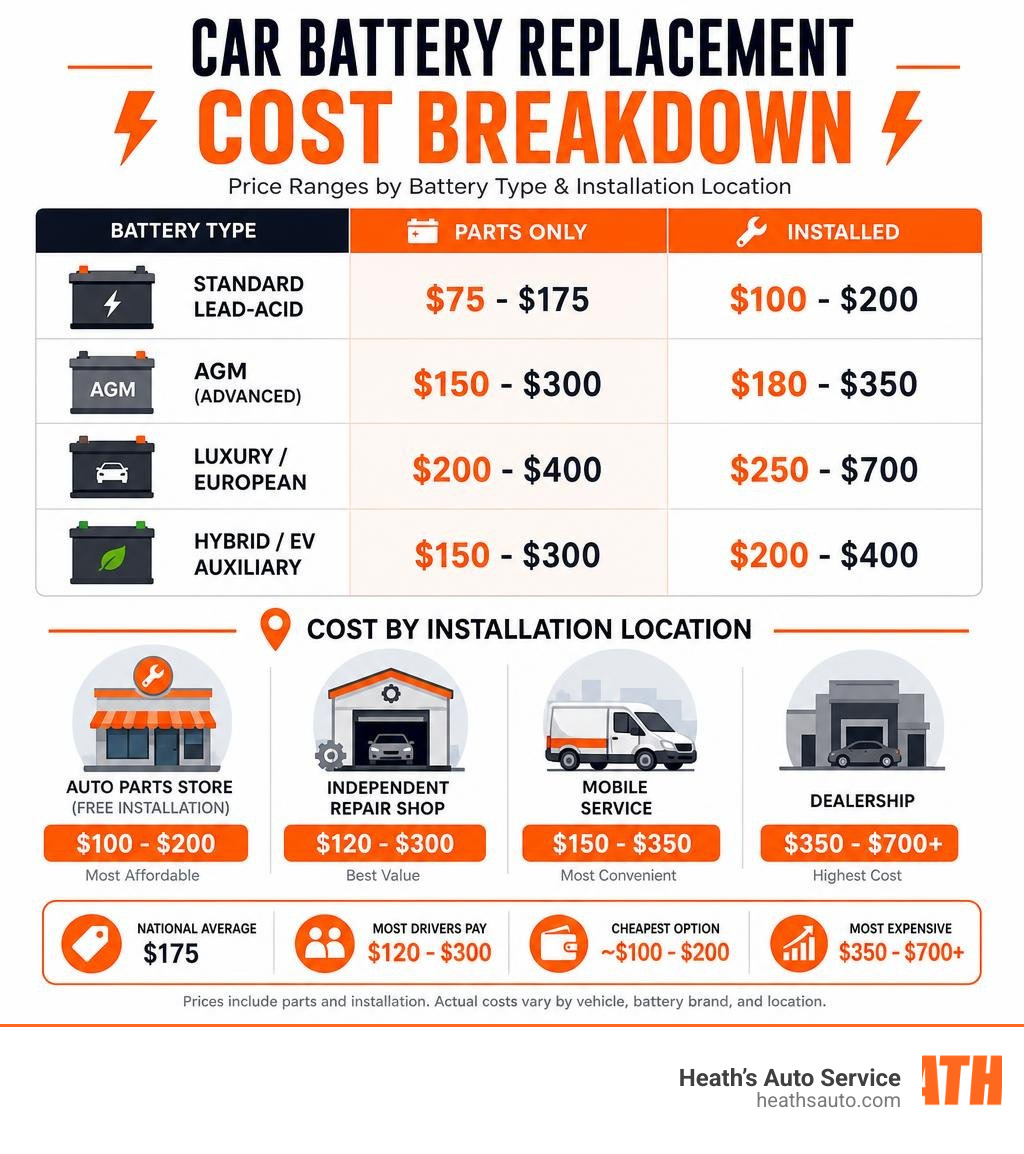
The cost to replace a car battery typically falls between $120 and $300 for most drivers in 2026, including parts and installation.
| Battery Type | Parts Only | Installed |
|---|---|---|
| Standard Lead-Acid | $75 – $175 | $100 – $200 |
| AGM (Advanced) | $150 – $300 | $180 – $350 |
| Luxury/European | $200 – $400 | $250 – $700 |
| Hybrid/EV Auxiliary | $150 – $300 | $200 – $400 |
- National average: $175
- Most drivers pay: $120 – $300 all-in
- Cheapest option: Auto parts store with free installation (~$100 – $200)
- Most expensive: Dealership for luxury or European vehicles ($350 – $700+)
Few things kill a morning faster than turning your key and hearing nothing. One moment you are running on schedule, and the next you are stranded in the driveway wondering how much this is going to cost. For Arizona drivers especially, a dead battery is not just an inconvenience — it is an event that tends to happen without warning, often at the worst possible time.
The good news is that most battery replacements are straightforward and affordable when you know what to expect. Prices vary more than most people realize, though — driven by battery type, vehicle design, where you get the work done, and even the climate you drive in. Understanding these factors before you walk into a shop can be the difference between paying a fair price and significantly overpaying.
What is the Average Cost to Replace Car Battery in 2026?
When budgeting for a vehicle repair, it is helpful to look at both national trends and local realities. Across the United States, the national average battery replacement costs hover around $175. However, this number is a broad average that blends budget-friendly economy cars with high-end luxury vehicles.
In reality, most drivers find that the real-world cost to replace a car battery ranges from $120 to $300 for standard applications. If you drive a compact sedan with a standard flooded lead-acid battery, you might escape on the lower end of that spectrum. However, if your vehicle is equipped with modern start-stop technology, advanced safety features, or heavy accessory loads, you will likely require a premium battery, which pushes the total price toward the higher end.
To give you a clearer picture of what your budget might look like, let’s break down the typical parts and labor prices for standard versus premium options:
| Battery Category | Average Battery Cost (Parts Only) | Average Labor Cost | Total Estimated Cost |
|---|---|---|---|
| Budget / Economy | $75 – $110 | Free – $40 | $75 – $150 |
| Standard Flooded Lead-Acid | $100 – $180 | Free – $50 | $100 – $230 |
| Absorbed Glass Mat (AGM) | $180 – $280 | $20 – $70 | $200 – $350 |
| Premium / Luxury Vehicle | $250 – $400 | $50 – $150 | $300 – $550+ |
As we look at car battery costs in 2026, prices have felt the effects of general inflation over the last few years, rising approximately 17% to 18% since 2022. Despite these increases, understanding the key components of battery pricing can help you avoid overpaying.
Key Factors That Influence Car Battery Replacement Pricing
If you have ever shopped for a battery online, you have probably noticed that two batteries sitting side-by-side on a shelf can have vastly different price tags. That is because a car battery is not a one-size-fits-all component.
Several technical specifications and vehicle requirements dictate the final price of the unit:
- Battery Size (Group Size): Physical dimensions matter. Batteries are categorized by “Group Size” (e.g., Group 35, Group 24, Group 51R) to ensure they fit perfectly into your vehicle’s tray and connect securely to the cables. Some less common or specialized sizes are produced in smaller quantities, making them more expensive.
- Cold Cranking Amps (CCA): This rating measures a battery’s ability to start an engine in cold temperatures. The higher the CCA rating, the more starting power the battery delivers. While high CCA is critical for freezing Flagstaff winters, it also represents a more robust internal construction, which increases the price.
- Reserve Capacity (RC): This measures how long a battery can continue to run your vehicle’s essential electrical systems if the alternator fails. A higher reserve capacity provides peace of mind but adds to the retail cost.
- Brand and Warranty: Premium brands with longer, hassle-free replacement warranties (such as 3-year or 5-year nationwide warranties) cost more upfront. However, they often save you money in the long run by preventing out-of-pocket costs if the battery fails prematurely.
Battery Type and Technology
The internal chemistry of your battery is the single biggest driver of its retail price. There are three primary types of 12-volt automotive batteries on the market today:
- Standard Flooded Lead-Acid (Wet Cell): This is the traditional battery design that has powered vehicles for decades. It uses liquid electrolyte plates to store charge. It is highly reliable, widely compatible, and remains the most affordable option, typically costing between $90 and $200.
- Enhanced Flooded Battery (EFB): Introduced as an entry-level option for vehicles with basic start-stop technology, EFBs offer improved cyclic durability compared to standard flooded batteries. They bridge the price and performance gap, usually retail-pricing between $130 and $220.
- Absorbed Glass Mat (AGM): AGM batteries represent premium lead-acid technology. Instead of free-flowing liquid, the acid is absorbed in ultra-fine fiberglass mats sandwiched between the lead plates. AGM batteries handle deep discharges exceptionally well, recharge faster, are completely spill-proof, and offer superior resistance to vibration and extreme temperatures. Because of this, they are required for modern vehicles with start-stop systems and heavy electrical demands. Expect to pay between $150 and $350+ for an AGM battery.
Note: If your vehicle originally came equipped with an AGM battery, you cannot downgrade to a standard flooded battery. Doing so will likely cause the standard battery to fail in under a year because it cannot handle the heavy charging cycles of modern alternator systems.
Vehicle Design and Battery Location
In the past, replacing a car battery was simple: pop the hood, loosen two terminal bolts, lift the old battery out, and drop the new one in.
Today, automotive engineers place batteries wherever they can find room to optimize weight distribution or maximize cabin space. Your battery might be located:
- Under the hood (standard)
- Inside the trunk (common in passenger cars and sport sedans)
- Under the front passenger or driver’s seat (common in SUVs)
- Behind the front wheel well or bumper cover
When a battery is buried beneath seats, interior trim panels, or structural bracing, the labor required to access and replace it increases significantly. What would normally be a 15-minute job can easily turn into an hour of careful disassembly and reassembly, raising the overall labor cost.
Additional Fees: Labor, Testing, and Disposal
When calculating the total bill, the battery’s retail price is only one part of the equation. There are several additional costs to keep in mind:
- Diagnostic Testing: Before replacing a battery, it is essential to test the entire starting and charging system. A dead battery is sometimes just a symptom of a failing alternator or a parasitic electrical draw. Professional shops will test your system to ensure you actually need a new battery.
- Labor Rates: While some retail auto parts stores offer “free” installation, this usually only applies to easily accessible batteries under the hood. If your battery is in a complex location, expect to pay a professional technician between $40 and $100 for labor.
- Core Charges: To encourage recycling, battery manufacturers implement a “core charge” (typically $10 to $25). When you buy a new battery, you pay this fee upfront. It is fully refunded when you return your old battery to the shop or retailer for proper recycling.
- Battery Registration (Coding): Many modern vehicles, particularly European makes like BMW, Audi, and Mercedes-Benz, feature intelligent battery management systems. These systems track the age and health of the battery to adjust how aggressively the alternator charges it. When a new battery is installed, the vehicle’s computer must be programmed (registered) to let it know a fresh battery is in place. Failing to do this can lead to overcharging and premature battery failure. This service requires specialized diagnostic scan tools, which can add $50 to $150 to your dealership battery replacement costs.
How Long Do Car Batteries Last?
No car battery lasts forever. Over time, the constant chemical reactions occurring inside the plastic case degrade the lead plates, eventually reducing the battery’s ability to hold a charge.

Understanding how long your battery should last — and what factors shorten that lifespan — can help you plan for replacement before you find yourself stranded.
Average Lifespan and the Impact of Climate
While the national average lifespan for a car battery is three to five years, climate plays a massive role in determining exactly how long yours will survive.
According to Kelley Blue Book battery lifespan estimates, moderate climates allow batteries to comfortably reach the five- or six-year mark. However, extreme temperatures act like an accelerant on battery wear.
For those of us living and driving in Arizona, the reality is much tougher. If you are researching how long batteries last in Arizona, you will find that the average lifespan drops to just two to three years.
While many drivers assume cold winter mornings are a battery’s worst enemy, the truth is that heat is the real battery killer. The intense summer heat of the Arizona desert accelerates the chemical reactions inside the battery, leading to rapid water loss from the liquid electrolyte and faster internal corrosion. By the time winter rolls around, a heat-damaged battery simply does not have the strength to crank a cold engine, leading to sudden failure.
To learn more about the mechanics of battery longevity, check out our detailed guide on how long a car battery lasts.
Signs Your Vehicle Needs a New Battery
Fortunately, your car will usually try to warn you when its battery is on its last legs. Keep an eye and ear out for these common warning signs:
- Slow Engine Crank: When you turn the key or push the start button, does the engine sound sluggish, taking longer than usual to roll over? This “crank-crank-crank-start” behavior is the classic sign of a dying battery.
- Dim Headlights and Electrical Glitches: If your headlights look dim at idle but brighten when you rev the engine, or if your power windows roll up slower than usual, your battery is struggling to supply adequate voltage.
- A Swollen or Bloated Battery Case: Extreme heat can cause the battery’s plastic case to swell or bloat. If your battery looks like it had a big lunch, it needs to be replaced immediately.
- Corrosion and White Powdery Buildup: Excessive corrosion (a crusty white, blue, or green powder) around the battery terminals can restrict electrical flow, preventing the battery from charging properly.
- Frequent Need for Jump Starts: If you have had to jump-start your vehicle more than once recently, your battery is likely done. If your battery won’t hold a charge even after a long drive, the internal cells are permanently degraded.
DIY vs. Professional Installation: Which is Best?
When your battery dies, you have a choice: head to the local auto parts store, buy a battery, and install it yourself, or take it to a professional auto repair shop.
While the DIY route can seem like an easy way to save a few bucks, it is important to weigh the hidden costs and risks involved.
The True Cost to Replace Car Battery Yourself
On paper, replacing a battery yourself seems incredibly cheap. You only pay for the battery itself, plus a few basic hand tools if you don’t already own them. However, there are several factors that DIYers often overlook:
- Safety Hazards: Car batteries contain highly corrosive sulfuric acid and can output massive amounts of electrical current. A simple slip of a wrench that bridges the positive terminal to a metal part of the car’s frame can cause severe sparks, electrical burns, or even damage your vehicle’s expensive engine control module (ECM).
- Losing System Memory: When you disconnect your vehicle’s battery, you cut power to its onboard computers. This can reset your radio presets, clock, climate control settings, and even clear the engine’s learned fuel trims. In some modern vehicles, it can even cause the anti-theft system to lock you out of the radio. Professional shops use a “memory saver” tool that plugs into the OBD-II port to keep a small amount of power flowing to the computers while the battery is disconnected.
- Disposal Logistics: Once the job is done, you are responsible for transporting the heavy, dirty, and toxic old lead-acid battery back to a retailer to claim your core charge.
Why Professional Installation Saves Money Long-Term
Opting for professional installation at a trusted shop like Heath’s Auto Service offers several major advantages that easily outweigh the minor labor charge:
- Comprehensive Starting and Charging System Test: We don’t just swap the battery. We test your alternator, starter, and check for parasitic draws to ensure a bad alternator won’t immediately drain and ruin your brand-new battery.
- Proper Equipment and Registration: We have the specialized diagnostic scan tools required to perform battery registration and reset your vehicle’s computer systems correctly.
- Terminal Protection: Our technicians clean any existing terminal corrosion and apply specialized protective grease to prevent future buildup.
- Warranty Peace of Mind: When you get your battery replaced professionally, you benefit from a solid warranty. At Heath’s Auto Service, we back our work with an industry-leading 3-year/36,000-mile nationwide warranty.
- Proper Maintenance Guidance: Our team can provide personalized tips on maintaining your car battery to help you get every last month of life out of your investment.
Frequently Asked Questions About Car Battery Replacement
How much does it cost to replace car battery at a dealership?
Getting your battery replaced at a dealership is almost always the most expensive route. Dealerships typically charge a premium for Original Equipment Manufacturer (OEM) parts, and their hourly labor rates are significantly higher than independent repair shops.
A standard battery replacement that might cost $150 to $250 at an independent shop can easily run $250 to $500+ at a dealership. This price increase is driven by higher parts markups and flat-rate labor fees that often charge a full hour of labor for a 15-minute job. For a deeper look at these pricing structures, check out our guide on dealership battery costs.
Can extreme heat drain a car battery?
Yes, absolutely. In fact, extreme heat is far more damaging to a car battery than freezing cold. High temperatures cause the liquid electrolyte inside standard batteries to evaporate, exposing the internal lead plates to air and causing rapid corrosion.
Heat also increases the rate of self-discharge, meaning a car parked in the hot Arizona sun for a few weeks will lose its charge much faster than one parked in a cool garage. To protect your vehicle during the scorching summer months, read our expert breakdown on how heat drains a battery.
What is the total cost to replace car battery in hybrid or electric vehicles?
It is important to distinguish between the two different batteries found in hybrids and electric vehicles (EVs):
- The 12-Volt Auxiliary Battery: Just like a standard gas-powered car, hybrids and EVs use a traditional 12-volt auxiliary battery to power the computers, lights, radio, and safety systems before the main high-voltage system turns on. Replacing this battery typically costs between $150 and $400, depending on whether it is an AGM or specialized lead-acid unit.
- The High-Voltage Traction Battery Pack: This is the massive battery pack that propels the vehicle. These batteries are designed to last the lifetime of the vehicle, and failures are incredibly rare (statistically, only about 2.5% of EVs ever require a traction battery replacement out of warranty). However, if replacement is required outside of the manufacturer’s 8-year/100,000-mile warranty, the cost is substantial. Depending on the vehicle model and battery capacity, a replacement traction pack can range from $5,000 to over $20,000.
Conclusion
The cost to replace a car battery is a small price to pay to guarantee your vehicle starts reliably every time you turn the key. While the average cost of $120 to $300 is manageable, trying to cut corners with cheap parts or DIY shortcuts on a modern, electronically complex vehicle can lead to expensive headaches down the road.
Heath’s Auto Service In Prescott, AZ
At Heath’s Auto Service, we take pride in being your one-stop destination for full-service auto and truck repair in Prescott, AZ. Our team of skilled technicians possesses a wealth of experience and knowledge, allowing us to confidently handle domestic, Asian, and European vehicles with precision and expertise. Contact our team today!