
What Is Turbo Vacuum Leak Repair — and Do You Need It?
Turbo vacuum leak repair is the process of finding and fixing unintended gaps in your turbocharged engine’s vacuum system that allow unmetered air to enter where it shouldn’t.
Quick answer — here’s what you need to know:
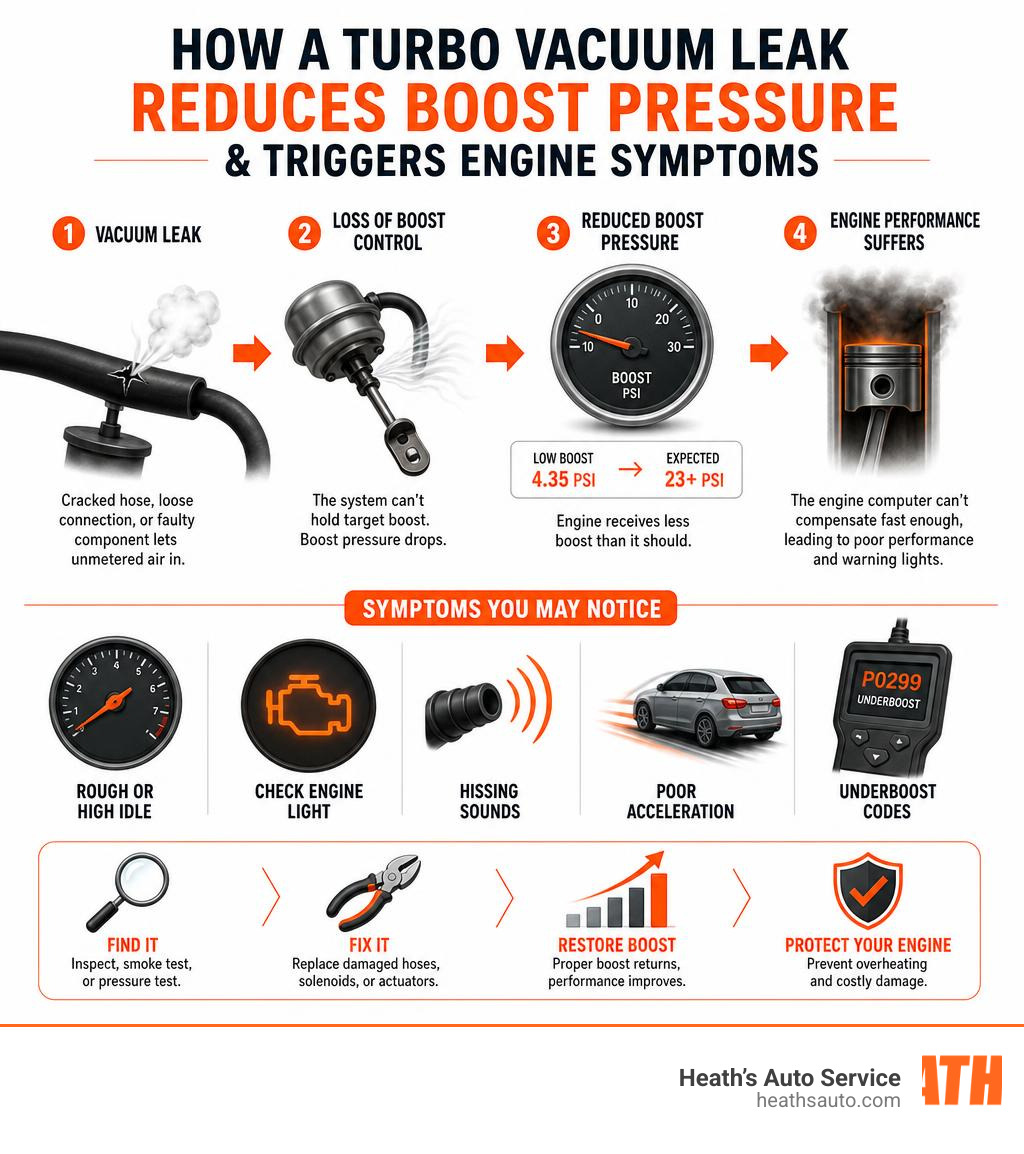
- What it is: A turbo vacuum leak lets air bypass your engine’s sensors, throwing off the air-fuel mixture and disrupting boost pressure.
- Common symptoms: Rough or high idle, check engine light, hissing sounds, poor acceleration, and underboost codes.
- How to find it: Visual inspection of vacuum hoses, a smoke test, or pressure testing the boost system.
- How to fix it: Replace cracked or disconnected hoses, faulty solenoids, or failed actuators — starting with the simplest components first.
- Cost: Repairs typically range from $150 to $1,000, depending on what’s leaking and how hard it is to reach.
- Can you drive? Short term, maybe — but ignoring it risks engine overheating and serious damage to pistons and bearings.
Your turbocharged engine works like a precision pump. Every bit of air entering the intake needs to be measured. When a vacuum line cracks, a solenoid leaks, or a wastegate actuator hose comes loose, unmetered air slips in — and your engine’s computer can’t compensate fast enough. The result? Lost power, rough running, and sometimes a cascade of confusing warning lights.
The problem is easy to dismiss at first. A slight hesitation. An idle that feels a little off. But on a turbocharged engine, even a small vacuum leak can cause boost pressure to drop dramatically. One real-world example: a driver with a broken vacuum nipple on a turbo system saw boost fall to just 4.35 psi — less than a fifth of the expected 23+ psi — until the leak was repaired.
Explore more about turbo vacuum leak repair:
Understanding Turbo Vacuum Leaks and Their Symptoms
To understand why a vacuum leak is so devastating to a turbocharged engine, we have to look at how these systems handle air.
In a naturally aspirated engine, the intake manifold is almost always under vacuum (negative pressure) because the pistons are sucking in air against a closed or partially closed throttle plate. In a turbocharged engine, the story is more complicated. Under light loads, the engine still runs under vacuum. But the moment you step on the gas, the turbocharger spins up, compressing the incoming air and creating positive pressure (boost) in the intake manifold.
Many modern turbochargers rely on vacuum-operated actuators to control this boost. A vacuum pump or manifold vacuum source pulls on a diaphragm inside the wastegate actuator or the Variable Nozzle Turbocharger (VNT) actuator to position the internal vanes or wastegate door.
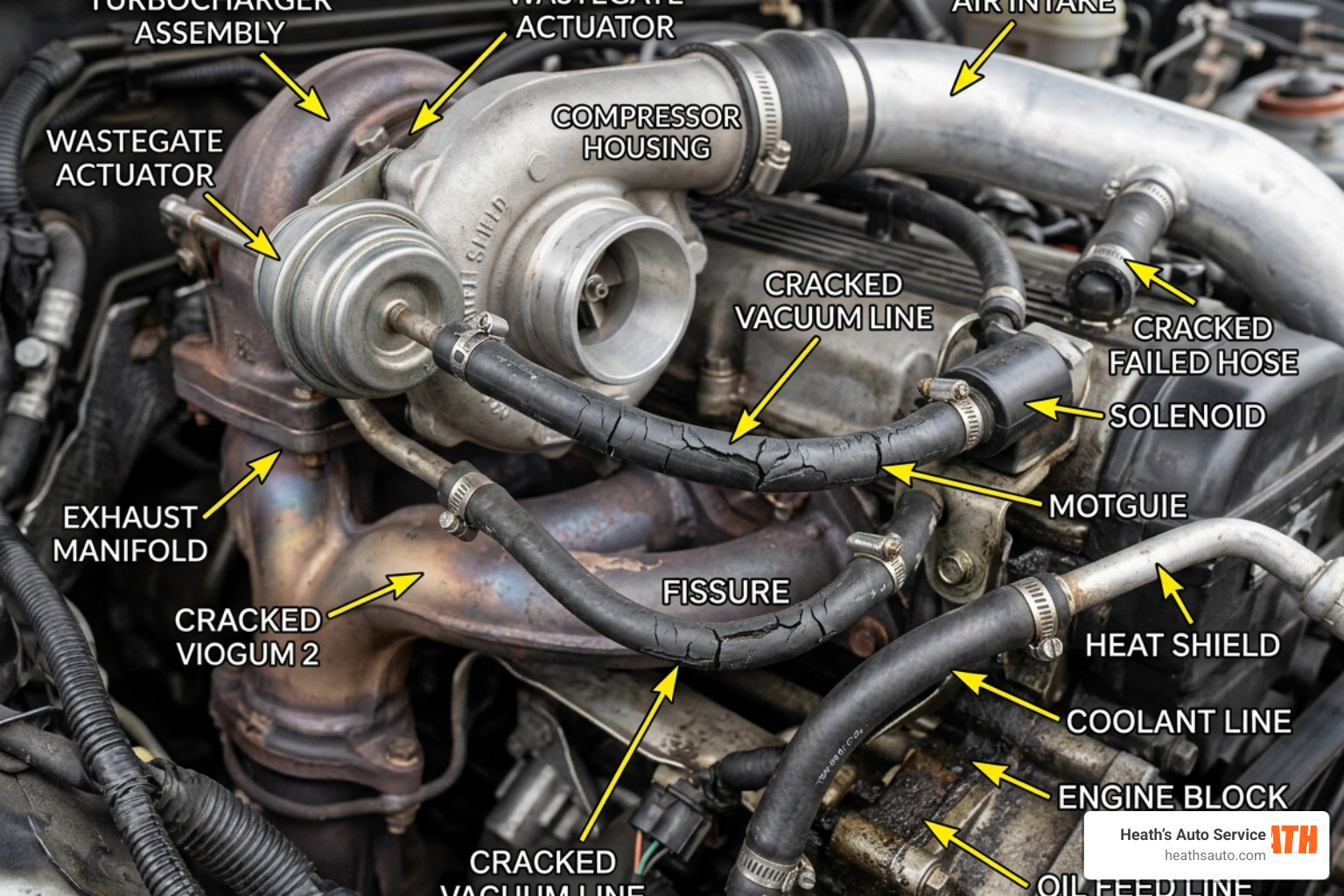
When a leak develops in these thin control lines, the actuator cannot hold the position commanded by the engine control unit (ECU). The unmetered air entering the system disrupts the calculated air-fuel ratio, causing the engine to run lean.
If you suspect your vehicle has a leak, you should watch out for several classic Signs Your Car’s Engine Has a Vacuum Leak. Common symptoms include:
- Underboost Codes (e.g., P0299): The ECU expects a certain amount of boost pressure. If a vacuum leak prevents the wastegate or VNT actuator from closing properly, the turbo cannot build pressure, triggering an underboost code.
- Rough or Sporadic Idle: Because manifold vacuum is highest when the throttle is closed, a small leak has its greatest relative impact at idle. This causes “idle hunting” or a rough, shaking idle.
- Check Engine Light (MIL): Lean codes (like P0171 or P0174) or turbocharger-specific codes (such as P003A, P2598, or P2599) will quickly illuminate your dashboard.
- Hissing or Sucking Sounds: A prominent leak often sounds like the high-pitched hiss of a home vacuum cleaner tube when it’s partially blocked.
- Increased Engine Temperatures: Running lean means there is too much air and too little fuel in the combustion chamber. This raises combustion temperatures. Over time, driving with a severe leak can cause extreme thermal stress, leading to catastrophic damage to your pistons and bearings.
| Engine Parameter | Normal Turbocharged Operation | Turbocharged Engine with a Vacuum Leak |
|---|---|---|
| Idle Quality | Smooth, steady RPM (usually 700–800 RPM) | Rough, surging, or “hunting” RPM |
| Boost Pressure | Reaches factory specifications quickly under load | Low boost, slow spooling, or complete boost loss |
| Air-Fuel Ratio | Perfectly balanced (approx. 14.7:1 for gasoline) | Lean (excess air), causing high cylinder temperatures |
| Dashboard Lights | No warning lights | Check Engine Light (Lean or Underboost codes) |
| Brake Pedal Feel | Light and responsive | Stiff or hard to press (if brake booster line leaks) |
How to Diagnose a Leaking Turbo Vacuum System
Diagnosing a turbo vacuum system requires a systematic approach. Because turbocharged engines operate under both vacuum and high boost pressures, a simple visual check isn’t always enough. A hose might seal perfectly under vacuum but balloon and leak under 15 psi of boost.
Here is our professional 4-step diagnostic framework to pinpoint the leak:
Step 1: Fuel Trim Analysis
Before turning a single wrench, we connect an OBD-II scanner to read the engine’s fuel trims. Your Short-Term Fuel Trim (STFT) and Long-Term Fuel Trim (LTFT) tell us exactly how much extra fuel the computer is adding to compensate for unmetered air. If your LTFT is sitting at +15% or higher at idle, but drops back down toward 0% when you rev the engine to 2,500 RPM, you have a classic vacuum leak. This happens because the volume of leaking air becomes negligible compared to the massive rush of metered air entering the engine at higher RPMs.
Step 2: Thorough Visual Inspection
Let the engine cool down, grab a bright flashlight, and inspect every inch of the vacuum network. Pay close attention to:
- The thin vacuum lines running to the turbo wastegate actuator and the N75 control solenoid.
- The thick brake booster supply line.
- The intake boot and charge pipes leading to and from the intercooler.
- Plastic vacuum reservoirs and check valves, which are highly susceptible to heat and oil vapor embrittlement.

Step 3: The Smoke Test (The Gold Standard)
If a visual inspection yields nothing, we perform a professional smoke test. This is the safest, most reliable method to find hidden hairline cracks in intake boots or gaskets that only open up under operating temperatures.
We seal the intake tract and inject a dense, non-flammable cosmetic smoke at a low pressure of 0.5 to 1 psi into the vacuum system. If there is a leak, you will see a plume of smoke escape from the exact failure point. You can learn more about how we use these specialized tools in our guide on Sucking Air: Your Guide to Vacuum Leak Car Repair.
Safety Note: Avoid using flammable aerosol sprays (like brake cleaner or starting fluid) to find leaks on a hot engine. While this old-school DIY trick can cause the engine idle to change when sprayed over a leak, it poses a major fire hazard in a cramped, hot turbo engine bay. For a detailed breakdown of safer diagnostic alternatives, check out this guide on How to Find and Diagnose a Vacuum Leak | AutoDTCs.
Step 4: Boost Leak/Pressure Testing
Because turbochargers create positive pressure, some leaks only show up when the intake tract is pressurized. To find these, we block off the turbo inlet with a specialized adapter and apply regulated compressed air.
Crucial tip: Always regulate the compressed air down to 5–7 psi. Applying unregulated shop air (which can exceed 100 psi) can easily blow out the turbo’s internal oil seals or damage delicate plastic components. Once pressurized, we spray soapy water onto the charge pipes, intercooler core, and couplers, watching for bubbles to identify the leak.
Step-by-Step Guide to Turbo Vacuum Leak Repair
Once you have diagnosed the leak, the repair process depends on which component has failed. Below, we outline how to tackle the most common repairs.
Replacing Brittle Vacuum Hoses
Most turbo vacuum leak repair jobs involve replacing worn-out rubber or plastic vacuum lines. Over years of driving in hot Arizona summers, these lines become incredibly brittle.
- Disconnect the battery and ensure the engine is completely cool.
- Remove the damaged hose gently. Do not yank on hoses connected to plastic solenoids or vacuum chambers—the plastic nipples break easily. Instead, use a utility knife to slice the hose lengthwise along the barb, then peel it off.
- Cut the new hose to length. Always use high-quality, high-temperature silicone or OEM-grade rubber vacuum hoses. Cheap auto parts store hoses can collapse under high vacuum.
- Route the new hose carefully. Keep it away from moving parts and direct heat sources like the exhaust manifold or the hot side of the turbocharger. Secure the ends with spring clamps or small zip ties.
Replacing or Adjusting the VNT/Wastegate Actuator
If the leak is inside the actuator itself (usually a torn internal rubber diaphragm), the actuator must be replaced.
On many variable-geometry turbochargers (like VW TDI models), you must calibrate the actuator rod after installation. If the rod is adjusted incorrectly, you risk dangerous boost spikes or sluggish throttle response.
- To test the actuator, connect a hand-held vacuum pump directly to its port.
- Apply vacuum. A healthy Garrett actuator should start moving its control rod at 3 to 5 inches of vacuum and hit its hard stop at 18 to 22 inches of vacuum.
- If the rod does not move smoothly, or if the actuator fails to hold vacuum, the internal diaphragm is torn, and the unit must be replaced. For a highly detailed walkthrough on this specific calibration, refer to the guide on How to test and replace a VNT turbo actuator VW TDI and VNT actuator adjustment.
Fixing a Broken Vacuum Chamber Nipple (The Budget Fix)
Many turbo vehicles feature a plastic vacuum reservoir or chamber. If a plastic nipple snaps off, replacing the entire reservoir can be expensive. A reliable DIY fix involves:
- Clearing the broken area and drilling a small, clean hole where the nipple used to be.
- Tapping the hole with a thread tap.
- Screwing in a threaded brass hose barb nipple with a small dab of high-temperature epoxy or thread locker to ensure an airtight seal.
For complex turbo diesel platforms, such as those covered in General Motors’ technical service bulletin PI1260 1..6, finding a leak requires checking the entire vacuum circuit supplied by the vacuum pump, including the EGR cooler bypass actuator and the brake booster. Replacing even a single leaking quick-connect fitting in these systems can instantly restore lost performance.
Essential Tools for Turbo Vacuum Line Replacement
Before starting your repair, gather these essential tools:
- High-temperature silicone vacuum tubing (matching the inner diameter of your factory lines)
- Hand-held vacuum pump with a pressure gauge (such as a Mityvac)
- Hose removal pliers or a sharp utility knife
- Small spring clamps or high-quality zip ties
- OBD-II diagnostic scanner to clear codes and monitor fuel trims post-repair
Frequently Asked Questions About Turbo Vacuum Leaks
When to Seek Professional Turbo Vacuum Leak Repair
While replacing an easily accessible vacuum hose is a great weekend project, some diagnostics and repairs are best left to professionals.
If your leak requires removing the intake manifold, accessing hard-to-reach lines behind the engine block, or diagnosing complex electro-pneumatic solenoids, a mistake can lead to severe engine damage. Our team at Heath’s Auto Service uses professional-grade diagnostic scanners and advanced smoke machines to pinpoint and fix leaks quickly.
Average Costs for Turbo Vacuum Leak Repair
The cost of fixing a turbo vacuum leak varies widely based on the location of the leak and the parts required:
- Simple Vacuum Hose Replacement: $150 to $300 (mostly labor for diagnostics, as the hose itself costs only a few dollars).
- Solenoid or Actuator Replacement: $350 to $700 (includes the cost of the replacement valve or actuator and calibration).
- Intake Manifold Gasket or Complex Leak Repair: $1,000 to $1,500+ (due to the extensive labor required to disassemble the top end of the engine).
If you suspect a leak and want an honest, upfront estimate, find out Where to Get Your Vacuum Leak Fixed Today at any of our six convenient Arizona locations.
Can You Safely Drive with a Turbo Vacuum Leak?
Technically, yes, you can usually drive your car short distances with a minor vacuum leak. However, we do not recommend it.
Driving with a vacuum leak for an extended period causes your engine to run lean. This raises combustion chamber temperatures, which can eventually melt pistons, damage valves, and ruin expensive catalytic converters. Additionally, if the leak is large enough, your car may enter “limp mode,” severely limiting engine power to protect itself—which can be a major safety hazard when merging onto busy Arizona highways.
Conclusion
A turbo vacuum leak might start as a minor annoyance—a faint hiss or a slight hesitation when you step on the gas—but ignoring it can lead to massive repair bills down the road. Regular preventive maintenance, including periodic inspections of your vacuum lines for brittleness and treating them gently during other engine services, is the best way to keep your turbocharged vehicle running smoothly.
Heath’s Auto Service In Scottsdale, AZ
At Heath’s Auto Service, we offer a comprehensive range of services and repairs to meet all your automotive needs. Our highly skilled technicians are equipped with the latest tools and technology to ensure your vehicle is serviced to the highest standards. Contact our team today!