

Is Your Car AC Blowing Warm Air? Here’s What to Do First
If you’re looking for a car AC recharge near me, here’s the short answer:
- What it is: A service that removes old refrigerant and replaces it with fresh refrigerant so your AC blows cold again.
- When you need it: When your AC blows warm or takes much longer than usual to cool the cabin.
- How often: Most manufacturers recommend every 2 years, or whenever cooling performance drops.
- Where to go: A certified auto repair shop with EPA-trained technicians — like Heath’s Auto Service in Arizona.
- How long it takes: Typically 45–90 minutes for a full evacuation and recharge.
Arizona summers are no joke. When your car’s AC starts blowing warm air, it goes from an inconvenience to a real problem — fast.
The good news? In most cases, weak or warm AC comes down to one simple cause: low refrigerant. Over time, even a well-sealed AC system slowly loses refrigerant. According to industry data, the average new economy car leaks roughly 0.41 ounces of refrigerant per year. That’s enough to gradually rob your system of cooling power without any obvious warning signs — until one sweltering afternoon when the air coming out of your vents is anything but cold.
A proper AC recharge restores that refrigerant, gets your system back to factory performance, and can protect expensive components from premature wear.
Quick car ac recharge near me terms:
What Is a Car AC Recharge and How Does It Work?
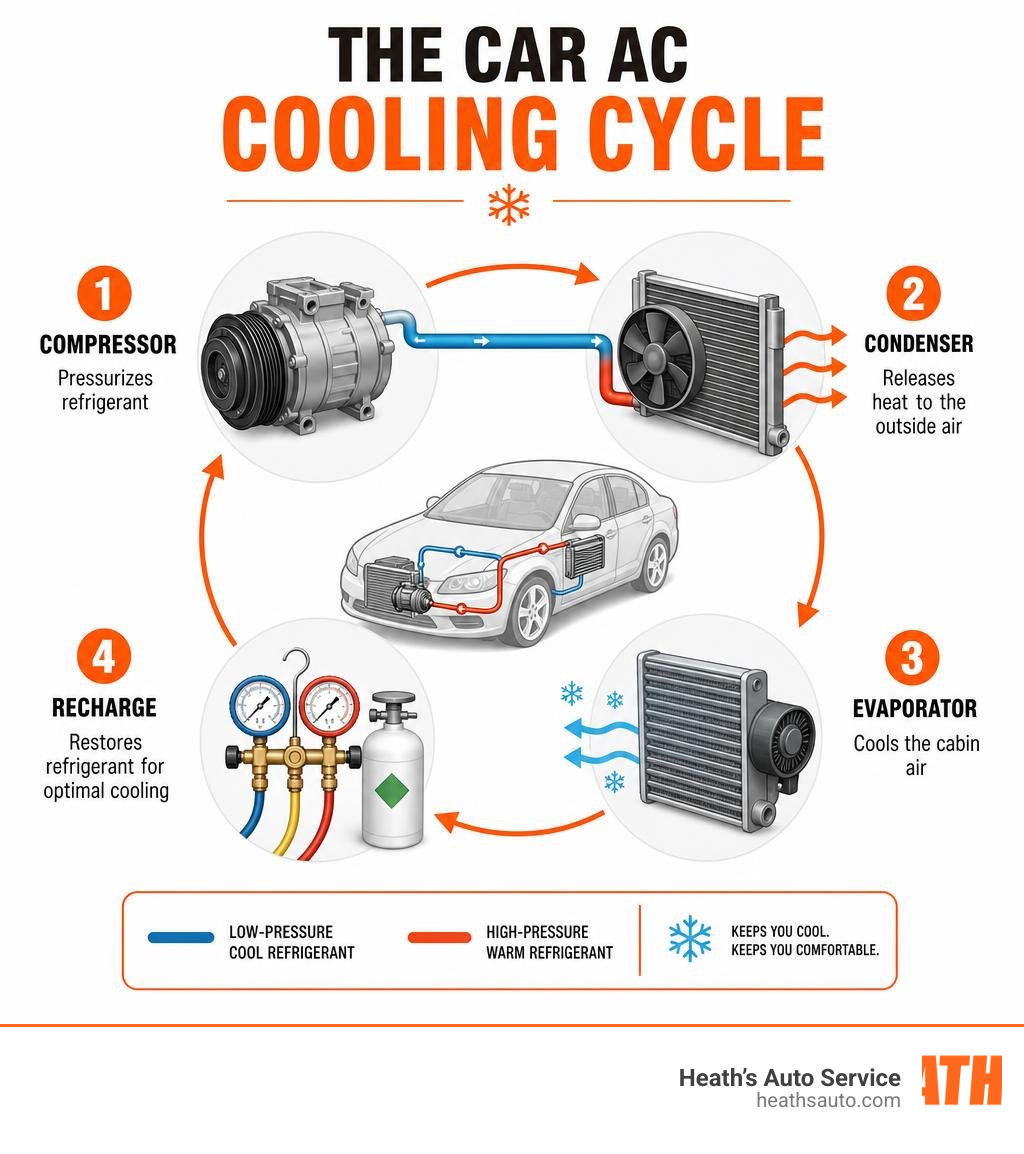
To understand what a car AC recharge actually does, it helps to know how your air conditioning system functions. Your car doesn’t actually “create” cold air. Instead, it uses a closed-loop chemical process to extract heat and moisture from inside the cabin and dump it outside.
This magic is made possible by a specialized chemical compound called refrigerant (often referred to by the brand name Freon). The refrigerant cycle relies on four main components:
- The Compressor: Driven by your engine’s accessory belt, the compressor pressurizes the gaseous refrigerant, turning it into a hot, high-pressure gas.
- The Condenser: Located at the front of your vehicle (usually right in front of the radiator), the condenser cools this hot gas, condensing it into a high-pressure liquid as air flows through it.
- The Expansion Valve/Orifice Tube: This component acts as a restriction, dropping the pressure of the liquid refrigerant rapidly, which causes its temperature to plummet.
- The Evaporator: Located deep inside your dashboard, the cold liquid refrigerant flows through the evaporator. Your cabin’s blower fan pushes warm air across the evaporator coils. The refrigerant absorbs the heat from this air, cooling the air before it enters your cabin. As the refrigerant absorbs heat, it evaporates back into a low-pressure gas, returning to the compressor to start the cycle all over again.
Over time, this system can lose its charge. When we perform a professional car AC recharge, we don’t just squirt more refrigerant into the lines. A proper service involves evacuating the remaining old refrigerant, pulling a deep vacuum to remove any moisture or air that has seeped into the sealed system, and then refilling the system with the exact weight of fresh refrigerant specified by your vehicle’s manufacturer.
For more detailed information on how these components work together to keep you comfortable, check out our guide on Ac And Heat Repair.
How to Know If Your Vehicle Needs a Car AC Recharge Near Me
Most of us don’t think about our air conditioning until we turn the dial to “Max AC” on a 105-degree day and get greeted by a face full of lukewarm air. However, your car will usually give you a few warning signs before it quits on you completely.
Paying close attention to how your system behaves can save you from a miserable drive and prevent minor issues from turning into major, expensive component failures.

If you suspect your system is losing its cooling power, it is highly recommended to seek a professional diagnostic. To help you identify what is happening under the hood, you can Learn about signs your car AC is dying to catch these issues early.
Signs Your Car AC Is Losing Cooling Power
Here are the most common symptoms that indicate your vehicle is running low on refrigerant and is ready for a recharge:
- Warm Air from the Vents: The most obvious sign. If your system is set to the coldest setting but only blows lukewarm or ambient temperature air, your refrigerant levels are likely too low to facilitate the heat-exchange process.
- Weak Airflow or Slow Cooling: If your AC eventually gets cold but takes 15 to 20 minutes of driving to reach a comfortable temperature, the system is struggling due to a diminished charge.
- Rapid Compressor Cycling: When you turn on your AC, you should hear the compressor clutch engage with a distinct “click” and run for a while. If you hear this clicking sound every few seconds (rapid cycling), it means the system pressure is too low, triggering the low-pressure safety switch to shut the compressor off to prevent damage.
- AC Only Cold While Driving: If the air is cool while cruising down the highway but turns warm when you idle at a red light in Flagstaff or Scottsdale, your system pressure is marginal and needs attention.
If you are experiencing these frustrating symptoms, read our expert advice on Your Car Ac Is Blowing Hot Air And Here Is How To Fix It to understand the next steps.
AC Recharge vs. AC Repair: What is the Difference?
It is common to confuse an AC recharge with an AC repair, but they are fundamentally different services. A recharge is a maintenance procedure designed to restore the correct level of clean refrigerant to a system that has lost its charge due to normal, microscopic seepage over time.
An AC repair, on the other hand, is required when there is a mechanical failure or a physical leak in the system. Because the AC system is fully sealed, if you lose all your refrigerant rapidly, simply recharging it is a waste of money — the new gas will quickly leak right back out into the atmosphere.
| Feature | AC Recharge | AC Repair |
|---|---|---|
| Primary Goal | Restore correct refrigerant levels and remove moisture. | Fix broken parts (compressor, condenser, hoses) or seal leaks. |
| When It’s Needed | Slow, natural loss of cooling over years. | Sudden loss of cold air, visible leaks, or mechanical noises. |
| Process Involved | Evacuating old gas, vacuum testing, refilling to factory weight. | Replacing physical components, patching lines, replacing seals. |
| Typical Cost | Affordable, standard maintenance pricing. | Variable; depends on the broken component. |
Step-by-Step Guide: How to Recharge Your Car AC
When you bring your vehicle into a professional shop for an AC service, the technicians follow a precise, multi-step process to ensure the system is completely clean, dry, and filled to the exact manufacturer specifications. Here is how a professional service works step-by-step:
- Initial Inspection and Temperature Benchmark: The technician measures the current vent temperatures and hook up manifold gauges to check the high-side and low-side pressures. This helps determine if the issue is a simple low charge or a failed mechanical component.
- Refrigerant Recovery (Evacuation): Using a specialized, EPA-certified recovery machine, the technician safely extracts any remaining refrigerant from your vehicle. It is illegal to vent refrigerant into the air, so this gas must be captured and contained.
- Deep Vacuum Pull: The machine pulls a deep vacuum on the system for 15 to 30 minutes. This serves two purposes: it boils off and evacuates any moisture that has entered the system, and it removes air. Moisture is the ultimate enemy of an AC system; when mixed with refrigerant, it can form corrosive acids that destroy components from the inside out.
- Vacuum Hold (Leak Test): Once the vacuum is established, the system is monitored to see if it can hold that vacuum. If the vacuum drops, it indicates a physical leak that must be repaired before adding new refrigerant.
- Recharge by Weight: If the system passes the leak test, the technician recharges the system with fresh refrigerant. This is done strictly by weight (in ounces or grams) as specified on the vehicle’s under-hood factory label, rather than just reading gauge pressures.
- Performance and Temperature Test: Finally, the technician starts the vehicle, runs the AC, and measures the vent temperatures (ideally between 38°F and 45°F depending on ambient humidity) and system pressures to verify perfect operation.
For an in-depth breakdown of how you can identify and resolve these steps, check out our guide on How To Fix Ac In Car.
Understanding Refrigerant Types: R-134a vs. R-1234yf
The type of chemical refrigerant flowing through your vehicle’s air conditioner matters immensely. Automotive refrigerants have evolved over the years to reduce their environmental impact:
- R-12 (Freon): Used in vehicles built before 1994. It was highly effective but was banned due to its ozone-depleting properties. If you drive a classic car in Prescott or Cottonwood, your system must be professionally retrofitted to use modern refrigerants.
- R-134a: The industry standard from 1994 through roughly 2017. It does not deplete the ozone layer, though it is still a greenhouse gas.
- R-1234yf: The modern, eco-friendly standard used in almost all vehicles manufactured after 2018. It has an incredibly low Global Warming Potential (GWP) but requires highly specialized, expensive equipment to service.
Because R-1234yf systems are incredibly sensitive to the exact charge weight, even a fraction of an ounce of undercharging or overcharging can drastically reduce cooling performance or damage the compressor.
Why You Should Avoid DIY and Find a Professional Car AC Recharge Near Me
It is incredibly tempting to walk into an auto parts store, grab a $35 DIY recharge can, and try to hook it up to your car in your driveway. However, this is one of the most common ways well-meaning car owners accidentally destroy their air conditioning systems.
Here is why you should avoid DIY kits and leave this service to certified professionals:
- No Way to Evacuate Moisture: A DIY can only add refrigerant to whatever is already in your system. It cannot pull a vacuum to remove moisture or air. If moisture remains inside, it will continue to corrode your expensive compressor and expansion valves.
- Inaccurate Charging: DIY cans rely on a cheap, low-side pressure gauge. However, AC pressure changes drastically based on the outside temperature. Without monitoring the high-side pressure and charging by exact weight, it is incredibly easy to overcharge the system.
- The Danger of Overcharging: Too much refrigerant creates excessive pressure. This can lock up your compressor, blow out rubber seals, or cause the system to shut down entirely as a safety precaution.
- Environmental Regulations: Under Section 609 of the EPA Clean Air Act, handling and recovering automotive refrigerant requires professional certification to prevent harmful chemicals from escaping into the environment.
Save yourself the headache and potential thousands of dollars in component damage. Look for the Top Auto Ac Repair Services Near You to get it done right the first time.
What to Expect: Cost, Time, and Frequency of AC Service
A standard, professional AC evacuation and recharge service is highly efficient. In most cases, you can expect to be in and out of the shop in 45 to 90 minutes. This gives the technician enough time to safely recover your old refrigerant, pull a proper deep vacuum to boil off moisture, run a leak test, and recharge the system to factory weight.

When it comes to pricing, the cost of your recharge will largely depend on the type of refrigerant your vehicle requires. Because R-1234yf is a newer, highly regulated chemical, it is significantly more expensive than the older R-134a. For an accurate, up-to-date breakdown of what you should expect to pay this year, check out our resource on Car Ac Repair Costs 2026.
How Often Should You Recharge Your Car AC?
Unlike an oil change or tire rotation, there is usually no strict mileage interval in your owner’s manual for recharging your AC. Instead, the service is performed as needed when cooling performance begins to decline.
However, most manufacturers and industry experts recommend having your AC system inspected and serviced every two years. This proactive maintenance ensures that any minor, slow leaks are caught early, and it refreshes the lubricating oil suspended within the refrigerant, which keeps your compressor running smoothly.
Finding a Reliable Car AC Recharge Near Me Service
When searching for a trustworthy car AC recharge near me, you want to ensure you are choosing a shop with ASE-certified technicians who possess the correct EPA certifications and state-of-the-art recovery machines.
At Heath’s Auto Service, we are proud to serve communities across Arizona with six dedicated locations, including Flagstaff, Prescott, Gilbert, Scottsdale, Chandler, and Cottonwood. We stand behind our work with an industry-leading 3-year/36,000-mile nationwide warranty and offer free second opinions to ensure you never pay for repairs you don’t actually need.
For drivers in our service areas, you can explore our resources to find the Best Auto Air Conditioning Near Me Top Local Ac Repair to learn more about keeping your vehicle cool and finding professional service near you.
Frequently Asked Questions About Car AC Recharges
What happens if I overcharge or undercharge my car AC system?
Undercharging your system means there won’t be enough refrigerant to absorb heat, resulting in weak cooling or warm air blowing from your vents. Overcharging is much more dangerous; it creates excessively high pressures inside the sealed lines. This can trigger safety switches that shut the system down completely, blow out rubber hoses and seals, or cause catastrophic mechanical failure of your AC compressor.
Can I recharge my car AC myself?
While DIY kits are widely available, we strongly advise against using them. They do not allow you to evacuate air and moisture from the lines, they make it incredibly easy to overcharge the system, and they often contain stop-leak additives that can clog professional recovery equipment and ruin your internal AC components.
Why is my car AC still blowing warm air after a recharge?
If your system was recently recharged but is still blowing warm air, you likely have an underlying mechanical issue. This could be a failed compressor clutch, a clogged expansion valve, a broken condenser fan, or a major physical leak that allowed the new refrigerant to escape immediately. To find out what it will cost to diagnose and repair these deeper issues, read our guide on How Much To Fix Ac In Car.
Conclusion
A failing car air conditioner can quickly turn any Arizona drive into an unbearable, sweaty chore. Fortunately, a professional car AC recharge is a straightforward, highly effective maintenance service that can restore your cabin to icy-cold comfort in under an hour.
Heath’s Auto Service in Cottonwood, AZ
At Heath’s Auto Service, our comprehensive range of services covers everything from routine maintenance to complex repairs. Whether it’s a minor tune-up or a major overhaul, trust us to get you back on the road with confidence. Contact our team at Heath’s Auto Service today!