
Why Finding Reliable Car AC Service Near Me Matters This Summer
If you’re searching for car AC service near me, here’s the short answer:
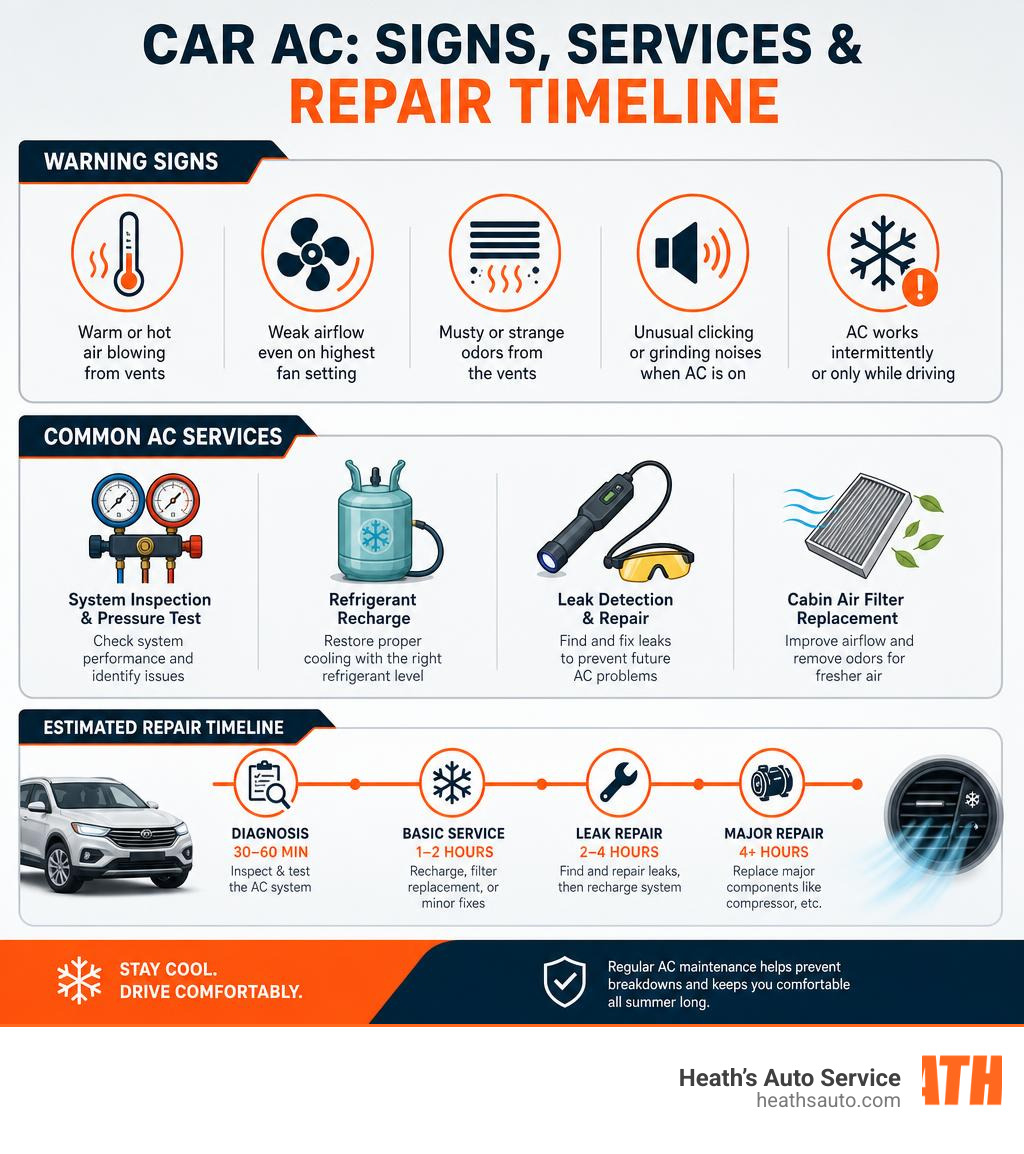
Get your car AC checked if you notice any of these:
- Warm or hot air blowing from vents
- Weak airflow even on the highest fan setting
- Musty or strange odors from the vents
- Unusual clicking or grinding noises when AC is on
- AC that works intermittently or only while driving
What to do next:
- Visit a local ASE-certified shop for a diagnostic inspection
- Ask for a pressure and leak test before any recharge
- Get a written estimate with parts, labor, and warranty details
Nearly 80% of U.S. vehicles have air conditioning, and AC problems rank among the top five reasons drivers visit repair shops during summer months. In hot-weather states like Arizona, that number climbs even higher — drivers here are far more likely to need AC service every single year.
A broken AC isn’t just uncomfortable. It can strain your engine, reduce your ability to defog windows safely, and — if left alone — turn a simple refrigerant top-up into an expensive compressor replacement.
At Heath’s Auto Service, our team has years of experience helping Arizona drivers get reliable, honest car AC service near me across Flagstaff, Scottsdale, Chandler, Gilbert, Cottonwood, and Prescott. In this guide, we’ll walk you through everything you need to know to stay cool without overpaying.
Common car ac service near me vocab:
Recognizing the Signs: When Do You Need a Car AC Service Near Me?

Your car’s climate control system is highly expressive. Long before it completely dies, it will drop hints that it is struggling. Learning to read these warning signs can save you from a miserable, sweat-soaked commute through Scottsdale or Chandler traffic. Recognizing the signs your car’s AC is dying early allows you to address minor issues before they cascade into catastrophic component failures.
Weak Airflow and Strange Odors
If you turn your fan speed to the maximum setting and only feel a pathetic, gentle whisper of air, you are dealing with a weak airflow issue. This is frequently caused by a heavily clogged cabin air filter, which chokes off the air entering your passenger cabin. Over time, this filter collects dust, pollen, leaves, and insect debris.
Another common culprit behind weak airflow is a failing blower motor or a damaged blend door actuator. When these internal doors fail to route air correctly, you won’t get the refreshing breeze you expect.
Even worse than weak airflow is a foul odor. If turning on your AC releases a musty, locker-room smell, mold or bacteria has likely colonized your evaporator core. Because the evaporator remains dark and damp during operation, it becomes a perfect breeding ground for microorganisms. Ignoring this smell isn’t just unpleasant; it can trigger allergies and asthma. A professional cabin air service can disinfect the evaporator core and replace your cabin air filter to restore clean, healthy air.
Why Your Car AC is Blowing Warm Air
There is nothing more frustrating than your car blowing hot air when you desperately need a cool breeze. The most common culprit is low refrigerant. Because the automotive AC system is a sealed loop, refrigerant should never simply “wear out” or disappear. If your refrigerant is low, it means there is a leak somewhere in the system—most often in hoses, seals, or the compressor. In fact, low refrigerant levels are responsible for approximately 70% of all car AC failures.
Another major reason for hot air is a failing compressor clutch. The compressor is the heart of the system; if its clutch fails to engage, refrigerant cannot circulate.
Finally, a blocked or damaged condenser can prevent the system from releasing heat. Located right behind your car’s front grille, the condenser is highly vulnerable to road debris, rocks, and dirt. If you suspect your condenser is failing, look out for bad car AC condenser symptoms, such as visible physical damage, rapid cooling loss when idling, or refrigerant leaks pooling near the front bumper.
Understanding the Car AC System and Diagnostic Process

Many drivers assume that fixing a car’s air conditioner is as simple as injecting a fresh can of refrigerant from a local auto parts store. However, modern automotive climate control is a complex, high-pressure thermodynamic loop. To safely diagnose issues, professional technicians rely on specialized equipment and a deep understanding of the system’s architecture.
The Core Components of Automotive Climate Control
Your vehicle’s cooling system relies on a continuous loop of pressure changes, phase shifts, and heat exchange. There are 5 parts of a car AC system that work in perfect harmony to keep you comfortable:
- The Compressor: Often called the heart of the system, it pressurizes the gaseous refrigerant and pumps it through the loop. If you suspect yours is failing, check our guide on how to tell if a car AC compressor is bad.
- The Condenser: Located at the front of the vehicle, it cools the high-pressure gas, transforming it into a high-pressure liquid.
- The Receiver-Drier or Accumulator: This component acts as a safety filter, using a desiccant packet to trap moisture and debris that could damage internal valves.
- The Expansion Valve or Orifice Tube: This parts acts as a gateway, dropping the pressure of the liquid refrigerant, which causes its temperature to plummet.
- The Evaporator: Tucked deep behind your dashboard, the cold refrigerant flows through its coils. The cabin blower motor pushes warm air across these cold coils, absorbing heat and humidity, and blowing chilled air into your cabin.
How Technicians Diagnose Complex AC Issues
When you bring your vehicle to us for a diagnostic check, we don’t guess. We use a systematic process to pinpoint the exact failure point. We begin with a visual inspection of all lines, connections, and drive belts. Next, we connect professional manifold gauges to the high- and low-pressure service ports to monitor system pressures.
If we suspect a refrigerant leak, we utilize two primary methods:
- Electronic Leak Detectors (Sniffers): These highly sensitive devices can detect trace amounts of escaping refrigerant gas along hoses and fittings.
- UV Dye Injection: We inject a specialized fluorescent dye into the system along with a small charge of refrigerant. After running the system, we scan the lines with an ultraviolet light to find the exact exit point of the leak.
To confirm if the compressor itself is receiving power or has suffered an internal electrical failure, we perform targeted electrical testing. You can read more about how to test a car AC compressor to understand how our technicians verify electrical integrity and clutch operation.
Comparing AC Recharge, Leak Repair, and Full System Overhauls
Depending on what our diagnostics reveal, your vehicle’s AC repair will fall into one of three categories: a recharge, a leak repair, or a full system overhaul. Understanding these differences will help you make informed decisions when reviewing your repair options.
What to Expect During a Professional Car AC Service Near Me
If your system has no major component failures but is slightly low on refrigerant, a professional recharge is the solution. In our comprehensive guide to auto AC repair, we emphasize that a proper recharge is not just a “top-off.”
A professional recharge involves:
- Refrigerant Recovery: Safely extracting any remaining refrigerant using EPA-compliant recovery machines.
- Vacuum Testing: Drawing a deep vacuum on the system for 30 to 45 minutes. This removes all moisture and air, which would otherwise degrade the system’s efficiency and damage components.
- Refrigerant Recharge by Weight: Refilling the system with the exact weight of refrigerant specified by the manufacturer. Modern vehicles use either R134a or the newer, eco-friendly R1234yf refrigerant (standard in vehicles built after 2021).
Investing in the importance of regular AC maintenance ensures that your system stays clean, properly lubricated, and free of moisture, preventing expensive failures down the road.
Addressing Refrigerant Leaks and Component Failures
If our diagnostic scan reveals a leak, simply recharging the system is a waste of money. The new refrigerant will leak right back out, harming the environment and your wallet.
Common leak points include dried-out rubber O-rings, cracked rubber hoses, and road-debris damage to the condenser. If the compressor has failed internally, it must be replaced. When a compressor fails, it often sheds tiny metal shavings throughout the lines. If we don’t flush the system and replace the receiver-drier and expansion valve, those leftover metal particles will instantly destroy your brand-new compressor.
We break down these realities in our article on the cold hard truth about AC compressor and hose repair, helping you understand why comprehensive repairs are necessary for long-term reliability.
The Cost of Restoring Your Cool: Pricing and Factors
When searching for car AC service near me, cost is always a major consideration. The ultimate price of your repair depends on your vehicle’s make and model, the type of refrigerant it uses, and the specific components that need to be replaced.
To help you budget, here is a general breakdown of what to expect for car AC repair costs in 2026:
| Service / Repair Type | Estimated Cost Range (Parts & Labor) | Typical Duration |
|---|---|---|
| Basic AC Diagnostic Test | $99 – $150 | 30 – 60 Minutes |
| AC Recharge (R134a Refrigerant) | $150 – $250 | 45 – 60 Minutes |
| AC Recharge (R1234yf Refrigerant) | $250 – $450 | 45 – 60 Minutes |
| Hose or Line Replacement | $200 – $450 | 1 – 2 Hours |
| Cabin Air Filter Replacement | $40 – $80 | 15 Minutes |
| Condenser Replacement | $450 – $900 | 2 – 3 Hours |
| AC Compressor Replacement | $800 – $1,800+ | 3 – 5 Hours |
| Evaporator Core Replacement | $1,000 – $2,200+ | 5 – 8+ Hours (Dashboard Removal) |
For a deeper dive into these numbers, check out our guide on how much to fix AC in a car.
Why Budget Recharges Can Cost More Long-Term
It can be tempting to buy a cheap, DIY recharge kit from an auto parts store or seek out a bargain-basement shop advertising a flat-rate “top-off.” However, these budget fixes often cost far more in the long run.
Most DIY cans contain leak-sealing additives. These chemical sealants react with moisture inside your AC system, hardening into a sticky sludge that can permanently clog your expansion valve and destroy your compressor.
Furthermore, without professional manifold gauges, it is incredibly easy to overfill the system. Overcharging raises head pressure, forcing the compressor to work harder, run hotter, and fail prematurely. If you or a previous owner overfilled your system, you will need to learn how to remove excess freon from car AC safely and legally using professional recovery equipment.
Frequently Asked Questions About Auto AC Repair
How often should a vehicle’s air conditioning system be inspected?
We recommend having your vehicle’s air conditioning system inspected at least once a year, preferably in the spring before the intense Arizona summer heat arrives. Regular check-ups allow us to catch tiny refrigerant leaks, replace dirty cabin filters, and verify compressor clutch operation before they turn into major breakdowns.
To understand how preventative care protects your wallet, read about the importance of auto AC maintenance and repair.
Can I drive with a broken or weak car AC?
Technically, yes—you can drive with a broken AC without damaging your engine, provided the compressor pulley still spins freely on the drive belt. However, driving in a sweltering cabin during an Arizona summer is a safety hazard.
Extreme heat degrades driver reaction times and can lead to dehydration or heat exhaustion. Additionally, your AC system plays a vital role in defogging your windshield during rainstorms by stripping moisture from the air. If you’re dealing with an ac and heat not working in car situation, it is best to get it fixed for your comfort and safety.
How do I find the best car ac service near me?
Look for local, independent repair shops that employ ASE-certified technicians. A reputable shop will always perform a comprehensive diagnostic test before recommending repairs, explain their findings clearly, and stand behind their work with a nationwide warranty.
For more tips on finding a trustworthy local shop, check out our resource on the best auto air conditioning near me.
Conclusion
When the Arizona summer sun is beating down on your vehicle, a fully functional air conditioner isn’t a luxury—it’s an absolute necessity. Don’t spend your daily commute sweating through your clothes or breathing in musty, allergen-filled air.
Heath’s Auto Service In Gilbert, AZ
We stand behind our work with a 3-year/36,000-mile nationwide warranty and offer free second opinions if you’ve been told you need a major repair elsewhere. Don’t spend another day melting in traffic.
At Heath’s Auto Service, our comprehensive range of services covers everything from routine maintenance to complex repairs. Our certified technicians are skilled in handling oil changes, brake inspections, tire rotations, and much more. Whether it’s a minor tune-up or a major overhaul, trust us to get you back on the road with confidence. Contact our team at Heath’s Auto Service today!