

Why Your Car AC Blows Warm Air — and What to Do About It
Vehicle AC repair is one of the most common automotive services, especially during Arizona summers when temperatures push well past 100°F. If your car’s air conditioning is blowing warm or lukewarm air, you’re not alone — and the fix is often more straightforward than you’d expect.
Quick Answer: Most Common Reasons Your Car AC Blows Warm Air
- Low refrigerant — the most frequent cause, usually from a slow leak
- Refrigerant leak — must be found and fixed before recharging
- Failing AC compressor or clutch — the heart of the system stops working
- Blocked or damaged condenser — restricted airflow prevents heat from escaping
- Electrical fault — a bad fuse, relay, or sensor cuts power to key components
- Blend door actuator failure — hot and cold air mix incorrectly inside the cabin
- Clogged cabin air filter — restricts airflow through the vents
According to industry data, over 50% of AC system failures trace back to refrigerant leaks. Simply recharging without finding the leak is a short-term fix that leads to the same problem — and sometimes bigger repair bills — down the road.
Key vehicle ac repair vocabulary:
How a Car Air Conditioning System Works
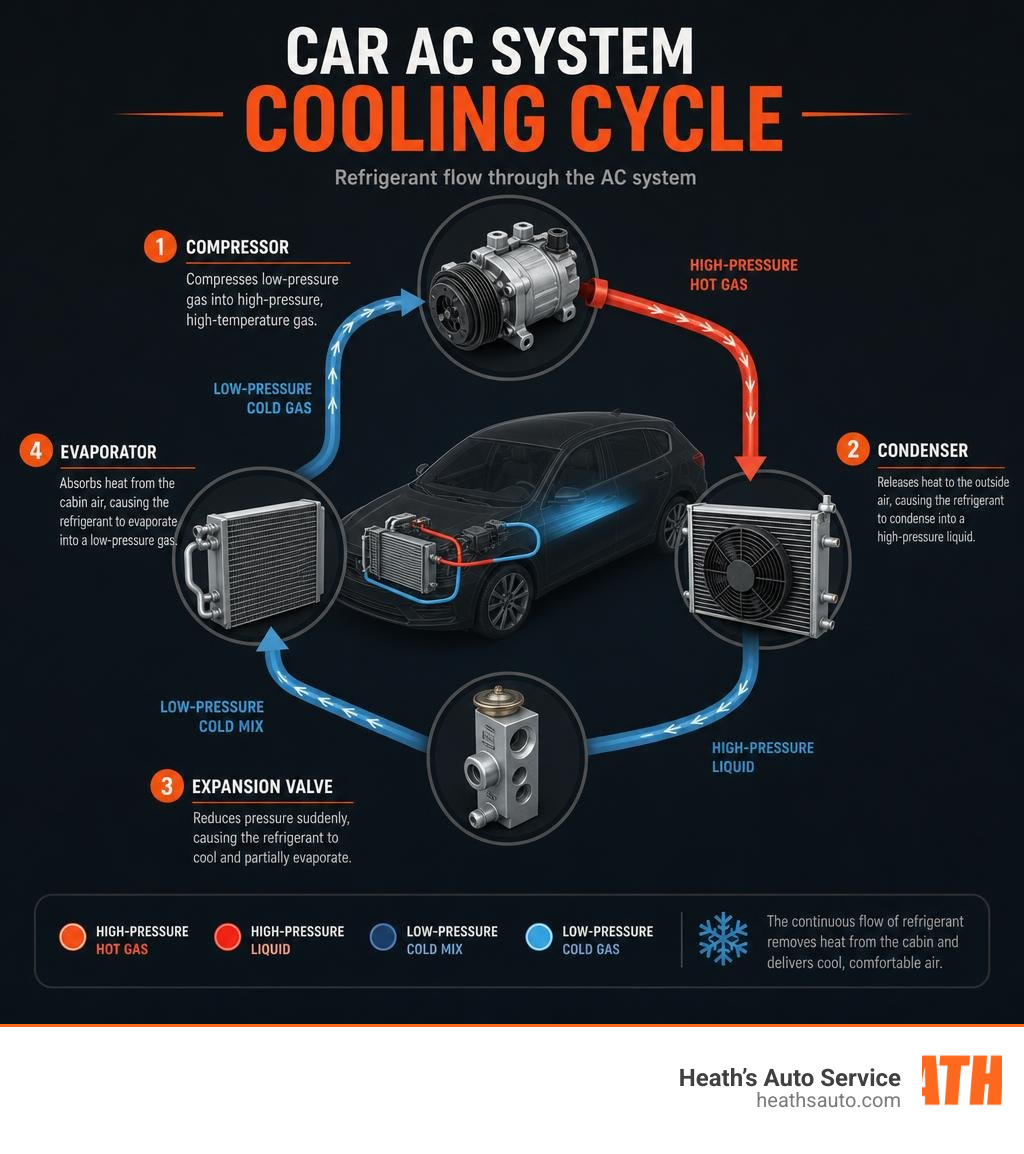
Before we dive into what goes wrong, it helps to understand how your air conditioner works. Many drivers think the AC system generates cold air from scratch. In reality, your car’s AC is a heat extraction machine. It works by absorbing the heat and moisture from inside your cabin and dumping it outside, leaving behind cool, refreshing air.
To do this, the system relies on a continuous, pressurized thermodynamic cycle involving five primary components:

- The Compressor: Often called the heart of the system, the compressor is driven by your engine’s serpentine belt. It pressurizes the gaseous refrigerant, raising its temperature, and pumps it through the system.
- The Condenser: Located right in front of your vehicle’s radiator, the condenser acts like a mini-radiator. As the hot, pressurized gas flows through its tubes, oncoming air cools it down, transforming the gas into a high-pressure liquid.
- The Receiver-Dryer or Accumulator: This component acts as a temporary holding tank and filter. It contains a desiccant bag that pulls moisture out of the refrigerant to prevent internal corrosion and ice formation.
- The Thermal Expansion Valve (or Orifice Tube): This part acts as a gateway. It restricts the flow of high-pressure liquid refrigerant, causing its pressure and temperature to drop rapidly as it enters the evaporator.
- The Evaporator: Located deep inside your dashboard, the evaporator is where the cooling magic happens. Liquid refrigerant absorbs heat from the cabin air blown across its fins by the blower motor. The refrigerant boils back into a low-pressure gas, and the cycle starts all over again.
Understanding these 5 Parts of a Car AC System is crucial because a failure in any single component can disrupt the entire cycle, resulting in warm air blowing directly into your face.
Why Your Car AC Blows Warm Air: Common Causes
When your vents start blowing warm air, it is a clear sign that the thermodynamic cycle has been broken. Let’s look at the most common culprits behind this frustrating issue and explore Your Car AC Is Blowing Hot Air and Here Is How to Fix It.
Low Refrigerant and System Leaks
By far, the number-one reason a car’s AC stops blowing cold is a loss of refrigerant. Your AC is a sealed system, meaning the refrigerant should theoretically last the lifetime of the vehicle. However, automotive AC systems operate under extreme pressures, vibrations, and temperature swings. Over time, rubber hoses degrade, O-rings dry out, and metal fittings loosen.
This causes slow, microscopic leaks. In fact, a typical car AC system can lose about 10-15% of its refrigerant each year through normal seepage. Once the refrigerant level drops below a certain threshold, the system’s low-pressure switch cuts power to the compressor to prevent it from running dry and burning out.
Failing AC Compressor or Clutch
The compressor cannot circulate refrigerant without its electromagnetic clutch. When you press the AC button inside your cabin, an electrical signal engages the compressor clutch, locking it to the pulley turned by the serpentine belt.
If the clutch fails to engage, the pulley will spin freely, but the compressor pistons won’t pump. You can check this yourself: with the engine running and the AC turned on high, look at the front of the AC compressor. The very center of the pulley should be spinning. If only the outer pulley is turning, the clutch is not engaging. This can be caused by a failed clutch coil, an electrical issue, or low system pressure.
Alternatively, the internal pistons of the compressor can wear out over time, preventing the unit from building adequate pressure. If you hear loud squealing, rattling, or clicking noises when you turn the AC on, it is time to learn How to Tell If Car AC Compressor Is Bad and have it inspected.
Blocked or Damaged Condenser
Because the condenser sits at the very front of your vehicle, it is highly vulnerable to road debris, rocks, bugs, and dirt. If the thin aluminum fins of the condenser become clogged with dirt or bent by road debris, airflow is severely restricted.
Without adequate airflow, the condenser cannot shed the heat absorbed from the cabin. As a result, the refrigerant remains a hot gas, and the system blows warm air. If you notice that your AC blows cold when you are driving at highway speeds but turns warm when you are idling at a red light, a blocked condenser or a failing radiator cooling fan is highly likely. Keep an eye out for these Bad Car A/C Condenser Symptoms to catch the issue before it causes the system to overheat.
When to Seek Professional Vehicle AC Repair
While checking your cabin air filter or visually inspecting the compressor clutch are great starting points, most AC issues require professional diagnostics and specialized equipment. Working with pressurized refrigerants requires certified training to ensure environmental safety and system longevity.
Diagnostic Steps for Professional Vehicle AC Repair
When you bring your vehicle to one of our shops, we don’t just guess at the problem. We perform a structured, multi-step diagnostic process:
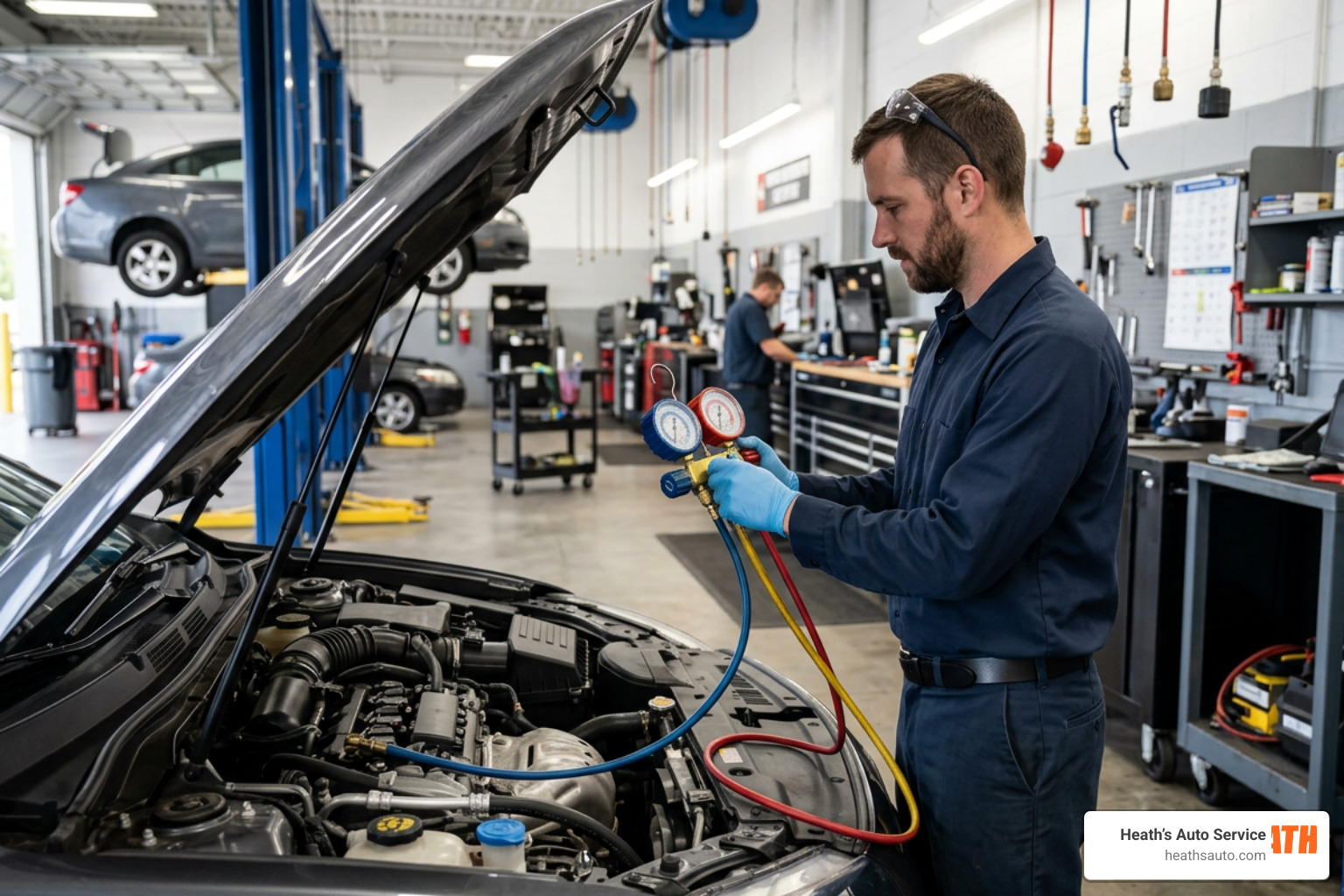
- Pressure Testing: We connect a professional manifold gauge set to the high- and low-pressure service ports. By reading these pressures while the system is running, we can instantly tell if the compressor is pumping correctly or if the refrigerant charge is low.
- UV Dye Leak Detection: Over 50% of AC failures are caused by leaks. We inject a specialized ultraviolet (UV) dye into the system, run the AC, and use a blacklight to trace the exact source of the leak, whether it is a tiny pinhole in the condenser or a leaking seal behind the compressor pulley.
- Electronic Sniffer Testing: For hard-to-reach areas like the evaporator core inside the dashboard, we use electronic leak detectors (or “sniffers”) that can sense refrigerant molecules in concentrations of less than a fraction of an ounce per year.
- Recovery and Evacuation: If a component needs replacement, federal law requires us to use a dedicated recovery machine to safely extract the remaining refrigerant. For example, high-voltage electric vehicle thermal systems require precise evacuation protocols, as detailed in the Tesla Model Y A/C Service Manual.
The Danger of DIY Recharge Kits
It is incredibly tempting to walk into an auto parts store and buy a $30 DIY recharge can. However, these kits often do far more harm than good.
First, DIY cans only measure pressure on the low side of the system. Without knowing the high-side pressure, it is incredibly easy to overcharge the system. Overcharging increases system pressure to dangerous levels, which can lock up your compressor or blow out fragile seals. If you have accidentally overfilled your system, you will need to know How to Remove Excess Freon from Car AC to prevent catastrophic component failure.
Second, many of these DIY cans contain “stop-leak” chemical additives. These chemicals are designed to swell rubber seals to stop leaks temporarily. However, inside your AC system, they can gum up the highly precise orifices of your thermal expansion valve and clog the tiny tubes of your condenser, ruining the entire system and turning a simple leak repair into a multi-thousand-dollar overhaul.
Choosing a Reputable Shop for Vehicle AC Repair
Your car’s AC system is complex and highly sensitive. When choosing a shop to handle your repairs, look for the following:
- ASE Certification: Ensure the technicians working on your car are certified by the National Institute for Automotive Service Excellence (ASE) and hold EPA Section 609 certification for safe refrigerant handling.
- Transparent Pricing: A reputable shop will always perform a diagnostic check first and explain their findings before performing any work.
- Warranty Protection: Look for shops that stand behind their work. At Heath’s Auto Service, we offer an industry-leading 3-year/36,000-mile nationwide warranty on our repairs.
R-134a vs. R-1234yf: Understanding Modern Refrigerants
If your vehicle was built after 1993, it uses one of two primary types of refrigerant. Understanding which one your car requires is essential, as they cannot be mixed, and they require completely different service equipment.
| Feature | R-134a | R-1234yf |
|---|---|---|
| Primary Era | 1994 to ~2016-2021 | 2016+ (Mandatory on all vehicles post-2021) |
| Global Warming Potential (GWP) | 1,430 | 4 |
| Environmental Impact | High atmospheric greenhouse effect | Extremely low, eco-friendly |
| Flammability | Non-flammable | Mildly flammable (requires specialized handling) |
| Cost | Budget-friendly | 5 to 10 times more expensive per pound |
The transition to R-1234yf was driven by environmental regulations. Because R-1234yf breaks down much faster in the atmosphere, it has a global warming potential of just 4, compared to R-134a’s GWP of 1,430.
Because of the higher cost of R-1234yf and the specialized, highly automated recovery machines required to service it, vehicles with newer systems can cost up to 30% more to recharge. Modern electric vehicles and advanced thermal systems, such as those highlighted in the Tesla Cybertruck A/C Service Manual, rely heavily on these newer, eco-friendly refrigerants to manage battery temperatures alongside cabin comfort.
Frequently Asked Questions About Car AC Systems
To keep you cool and informed, we’ve gathered answers to some of the most common questions our technicians receive about automotive climate control and The Importance of Regular AC Maintenance and Repair.
How often should a car’s AC system be serviced?
While your engine oil needs to be changed every few thousand miles, your AC system doesn’t require such frequent attention. We recommend having an AC performance check performed once a year, ideally in the spring before the intense Arizona summer heat sets in. During this check, a technician will test your vent temperatures, inspect the cabin air filter, check the tension on your compressor belt, and inspect the system for any early signs of leaks.
Why does my car AC smell musty or moldy?
If turning on your AC releases a blast of air that smells like a damp locker room, the culprit is mold and mildew. As your evaporator core cools the hot cabin air, moisture naturally condenses on its outer surface. Usually, this water drains safely out of the vehicle through a drain tube under your car (which is why you see puddles under your car on hot days).
However, if that drain tube becomes partially clogged, or if dust settles on the damp evaporator fins, mold and bacteria can quickly flourish. Replacing your cabin air filter every 15,000 to 25,000 miles and having your evaporator core professionally treated with an anti-bacterial foam can quickly resolve this smelly issue.
How much does it cost to fix a car AC system?
The cost of vehicle AC repair depends entirely on the root cause of the issue:
- A/C Recharge: A professional evacuation and recharge typically ranges from $150 to $300, depending on your vehicle and whether it uses R-134a or the more expensive R-1234yf.
- Leak Repair: Replacing a simple O-ring might cost under $150, while replacing a leaking AC hose or a damaged condenser can range from $300 to $700.
- Compressor Replacement: Because the compressor is a highly complex mechanical pump, replacing a failed compressor can range from $800 to $1,500+ depending on the vehicle make and model.
For a detailed breakdown of current pricing, check out our comprehensive guide on Car AC Repair Costs 2026.
Conclusion
A blowing warm AC system is more than just an inconvenience in Arizona — it is a safety hazard. Fortunately, you don’t have to sweat through your daily commute. Whether you have a slow refrigerant leak, a failing compressor, or a clogged cabin filter, our team at Heath’s Auto Service is here to help.
Heath’s Auto Service in Cottonwood, AZ
At Heath’s Auto Service, our comprehensive range of services covers everything from routine maintenance to complex repairs. Whether it’s a minor tune-up or a major overhaul, trust us to get you back on the road with confidence. Contact our team at Heath’s Auto Service today!