
When Your Check Engine Light Is On: Cheap Catalytic Converter Fixes First
The cheapest way to fix a catalytic converter problem isn’t always a full replacement — and if you’ve just been handed a $1,500–$3,000 quote, that’s worth knowing right now.
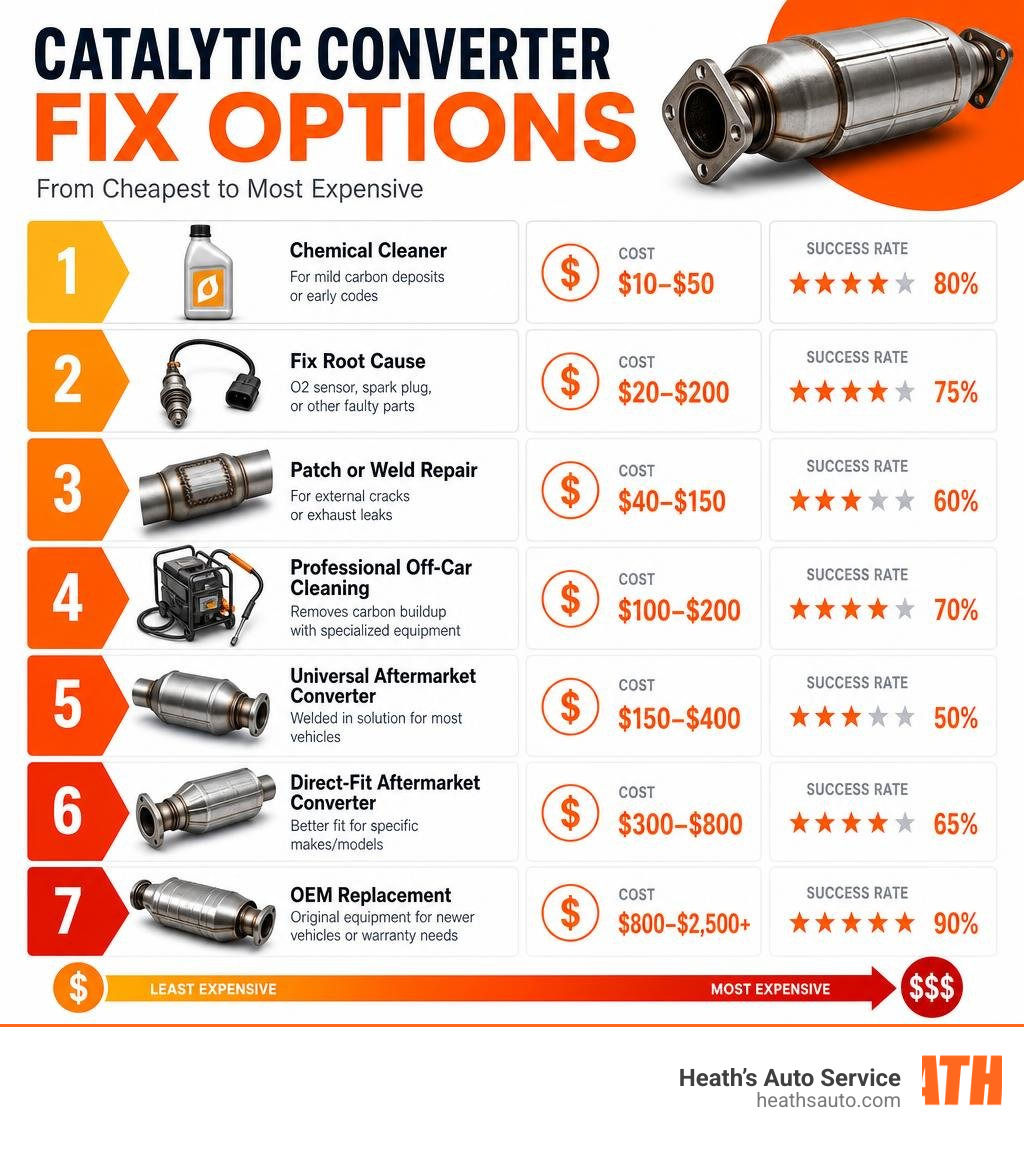
Here are the cheapest options, from least to most expensive:
| Fix | Estimated Cost | Best For |
|---|---|---|
| Chemical cleaner (e.g., Cataclean) | $10–$50 | Mild carbon deposits, early P0420 codes |
| Fix root cause (O2 sensor, spark plug) | $20–$200 | When a faulty sensor is triggering the code |
| Patch or weld repair | $40–$150 | External cracks or exhaust leaks only |
| Professional off-car cleaning | $100–$200 | Moderate contamination with intact substrate |
| Universal aftermarket converter (welded in) | $150–$400 installed | Failed converter on most vehicles |
| Direct-fit aftermarket converter | $300–$800 installed | Better fit, specific makes/models |
| OEM replacement | $800–$2,500+ | Newer vehicles, warranty requirements |
A failing catalytic converter can feel like a financial gut punch — especially when you’re not sure if the repair is even necessary. Many P0420 or P0430 check engine codes get misdiagnosed, and plenty of drivers end up paying for a new converter when a $40 bottle of cleaner or a faulty oxygen sensor was the real problem all along.
The key is knowing which fix applies to your situation — before spending a dime.
At Heath’s Auto Service, after years of helping Arizona drivers avoid unnecessary repairs, we’ve seen how often the cheapest way to fix a catalytic converter starts with a proper diagnosis rather than a rushed replacement. Let’s walk through exactly what to check first.
How to Diagnose a Failing Catalytic Converter
Before you start pricing out replacement parts or buying every additive on the auto parts store shelf, you need to understand what you’re dealing with. So, What is a Catalytic Converter? Simply put, it is an exhaust emission control device situated between your engine and your tailpipe. Inside its metal shell is a ceramic honeycomb structure coated with precious metals like platinum, palladium, and rhodium. These metals act as catalysts, chemically converting toxic engine byproducts—such as carbon monoxide, hydrocarbons, and nitrogen oxides—into safer gases like carbon dioxide, nitrogen, and water vapor.
When this component begins to degrade, modern onboard computer systems will immediately flag the issue. To find the root of the problem, the first tool any mechanic (or savvy DIYer) will reach for is an OBD-II scanner. By plugging this diagnostic tool into the port under your dashboard, you can read the stored trouble codes.
The most infamous codes associated with converter failure are P0420 (Catalyst System Efficiency Below Threshold for Bank 1) and P0430 (for Bank 2). While these codes certainly point to the exhaust system, they do not automatically mean your converter is physically ruined. Sensor errors, exhaust leaks, or temporary carbon buildup can easily trigger these codes. To avoid misdiagnosing your vehicle, it is highly recommended to consult a comprehensive resource like our Slugfailing Catalytic Converter Signs Guide to cross-reference your vehicle’s physical symptoms with the computer’s readings.
Common Signs of a Clogged or Damaged Converter
A dying catalytic converter rarely suffers in silence. There are several unmistakable physical symptoms that will accompany a P0420 Code When Your Check Engine Light is On.
- The Rotten Egg Smell: This is perhaps the most famous symptom. When the honeycomb substrate inside the converter becomes clogged or fails to convert exhaust gases properly, unburned fuel and sulfur compounds (specifically hydrogen sulfide) pass through the exhaust. This creates a highly offensive, distinct sulfur odor resembling rotten eggs.
- Severe Loss of Engine Power: If the ceramic honeycomb structure melts or becomes heavily coated in soot, it restricts the flow of exhaust gases. This restriction creates massive backpressure in the engine. You will notice your vehicle struggling to accelerate, especially when driving up steep Arizona hills, and your fuel economy will plummet.
- Rattling Noises: If the internal ceramic structure has shattered due to physical road damage or thermal shock, you will hear a distinct metallic rattling sound from underneath the vehicle while idling or accelerating.
Testing Backpressure and Oxygen Sensors
To truly determine if a converter is physically clogged or if you are simply dealing with a bad sensor, a professional diagnostic approach is required.
Your vehicle uses oxygen (O2) sensors located both upstream (before the converter) and downstream (after the converter) to monitor exhaust gas concentrations. The upstream sensor measures oxygen levels directly from the engine, while the downstream sensor monitors the efficiency of the converter. If the downstream sensor’s readings mirror the upstream sensor’s constantly fluctuating readings, the computer assumes the converter is dead. However, if the downstream sensor itself is faulty, it will report incorrect data and trigger a false check engine light.
To rule out a physical blockage without guessing, we perform a backpressure test. This is done by temporarily removing the upstream oxygen sensor and installing a low-pressure gauge in its place.
- Under 1.5 PSI at 2,500 RPM: The exhaust flow is healthy, and any code you have is likely due to mild surface contamination or a sensor issue. This is prime territory for a cheap chemical cleaning fix.
- Above 3.0 PSI at 2,500 RPM: The converter is severely clogged or melted. At this stage, chemical cleaners will not work, and the unit must be repaired or replaced.
What is the Cheapest Way to Fix Catalytic Converter Issues?
If your diagnostics show that the converter’s internal structure is still physically intact (not shattered or melted) and your backpressure is within a reasonable range, you do not need to buy a new unit. There are several highly effective, budget-friendly ways to clean and restore your existing converter.

Using Chemical Cleaners as the Cheapest Way to Fix Catalytic Converter Deposits
For many drivers, the absolute cheapest way to fix a catalytic converter showing early signs of efficiency loss is to use a dedicated chemical additive. Products like Cataclean, Liqui Moly, or CRC Catalytic Converter Cleaner are designed to dissolve carbon deposits, gums, and carboxylic acids that accumulate on the precious metal catalysts over time.
These cleaners are incredibly simple to use:
- Wait until your fuel tank is down to about one-quarter full.
- Pour the entire bottle of cleaner directly into your fuel tank.
- Drive your vehicle on the highway at sustained speeds for 20 to 30 minutes. This ensures the engine and exhaust system reach their optimal operating temperatures, allowing the chemical vapor to pass through the converter and burn off the choking carbon deposits.
- Refuel your tank and continue driving.
Many drivers wonder: does this cheap fix actually work? According to the diagnostic data analyzed in the Catalytic Converter Cleaning vs Replacement Cost (2026 Guide) | AmpAuto, chemical cleaning additives have a success rate of roughly 15% to 25%. While that might seem low, spending $20 to $40 on a bottle of cleaner is an incredibly smart, low-risk first step before committing to a costly replacement.
For those who love unconventional DIY methods, there is a widely discussed “20-minute Japanese trick” involving adding a small amount of hardware-store lacquer thinner to the fuel tank to dissolve stubborn deposits. This process is detailed in resources like Stop Replacing Your Catalytic Converter This 20 Minute Fix Actually Works – Otosection. However, we urge extreme caution with this method. While it can dissolve heavy carbon, lacquer thinner can degrade rubber seals, fuel lines, and plastic components in modern fuel systems if not mixed precisely. For a safer, step-by-step video demonstration of low-cost cleaning options, check out this popular guide: Fix your Catalytic Converter for $10? – YouTube.
Fixing Root Causes to Avoid Replacement
Here is an industry secret that dishonest shops won’t tell you: catalytic converters rarely die of old age. They are almost always killed by an underlying engine issue. If you replace a failed converter without fixing the root cause, your brand-new unit can fail again in as little as a few thousand miles.
To protect your wallet, you must address these common culprits immediately:
- Engine Misfires: Unburned fuel from a misfiring cylinder travels directly down the exhaust pipe and ignites inside the white-hot catalytic converter. This thermal shock can instantly melt the ceramic honeycomb core. Replacing worn spark plugs and ignition coils is a cheap way to prevent this catastrophe.
- Excessive Oil Consumption: If your engine is burning oil due to worn valve guides or piston rings, the oil ash will coat the precious metals inside the converter, “poisoning” the catalyst and rendering it useless. Addressing oil leaks and using high-quality fuel can extend your converter’s life significantly.
- Faulty Oxygen Sensors: An O2 sensor that is sluggish or reading incorrectly can cause the engine to run too rich (too much fuel), leading to rapid carbon buildup inside the converter.
Budget-Friendly Replacement Options When Repairs Fail
If your converter is physically melted, rattling, or completely blocked, cleaning is no longer an option. You will need to replace the unit. Fortunately, you still do not have to pay dealership prices for an Original Equipment Manufacturer (OEM) part.

When shopping on a budget, you have two primary paths: aftermarket direct-fit converters and universal-fit converters. To understand how these are configured, you can read our guide on How to Install Catalytic Converter.
Welding a Universal Model: The Cheapest Way to Fix Catalytic Converter Failures Permanently
If you want the absolute lowest price on a permanent replacement, ask an auto mechanic or a local muffler shop to weld in a universal catalytic converter.
Unlike direct-fit models, which are engineered with specific pipes and flanges to bolt directly into your car’s exact exhaust layout, a universal converter is simply the “canister” itself. A technician will use a pipe cutter to remove your old, failed converter, slide the universal model into place, and weld the joints to create an airtight seal.
This route is incredibly cost-effective. While a direct-fit part can easily cost $400 to $1,200, a universal converter often costs between $50 and $150. Even with the labor of welding added in, a professional muffler shop can typically complete the job for $200 to $300 total. For more details on this process, explore the Cheapest Way to Fix a Catalytic Converter or find answers to What is the cheapest way to replace a catalytic converter?. If you are curious about the timing, our resource on How Long Does it Take to Install a Catalytic Converter breaks down the differences in labor hours between welded and bolted installations.
Aftermarket Direct-Fit vs. Used Converters
If you prefer a bolt-on solution that doesn’t require welding, an aftermarket direct-fit converter is your best option. These are manufactured by reputable third-party companies to match your vehicle’s original specifications perfectly. They offer an excellent balance of cost, reliability, and ease of installation, as outlined in Cheap and Effective Solutions: What’s the Cheapest Way to Replace a Catalytic Converter? – AutoCarsHub.
However, before purchasing any aftermarket converter, you must check your state’s emissions regulations. The Environmental Protection Agency (EPA) regulates replacement converters federally, but states like California, New York, Colorado, and others enforce strict CARB (California Air Resources Board) standards. CARB-compliant converters contain a higher concentration of precious metals to meet stricter emissions targets, making them 30% to 50% more expensive than Federal EPA-compliant versions. In Arizona, vehicle emissions requirements vary by county (such as Maricopa and Pima counties requiring testing), so always refer to our Catalytic Converter Installation Guide to ensure your replacement part is legally compliant for your specific area.
A Warning on Used or Salvaged Converters: You might be tempted to visit a local salvage yard to pull a used converter from a wrecked vehicle for $50 to $100. We strongly advise against this. Under federal EPA regulations, it is actually illegal for salvage yards or individuals to sell or install used, untested catalytic converters due to emissions control risks. Furthermore, there is no way to verify how much life is left in a used unit, and they carry zero warranty. If you are considering removing the old unit yourself to save on labor, make sure to read DIY: Can You Remove a Catalytic Converter Yourself? to understand the safety hazards, rusted bolt challenges, and legal requirements involved.
Comparing Costs: Cleaning, Patching, and Replacement
To help you visualize your options and budget accordingly, we have compiled the average industry costs for various catalytic converter solutions in 2026. That labor rates typically range from $70 to $130 per hour depending on your location.
| Repair Option | Average Part Cost | Average Labor Cost | Total Estimated Cost | Success Rate / Lifespan |
|---|---|---|---|---|
| Chemical Additive (DIY) | $10 – $50 | $0 | $10 – $50 | 15% – 25% success rate; temporary fix |
| Exhaust Leak Patch / Weld | $10 – $30 | $50 – $120 | $60 – $150 | Highly successful for external leaks only |
| Professional Off-Car Clean | $20 (solvents) | $100 – $200 | $120 – $220 | Mixed results; depends on core condition |
| Universal Replacement (Welded) | $50 – $150 | $150 – $250 | $200 – $400 | 50,000+ miles; highly cost-effective |
| Aftermarket Direct-Fit | $200 – $600 | $100 – $250 | $300 – $850 | 50,000 to 100,000 miles; great overall value |
| OEM Replacement (Dealer) | $800 – $2,500 | $150 – $500 | $950 – $3,000+ | 100,000+ miles; maximum longevity |
For a deeper dive into the long-term financial trade-offs of these options, you can read the Catalytic Converter Cost: Repairs & Replacements – SoFi guide.
Frequently Asked Questions about Catalytic Converter Fixes
Is it legal to bypass, remove, or gut a catalytic converter?
No. Under federal law and Environmental Protection Agency (EPA) regulations, it is strictly illegal to remove, bypass, or “gut” (hollow out) a catalytic converter on any vehicle driven on public roads in all 50 states. Doing so can result in massive fines for both the vehicle owner and the shop performing the work.
Beyond the legal penalties, removing your converter will cause your vehicle to immediately fail emissions testing, trigger a permanent check engine light, and release highly toxic pollutants into the environment. Furthermore, if your exhaust system is compromised or open, you run serious risks. To understand what happens when your exhaust system is suddenly left without this crucial component, read our guide on The Following Problems Happen When the Catalytic Converter Has Been Stolen.
How long do catalytic converters typically last?
Under normal operating conditions, a high-quality catalytic converter is designed to last between 10 years or 100,000 to 150,000 miles. They are built to be incredibly durable. However, their lifespan is heavily dictated by vehicle maintenance. If your engine is running clean, the precious metals inside will continue to catalyze emissions indefinitely. If you ignore spark plug replacements, drive with oil leaks, or ignore a rich fuel mixture, you can destroy a converter in a fraction of that time.
Can a bad catalytic converter cause my car to stall?
Yes, absolutely. If the ceramic honeycomb core inside the converter melts or becomes completely blocked by heavy carbon soot, it creates an extreme exhaust restriction. The engine’s cylinders will not be able to push out waste exhaust gases, preventing fresh air and fuel from entering the combustion chamber. This extreme backpressure will cause a severe drop in engine performance, rough idling, and will eventually cause the engine to stall out completely and refuse to restart until the blockage is cleared.
Conclusion
Finding the cheapest way to fix a catalytic converter doesn’t have to mean cutting corners or breaking the bank on a dealership replacement. By starting with an accurate diagnosis, testing your exhaust backpressure, and trying affordable chemical cleaning methods first, you can often save thousands of dollars. If replacement is ultimately necessary, opting for a welded universal aftermarket converter or a direct-fit model will keep your car running clean and legal without draining your savings.
Heath’s Auto Service In Gilbert, AZ
We stand behind our work with a 3-year/36,000-mile nationwide warranty and offer free second opinions if you’ve been told you need a major repair elsewhere. Don’t spend another day melting in traffic.
At Heath’s Auto Service, our comprehensive range of services covers everything from routine maintenance to complex repairs. Our certified technicians are skilled in handling oil changes, brake inspections, tire rotations, and much more. Whether it’s a minor tune-up or a major overhaul, trust us to get you back on the road with confidence. Contact our team at Heath’s Auto Service today!