
When You Need Vacuum Leak Repair Near Me: Quick Answer First
If you’re dealing with vacuum leak repair near me, here are the fastest ways to get help today:
| What You Need | Best Next Step |
|---|---|
| Same-day diagnosis | Call a local ASE-certified shop and ask about smoke testing |
| Cost estimate | Expect $100–$1,500 depending on the leak location |
| Quick fix (cracked hose) | A certified mechanic can often resolve this in under an hour |
| Complex leak (gasket, solenoid) | Schedule a full diagnostic — don’t delay |
A strange hissing sound under the hood. A rough idle that wasn’t there last week. A brake pedal that suddenly feels like a workout. These are the kinds of symptoms that send Arizona drivers straight to their phones to search for help.
And for good reason. A vacuum leak isn’t just an annoyance — it throws off the precise air-fuel balance your engine depends on. Unmetered air sneaks in where it shouldn’t, and your engine struggles to compensate. Left unchecked, it can cause poor fuel economy, misfires, stalling, and even safety issues with your braking system.
The good news? Vacuum leaks are diagnosable and fixable — often the same day — when you get to the right shop quickly.
Understanding Engine Vacuum and Common Causes of Leaks
To understand why your car needs a vacuum, think of the engine as a giant air pump. During the intake stroke, the pistons move downward, creating a low-pressure area (a vacuum) in the intake manifold. This vacuum is essential for drawing in the air-fuel mixture that keeps your car moving. In modern vehicles, this negative pressure is also used to power accessories like the brake booster and various emissions control systems.
A vacuum leak occurs when “unmetered” air—air that hasn’t been measured by the mass airflow sensor—enters the engine. This disrupts the delicate fuel-air ratio, leading to a “lean” condition where there is too much air and not enough fuel.
What Causes These Leaks?
In the dry Arizona heat of May 2026, we see a lot of rubber and plastic components fail prematurely. Here are the most common culprits:
- Brittle Hoses: Over time, heat and vibration cause rubber vacuum lines to harden, crack, or split. They can end up feeling like fragile drinking straws.
- Intake Manifold Gaskets: These seals sit between the engine block and the intake manifold. If they fail, air leaks directly into the cylinders.
- Brake Booster Diaphragm: If the internal seal of your brake booster fails, it creates a massive vacuum leak every time you press the pedal.
- EGR Valves and Solenoids: Systems like the Exhaust Gas Recirculation (EGR) use vacuum to operate. A stuck valve or a leaking solenoid can trigger a Check Engine Light.
- Heat Degradation: Arizona’s extreme temperatures accelerate the aging of every plastic connector under your hood.
When these components fail, your car’s computer tries to compensate by adding more fuel, but it can only do so much before performance suffers. If you suspect an issue, getting a professional engine repair assessment is the best way to prevent long-term damage.
Common Symptoms: How to Know You Need Vacuum Leak Repair Near Me
How do you know if that weird noise is actually a vacuum leak? Because the engine relies so heavily on consistent pressure, the symptoms are usually quite noticeable.
- Rough Idle: This is the classic sign. When the car is stopped at a light in Scottsdale or Gilbert, you might feel the engine shaking or see the RPM needle bouncing.
- Engine Stalling: If the leak is large enough, the engine may stall completely when you come to a stop or let off the gas.
- Poor Acceleration: You might notice a “stumble” or hesitation when you try to merge onto the I-17 or Loop 101.
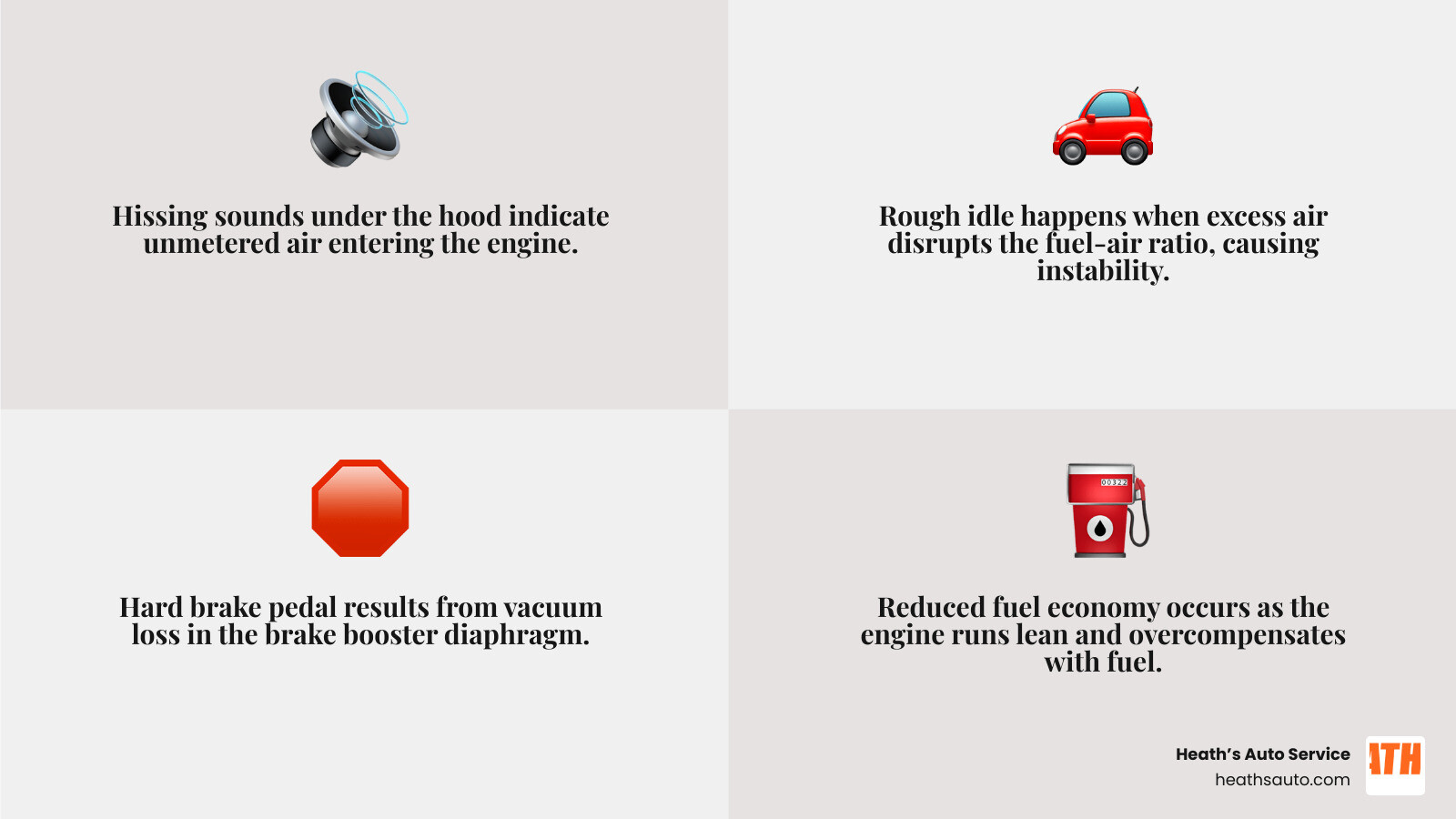
- Hissing Sounds: Sometimes, you can actually hear the leak. It sounds like a high-pitched whistle or a sucking sound, similar to the end of a household vacuum cleaner tube.
- Hard Brake Pedal: Since the brake booster uses engine vacuum to help you press the pedal, a leak can make the brakes feel extremely heavy or difficult to engage.
- Reduced Fuel Economy: Your computer will dump extra fuel into the engine to balance out the extra air, which means more frequent trips to the gas station.
Identifying Symptoms for Vacuum Leak Repair Near Me
When a leak occurs, the engine’s computer (ECU) detects a mismatch in sensor data. It may log “lean” trouble codes (like P0171 or P0174). To keep the car running, the ECU might enter open loop mode, where it ignores certain sensors and uses pre-set fuel maps. This often results in misfires and a noticeable loss of power.
When to Seek Professional Vacuum Leak Repair Near Me
While some DIYers like to poke around under the hood, modern engines are incredibly complex. If your Check Engine Light is flashing, or if your car is physically difficult to stop due to a hard brake pedal, it is a significant safety risk.
Professional car diagnostics services are essential for pinpointing the exact location of a leak without wasting money on “parts cannon” repairs. Understanding the importance of diagnostics in auto repair can save you hundreds of dollars by ensuring the right part is fixed the first time.
Professional Diagnostics and Repair Methods
At our shops in Flagstaff, Cottonwood, and across the Valley, we don’t guess—we test. Finding a tiny crack in a hidden hose requires specialized tools and a methodical approach.
The Diagnostic Process
- Visual Inspection: We start by looking for obvious signs of trouble—swollen, cracked, or disconnected hoses.
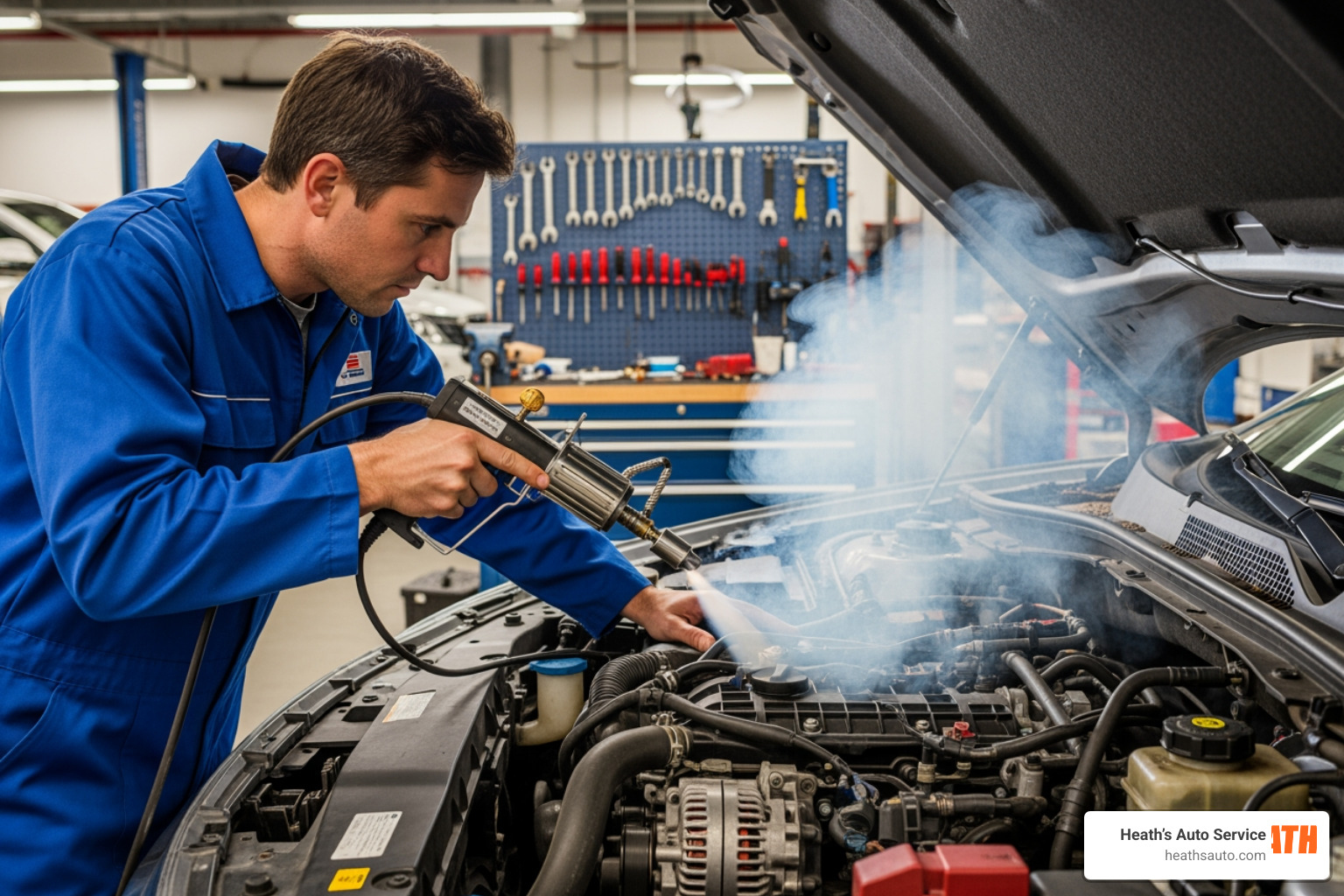
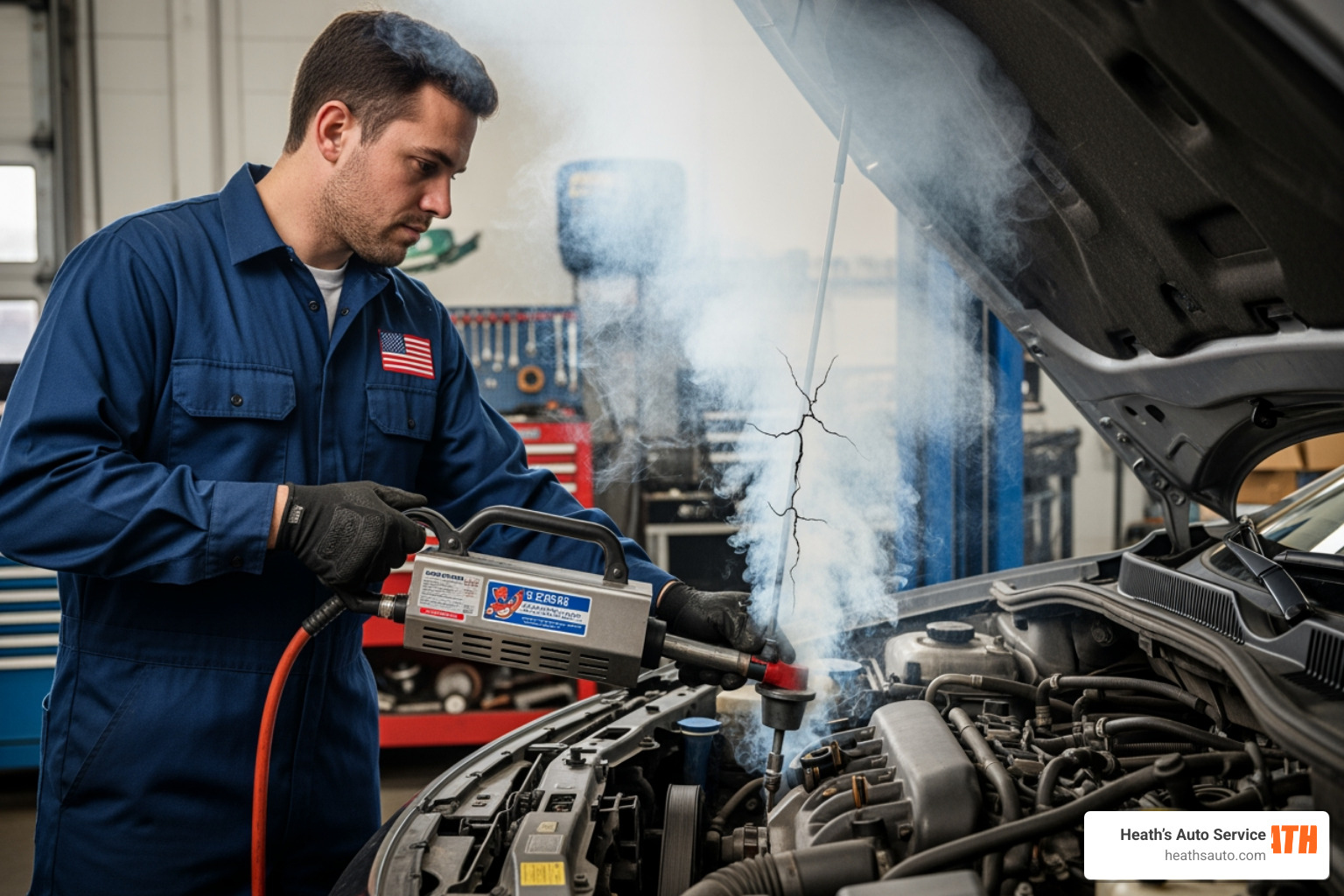
- Smoke Machine Test: This is the gold standard. We inject a non-flammable fog into the intake system. If there is a leak, the smoke will drift out of the hole, making even the smallest pinprick visible.
- Vacuum Gauge Testing: By connecting a gauge to the manifold, we can watch how the pressure behaves. A steady, low reading often points to a specific type of internal leak.
- Fuel Trim Analysis: We use high-end scanners to see how much extra fuel the computer is adding. This helps us confirm if the issue is a vacuum leak or a failing sensor.
- Stethoscope/Ultrasonic Testing: For leaks that are hard to see, we use acoustic tools to “hear” the high-frequency hiss of air being sucked into the engine.
Once the leak is found, the repair might be as simple as a hose replacement or as involved as gasket resealing. Our auto electrical services team also checks the solenoids and sensors that interact with the vacuum system to ensure everything is communicating correctly. For more details on our process, visit our diagnostics page.
Professional Diagnostics for Vacuum Leak Repair Near Me
Our ASE-certified technicians use these advanced methods to provide a definitive answer. While a simple visual check is free, a full car diagnostic cost is a small investment that prevents you from replacing expensive parts like oxygen sensors when the real culprit is just a $5 rubber hose.
The Cost of Vacuum Leak Repair in 2026
The cost of vacuum leak repair near me varies significantly based on what part has failed. A simple hose is cheap; a buried manifold gasket is labor-intensive.
| Repair Type | Estimated Parts Cost | Estimated Labor | Total Range |
|---|---|---|---|
| Vacuum Hose Replacement | $10 – $50 | $50 – $100 | $60 – $150 |
| Smoke Test Diagnosis | N/A | $100 – $150 | $100 – $150 |
| Intake Manifold Gasket | $40 – $150 | $300 – $700 | $340 – $850 |
| Brake Booster Replacement | $150 – $400 | $200 – $400 | $350 – $800 |
| EGR Valve/Solenoid | $50 – $250 | $100 – $200 | $150 – $450 |
Note: Prices are estimates for May 2026 and can vary based on vehicle make and model.
Several factors influence these costs:
- Location of the Leak: If the leak is on the front of the engine, it’s a quick fix. If it’s behind the engine against the firewall, labor time increases.
- Diagnostic Complexity: Some leaks only happen when the engine is hot, requiring more time for a smoke test.
- Parts Availability: While most hoses are universal, specific molded hoses or solenoids may need to be ordered from the manufacturer.
For a clearer picture of what you might spend, you can check out our guides on 2025 car diagnostic costs and car diagnostic costs 2025. We always provide transparent, upfront estimates before any work begins.
Frequently Asked Questions about Vacuum Leaks
How long does it take to fix a vacuum leak?
Most vacuum leak repairs can be completed in a single day. A simple hose replacement might take less than an hour, while a more complex intake manifold gasket repair could take 4 to 6 hours. At Heath’s Auto Service, we strive for same-day service whenever possible to get you back on the road quickly.
Can I drive my car with a vacuum leak?
Technically, yes, but we don’t recommend it. Driving with a vacuum leak causes your engine to run “lean,” which creates excessive heat. Over time, this can damage your spark plugs, catalytic converter, and even lead to engine failure. Plus, the poor fuel economy will cost you more at the pump than the repair itself.
Why is my brake pedal hard to press when I have a vacuum leak?
Most cars use a “vacuum power booster” to multiply the force you apply to the brake pedal. If there is a leak in the booster or the hose leading to it, you lose that assistance. This makes the pedal feel incredibly stiff, significantly increasing your stopping distance. This is a major safety concern that requires immediate attention.
Conclusion
A vacuum leak can turn a smooth-running vehicle into a stuttering, gas-guzzling headache. Whether you’re hearing a mysterious hiss in Flagstaff or dealing with a rough idle in the heat of Scottsdale, ignoring the problem will only lead to more expensive repairs down the road.
Heath’s Auto Service in Cottonwood, AZ
At Heath’s Auto Service, our comprehensive range of services covers everything from routine maintenance to complex repairs. Whether it’s a minor tune-up or a major overhaul, trust us to get you back on the road with confidence. Contact our team at Heath’s Auto Service today!
We stand behind our work with an industry-leading 3-year/36,000-mile nationwide warranty and offer same-day service to keep your life moving. Don’t let a tiny leak cause a big problem.