
When Tune-Up Starting Problems Leave You Stranded
Tune-up starting problems are one of the most frustrating — and preventable — reasons drivers end up stranded.
Here’s a quick answer if you’re in a hurry:
Most common causes of tune-up related starting problems:
| Cause | What You’ll Notice |
|---|---|
| Worn spark plugs | Hard starting, misfires, rough idle |
| Weak or dead battery | Clicking sounds, slow crank, no power |
| Bad alternator | Battery dies repeatedly, dim lights |
| Faulty starter motor | Single loud click, engine won’t crank |
| Clogged fuel filter or bad fuel pump | Engine cranks but won’t fire |
| Ignition switch or security system fault | No crank, security light on |
According to AAA, over 27 million emergency roadside calls were made in 2024 — and roughly 7 million of those were tied directly to battery and starting-system failures. A dead or weak battery alone accounts for about 60% of all car starting problems. But spark plugs, fuel delivery, and ignition components are close behind.
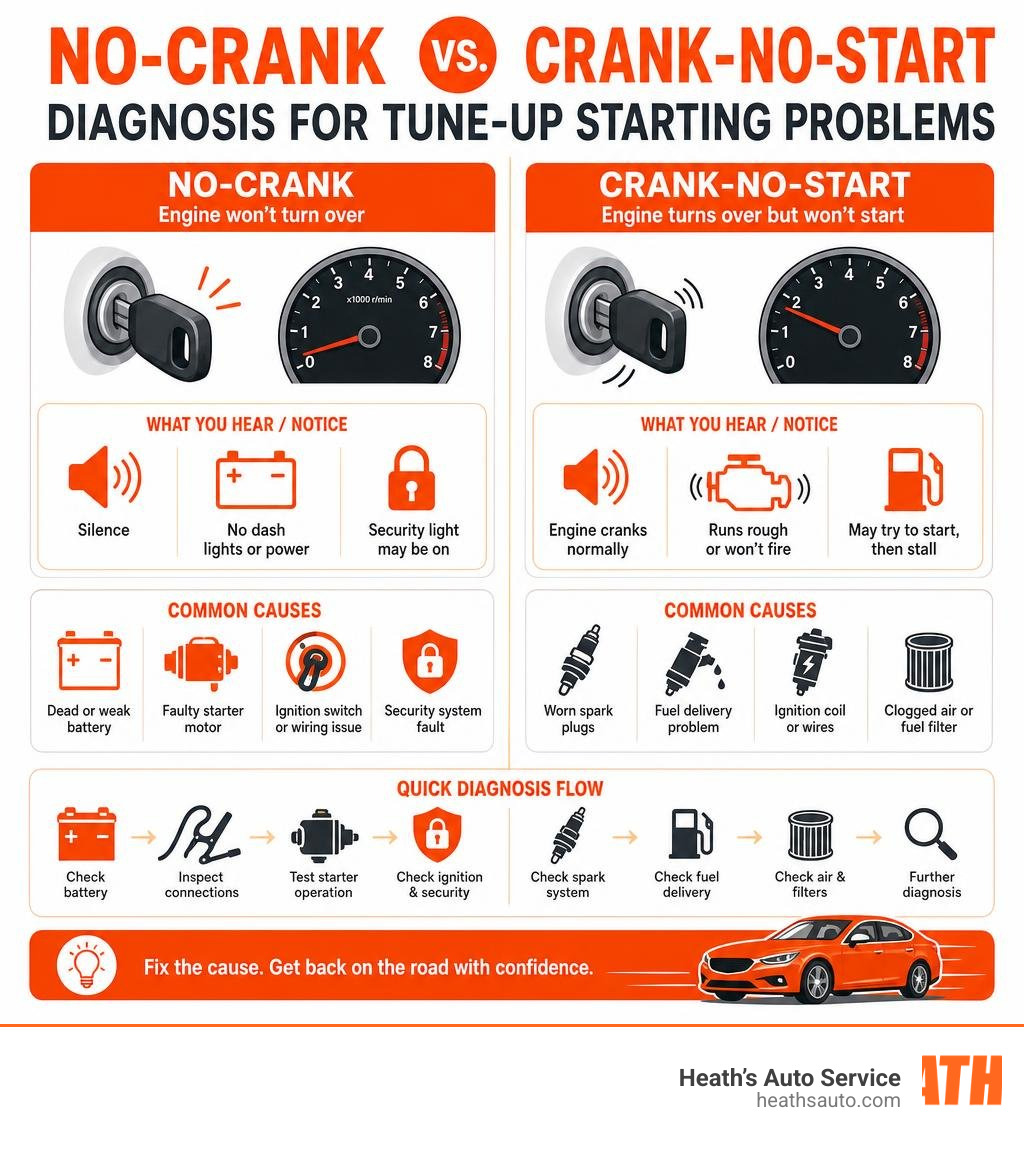
The difference between a car that cranks but won’t start and one that won’t crank at all matters a lot when diagnosing the problem. This guide walks you through both.
Recognizing the Signs of Tune-Up Starting Problems

Before your car completely refuses to start, it almost always leaves a trail of breadcrumbs. Ignoring these minor warnings is the most common reason drivers end up stuck in a parking lot on a hot Arizona afternoon. When we talk about tune-up starting problems, we are referring to the gradual degradation of ignition, fuel, and electrical components that eventually prevent your engine from firing up cleanly.
A vehicle that is overdue for maintenance will show clear warning signs. Recognizing these symptoms early can save you from the stress and expense of an emergency tow. If you are wondering whether your vehicle is approaching this critical window, it helps to understand How Often to Get a Tune Up to keep your engine running efficiently.
Common Symptoms That Your Vehicle Needs a Tune-Up
When ignition and fuel delivery systems begin to degrade, you will notice a distinct drop in overall performance. The most common symptoms include:
- Rough Idling: If your car shakes, vibrates, or feels like it is struggling to stay running while stopped at a red light in Scottsdale or Prescott, your air-to-fuel ratio or spark timing is off.
- Stalling: An engine that randomly cuts out while idling or when you come to a stop is a major safety hazard. This is often caused by badly worn spark plugs, a clogged fuel filter, or a failing sensor.
- Rough Acceleration and Engine Misfires: If you step on the gas and feel a jerk, hesitation, or a sudden loss of power, your engine is misfiring. This means the fuel in one or more cylinders is not igniting properly.
- Poor Fuel Economy: When spark plugs are fouled or the air filter is choked with dust, the engine has to work much harder and burn more fuel to produce the same amount of power.
- The Warning Lights: An illuminated dashboard indicator is your car’s way of asking for help. If this occurs, it is essential to know What To Do When Check Engine Light Comes On to prevent minor sensor glitches from turning into catastrophic engine failures.
Tune-Up Intervals: Older vs. Newer Vehicles
The definition of a “tune-up” has changed dramatically over the decades. Knowing what kind of system your vehicle uses is essential for setting the right maintenance schedule.
For older vehicles built before the mid-1990s, the ignition system relied on mechanical distributors, points, and carburetors. These components wear out quickly and require physical adjustment. For these classic cars, a tune-up is recommended every 10,000 to 12,000 miles or once a year, whichever comes first.
Modern vehicles, on the other hand, utilize highly advanced electronic ignition systems and direct fuel injection. These systems are managed by an onboard computer (the Powertrain Control Module, or PCM) that constantly adjusts timing and fuel delivery. Consequently, modern cars can easily go 25,000 to 100,000 miles before needing a major tune-up.
However, driving conditions in Arizona — such as extreme desert heat, dusty roads, and heavy stop-and-go traffic — accelerate the wear on these parts. To keep your budget in check, it is wise to research the average Car Tune Up Cost so you can plan your maintenance visits proactively.
The Core Culprits: Spark Plugs and the Ignition System
At the heart of your engine’s combustion process is the ignition system, and no component plays a more critical role in starting reliability than the spark plugs. Your engine requires three things to run: fuel, air, and a spark to ignite the mixture inside the combustion chamber. If the spark is weak, mistimed, or absent altogether, you will experience immediate starting issues.
When planning your vehicle’s maintenance budget, understanding the breakdown of Car Tune Up Costs 2025 can help you appreciate why replacing these small ignition components is such a smart, cost-effective investment.
How Spark Plugs Cause Tune-Up Starting Problems
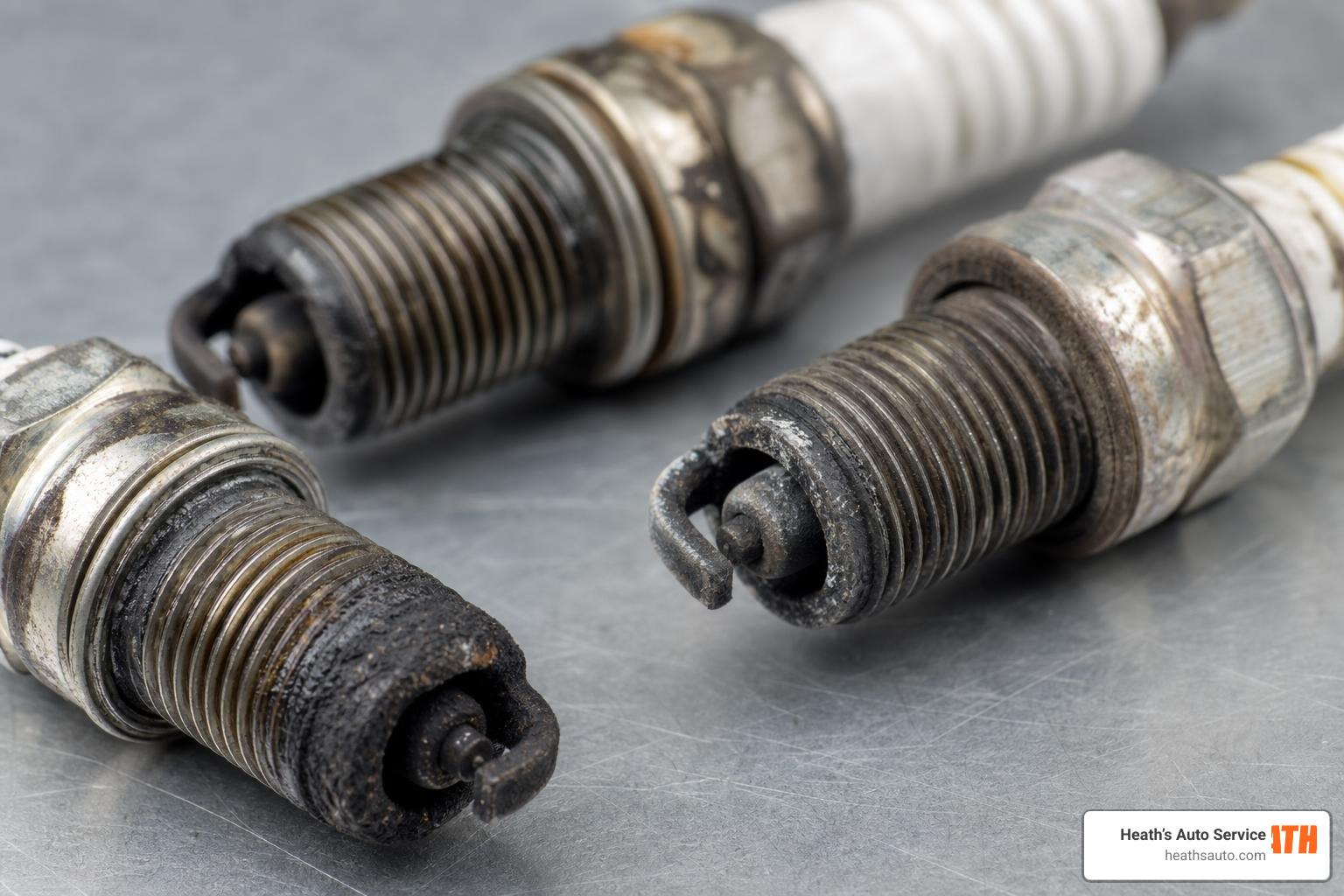
Each time your engine rotates, your spark plugs must produce a hot, precise spark to ignite the compressed fuel and air mixture. Over time, the extreme heat and pressure inside the combustion chamber erode the spark plug electrodes, widening the “gap” that the electrical spark must jump.
When this gap becomes too wide, or if the plug becomes fouled by carbon deposits, oil, or fuel, the ignition coils cannot generate enough voltage to create a spark. This leads to:
- Hard Starting: The engine must crank repeatedly before it finally catches and fires up.
- Engine Stalling: A weak spark can fail to keep the combustion cycle going, especially when the engine is cold or under load.
- Unburned Fuel Misfires: Raw fuel passes directly into the exhaust system, which can quickly destroy your expensive catalytic converter.
For a deeper look into how these ignition failures disrupt your vehicle’s starting cycle, you can check out this guide on Why Your Car Won’t Start and How to Fix It Fast — Ricks Free Auto Repair Advice Ricks Free Auto Repair Advice | Car Repair Tips and How-To Advice .
Environmental Impacts: Cold Weather, Ethanol, and Moisture
Arizona drivers have to deal with unique environmental factors that put extra stress on the starting system. Whether you are dealing with freezing winter mornings in Flagstaff or humid monsoon storms in Gilbert, the weather plays a massive role in starting reliability.
- Cold Weather Battery and Oil Strain: At 32°F, a standard car battery loses roughly 20% of its starting capacity. If the temperature drops to 0°F, that capacity is cut in half (operating at only 50%). Combine this with engine oil that thickens in the cold, and your starter motor has to work twice as hard to turn the engine over.
- Moisture in the Ignition System: On rainy or foggy mornings, moisture can condense on cracked ignition coils, distributor caps, or spark plug wires. Because electricity always takes the path of least resistance, this moisture causes the high-voltage current to short out to the engine block instead of reaching the spark plug, resulting in an intermittent no-start.
- Ethanol in Fuel: Modern gasoline blends often contain up to 10% or 15% ethanol. Ethanol is hygroscopic, meaning it actively absorbs moisture from the air. If your car sits unused, this water-fuel mixture can separate, leading to fuel line freeze-up in mountain towns like Flagstaff, or clogged fuel injectors in desert climates.
For more troubleshooting tips on environmental starting issues, refer to the Car Won’t Start? Troubleshooting Tips & Roadside Help Guide | GEICO .
Battery, Alternator, and Starter Motor Failures
When you turn your key or press the engine start button, a complex chain reaction of electrical components must occur instantly. If any link in this chain fails, you will be met with silence, clicking, or a painfully slow cranking sound. Understanding where your starting problem lies requires separating the battery, the alternator, and the starter motor.
If your vehicle exhibits a complete loss of electrical power — such as no dashboard lights, no radio, and no starting noise — you may be dealing with a severed main connection or a completely drained battery. In these situations, reading about Car Has No Power at All Causes Solutions will help you track down the source of the total blackout.
Cranking vs. No-Cranking Starting Issues
The easiest way to narrow down a starting issue is to listen closely to what happens when you try to start the car:
- No Cranking (Silence or a Single Click): If you turn the key and hear absolutely nothing, or if you hear a single, solid “clunk” or click, the starting system is not physically turning the engine. This is usually caused by a completely dead battery, a faulty ignition switch, a bad neutral safety switch, or a failed starter motor solenoid. If you suspect the starter is the culprit, check out Car Wont Start It Could Be Your Starter to learn how starter solenoids fail.
- Rapid Clicking (Click-Click-Click): This is the classic sound of a weak battery. The battery has just enough voltage to push the starter solenoid forward, but as soon as the starter motor tries to draw heavy current to spin the engine, the battery’s voltage collapses, causing the solenoid to snap back. This cycle repeats rapidly, creating the clicking noise.
- Normal Cranking but Engine Won’t Fire: If the engine spins rapidly and sounds completely normal, but simply refuses to catch and run, your starting electrical system is working fine. The problem lies downstream in the fuel delivery system, the spark plugs, or an engine sensor.
The Role of the Alternator and Battery
The battery and the alternator work as a team, but they have completely different jobs:
- The Battery: Its sole purpose is to provide a massive burst of electrical current to start the engine and power accessories when the vehicle is turned off. Most car batteries have a lifespan of 3 to 5 years. In hot climates like Scottsdale and Chandler, battery life is often closer to 3 years because intense heat accelerates internal plate corrosion and fluid evaporation.
- The Alternator: Once the engine is running, the alternator takes over. It acts as a generator, supplying electrical power to run your headlights, air conditioning, and computer systems, while simultaneously recharging the battery for the next start.
If your alternator is failing, it won’t charge the battery while you drive. You might notice your headlights dimming at stoplights, or a battery warning light illuminating on your dashboard. If you continue to drive, the engine will eventually die as the battery drains completely. To help you differentiate between these failures, we recommend reading up on the Signs of a Faulty Starter so you don’t accidentally buy a new battery when your starter or alternator was the true culprit.
Fuel System and Electrical Switch Complications
Sometimes, starting problems have nothing to do with spark plugs or batteries. If your engine is cranking beautifully but refuses to fire up, or if the starting circuit seems completely disconnected from your ignition key, the issue likely lies within your fuel delivery system or electrical safety switches.
To help you quickly identify where your starting issue is coming from, we have compiled a quick symptom comparison table below:
| Component | Primary Starting Symptom | Key Diagnostic Clue |
|---|---|---|
| Fuel Pump | Cranks normally but will not fire | No humming sound from fuel tank when key is turned to “ON” |
| Fuel Filter | Hard starting, sputtering, stalls under load | Engine starts briefly then dies; poor acceleration |
| Ignition Switch | No cranking, dead dashboard accessories | Lights don’t turn on in “Accessory” mode; intermittent power loss |
| Neutral Safety Switch | No cranking, complete silence | Engine will start in “Neutral” but not in “Park” |
If your car recently suffered from an engine temperature issue before refusing to start, the problem might be more severe. In those cases, you should read about what happens when a Car Wont Start After Overheating to rule out internal engine damage like a blown head gasket.
Fuel Delivery Failures: Pumps, Filters, and Stale Gas
If your engine cannot get fuel, it cannot start. The fuel system must deliver highly pressurized fuel directly to the cylinders. Any interruption in this path will prevent combustion:
- Clogged Fuel Filter: Over time, the fuel filter traps dirt, rust, and debris from the gas tank. If it becomes completely choked, it will restrict fuel flow, leading to extended cranking times or stalling immediately after starting.
- Failing Fuel Pump: The electric fuel pump sits inside your gas tank and pushes fuel forward. When you turn your ignition key to the “ON” position (just before cranking), you should hear a faint, two-second humming sound from the back seat. If you hear silence, your fuel pump or its electrical relay has likely failed.
- Stale Gas: If you have a vehicle or outdoor power equipment that has been sitting idle, keep in mind that stale, untreated gas begins to break down and lose its volatility after about a month. This degraded fuel can gum up fuel injectors and carburetors, making starting nearly impossible.
For a deeper dive into fuel-related starting failures, you can read this diagnostic breakdown on How To Solve Car Engine Not Starting Problem 2026 Fix .
Electrical Switches and Security Systems
Modern vehicles are equipped with several electrical safety switches designed to prevent the vehicle from starting under unsafe conditions. However, when these switches fail, they can trick you into thinking you have a dead battery or starter:
- Neutral Safety Switch: This switch ensures your automatic transmission vehicle only starts when it is in “Park” or “Neutral.” If the switch wears out, it won’t recognize that the car is safely in gear, resulting in a complete no-crank condition. A quick trick is to try shifting into “Neutral” and turning the key; if it starts, your neutral safety switch is failing.
- Immobilizer and Security Systems: Modern car keys contain a tiny transponder chip that communicates with the vehicle’s computer. If the vehicle doesn’t recognize the signal from your key fob — often due to a dead key fob battery — the security system will disable the fuel injectors or the starter circuit. You will usually see a flashing “key” or “security” light on your dashboard.
- Ignition Switch: The physical switch behind your key cylinder can wear out internally. If the electrical contacts degrade, turning the key won’t send the necessary “start” signal to the starter relay, even if your dashboard lights up.
To map out these intermittent electrical issues and determine if a security glitch is leaving you stranded, check out the Intermittent No-Start Symptom Map: Battery vs Starter vs Alternator vs Security | Drive Sense .
How to Diagnose and Resolve Engine Starting Issues
When your car refuses to start, you don’t have to guess which part to replace. By following a structured, step-by-step diagnostic process, you can pinpoint the exact failure point.
The first step in any modern vehicle diagnosis is checking for stored diagnostic trouble codes (DTCs). Even if your check engine light isn’t currently illuminated, the computer may have stored “pending” codes that point directly to a misfiring cylinder, a bad sensor, or a security fault. Our Decoding the Check Engine Light Master Auto Diagnostics Guide is an excellent resource for learning how to read these codes.
Resolving Tune-Up Starting Problems: A Step-by-Step Diagnostic Guide
Before you run out to buy a new starter or battery, perform these quick, simple tests in your driveway:
- The Headlight Test: Turn on your headlights and try to start the car. If the lights stay bright but the engine doesn’t crank, your battery is likely fine, and the issue is in the starter motor, ignition switch, or safety switches. If the headlights dim drastically or go completely dark when you turn the key, your battery is flat or has a bad connection.
- Inspect and Clean Battery Terminals: Open the hood and look at your battery. If you see a crusty white, green, or blue powder around the terminals, that is corrosion. This buildup acts as an insulator, preventing electrical current from reaching your starter. Clean the terminals using a wire brush and a mixture of baking soda and water, then tighten the connections.
- Perform a Multimeter Voltage Check: A healthy, fully charged car battery should read between 12.6 and 12.8 volts when the engine is off. If your multimeter reads below 12.2 volts, the battery is discharged. Have a helper crank the engine while you watch the meter; if the voltage drops below 9.6 volts during cranking, the battery is failing and needs replacement.
- Listen for the Fuel Pump: Turn your key to the “ON” position without cranking the engine. Listen closely for a brief hum from the fuel tank area. If you hear it, your fuel pump is priming. If there is silence, check the fuel pump fuse and relay.
For a comprehensive breakdown of these tests, you can consult this guide on Car Won’t Start: Battery, Starter, or Alternator? | Alles Car Parts .
When to Seek Professional Help
While cleaning battery terminals and checking fuses are great DIY projects, some starting problems require professional diagnostic tools and expertise. You should stop troubleshooting and call an ASE-certified technician if you experience any of the following:
- A Burning Smell: If you smell burning plastic, electrical wiring, or hot metal while trying to start your car, stop immediately. This indicates a severe short circuit or an overheated starter motor that could lead to an engine fire.
- Metal Grinding Noises: A harsh grinding noise during cranking means the starter motor’s drive gear is not engaging properly with the engine’s flywheel. Continued cranking will strip the teeth off your flywheel, leading to an incredibly expensive repair.
- Repeated Blown Fuses: If you replace a starter or ignition fuse and it immediately blows again the moment you try to start the car, you have a direct short to ground that requires professional circuit testing.
- Unresolved Crank-No-Start: If your engine cranks perfectly, has plenty of fuel, but simply won’t start, the issue could be a broken timing belt, a failed crankshaft position sensor, or loss of engine compression.
Ignoring these complex issues can lead to permanent damage. To understand the risks of driving a vehicle with unresolved starting or running issues, read our guide on What Causes Engine Failure to protect your investment.
Frequently Asked Questions about Starting Issues
Why does my car click rapidly but won’t start?
A rapid clicking sound indicates that your battery has enough voltage to engage the starter solenoid, but lacks the amperage (cranking power) to spin the starter motor itself. When the starter tries to draw power, the battery’s voltage collapses, causing the solenoid to release. This cycle repeats rapidly, creating the clicking sound. The most common causes are a weak or discharged battery, loose or corroded battery terminals, or a bad ground connection.
Can a bad spark plug prevent my car from starting?
Yes. If your spark plugs are severely worn, fouled by carbon or oil, or wet with excess fuel (a flooded engine), they will not be able to ignite the air-and-fuel mixture in the combustion chamber. While a single bad spark plug will usually cause a rough idle or a misfire, a complete set of worn or fouled spark plugs can absolutely prevent your engine from starting, especially in cold weather or high humidity.
How often should I get a tune-up to prevent starting problems?
For modern vehicles with electronic ignition and fuel injection, we recommend a comprehensive tune-up inspection every 30,000 to 100,000 miles, depending on your manufacturer’s guidelines. However, because of the extreme desert heat and dusty conditions across Arizona, it is wise to have your spark plugs, battery, and filters inspected annually. Regular preventive maintenance is the single best way to ensure starting reliability and extend the life of your vehicle.
Conclusion
Preventing tune-up starting problems is always easier — and much less expensive — than dealing with an unexpected breakdown on the side of the road. By staying on top of your spark plugs, battery health, and fuel system maintenance, you can enjoy absolute confidence every time you turn your key.
Heath’s Auto Service In Scottsdale, AZ
At Heath’s Auto Service, we offer a comprehensive range of services and repairs to meet all your automotive needs. Our highly skilled technicians are equipped with the latest tools and technology to ensure your vehicle is serviced to the highest standards. Contact our team today!
We stand behind our work with an industry-leading 3-year/36,000-mile nationwide warranty, offer same-day service, and are always happy to provide free second opinions.