
When Your Car’s AC Fails in Arizona Heat, Here’s What to Do
If you need car air conditioner repair near me, here’s a quick answer before we dive into the details:
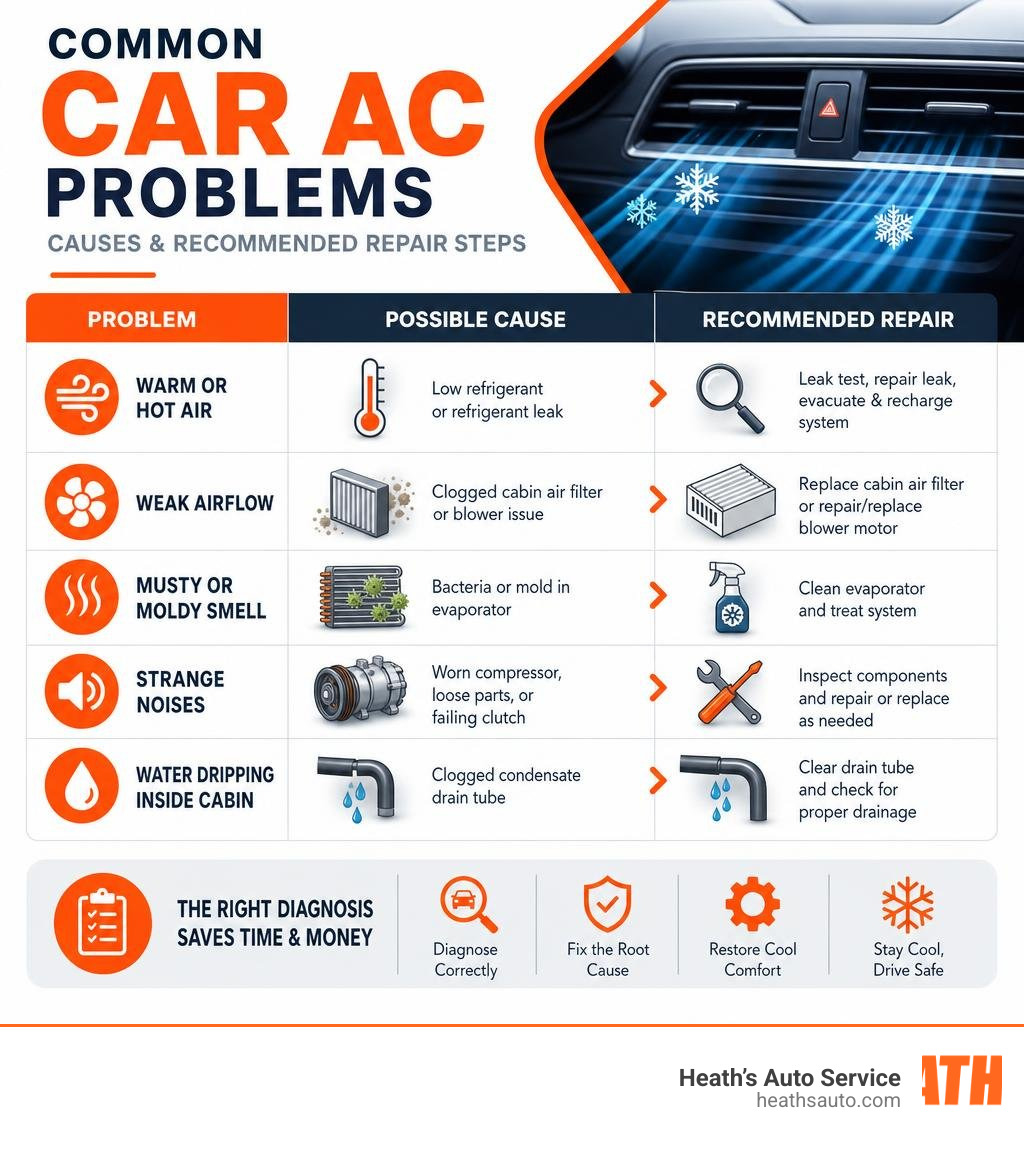
Top signs you need AC repair:
- Warm or hot air blowing from vents
- Weak airflow even on the highest fan setting
- Musty or moldy smell when the AC runs
- Strange noises when the AC is on
- Water dripping inside the cabin
What to do next:
- Stop repeatedly recharging the system — low refrigerant almost always means a leak
- Book a diagnostic with a certified local technician
- Get a written estimate before approving any repairs
- Ask about warranty coverage on parts and labor
A broken car AC is more than an inconvenience in Arizona. With summer highs regularly hitting 104–106°F, a failing AC system can make driving genuinely unsafe — especially for children, older passengers, or anyone on a long commute.
Most AC problems share the same symptom: warm air from the vents. But the causes range from a simple refrigerant recharge to a failed compressor or an electrical fault. Getting the right diagnosis matters — a lot. Skipping that step usually means paying twice.
Car air conditioner repair near me vocabulary:
Common Signs Your Car’s Air Conditioning Needs Professional Attention

When you turn on your climate control, you expect an instant blast of refreshing, arctic air. But automotive AC systems are highly complex, sealed systems that live in a harsh environment. Between the extreme temperatures of the Arizona desert and the constant vibrations of the road, components wear out, hoses crack, and seals eventually fail.
Recognizing the early warning signs of system failure can save you from a sweaty commute and protect your wallet from major component damage. If you ignore minor symptoms, a small leak can quickly spiral into a seized compressor. Keep an eye (and nose) out for these warning signs your car’s AC is dying:
- Weak Airflow: You turn the fan speed to maximum, but the breeze coming out of the dashboard vents feels more like a tired sigh than a gust of wind.
- Warm Air: The blower motor works fine, but the air coming out is the same temperature as the desert air outside—or worse, it feels like your heater is running.
- Foul Odors: A musty, moldy, or outright locker-room-like smell wafts through the cabin the second you turn on the AC.
- Strange Noises: You hear squealing, rattling, or a loud metallic grinding noise whenever the AC clutch engages under the hood.
- Water Leaks: Finding water dripping under your car on a humid day is completely normal (that’s just the evaporator doing its job to dehumidify the air). However, if you find damp carpets or water pooling in the passenger footwell, you have a problem.
Why Your Car AC is Blowing Hot Air
Few things are more frustrating than expecting a blast of cold air and getting a face full of desert heat instead. If you find yourself in this situation, you are likely dealing with one of three primary culprits.
First is low refrigerant. Because your car’s air conditioning is a completely sealed system, it should never lose refrigerant under normal operating conditions. If the level is low, you have a leak.
Second is compressor failure. The compressor is the heart of the system; if it cannot pump and pressurize the refrigerant, heat transfer stops completely.
Finally, electrical issues—such as a blown fuse, a bad relay, or a faulty climate control module—can prevent the compressor clutch from engaging. For a deeper look at these issues, check out our guide on how to fix a car AC blowing hot air.
Weak Airflow and Strange Odors
If your system blows cold but cannot seem to push the air out, the issue usually points to a clogged cabin air filter or a failing blower motor. Your cabin air filter catches dust, pollen, and road debris. In dusty Arizona environments, these filters can clog rapidly, choking off your system’s airflow and straining the blower motor.
When it comes to those unpleasant odors, the culprit is almost always mold or mildew growth on the evaporator core. Because the evaporator is dark, cold, and wet, it serves as the perfect breeding ground for bacteria. A clogged condensate drain line can trap water inside the evaporator housing, accelerating this growth and eventually causing water to leak directly into your passenger cabin.
Finding the Best Car Air Conditioner Repair Near Me

When your climate control fails, your immediate instinct is to search for car air conditioner repair near me on your phone. However, not all auto repair shops are equipped to handle modern automotive climate systems. You need a team that utilizes advanced diagnostic equipment, understands the nuances of different refrigerants, and employs ASE-certified technicians who can pinpoint the root cause of the issue rather than just throwing parts at it.
Why Choose Professional Car Air Conditioner Repair Near Me
Modern automotive AC systems are incredibly sensitive. They rely on precise pressures, exact oil quantities, and specific refrigerant weights to function efficiently. Choosing a professional shop ensures your vehicle is serviced using commercial-grade recovery and recharge machines that measure refrigerant down to the tenth of an ounce.
To understand why professional service is so critical, it helps to learn about the 5 parts of a car AC system:
- The Compressor: Pressurizes and circulates the refrigerant.
- The Condenser: Sits at the front of your car, radiating heat away from the hot refrigerant gas to turn it into a high-pressure liquid.
- The Receiver-Drier or Accumulator: Filters out debris and absorbs moisture to protect internal components from corrosion.
- The Expansion Valve or Orifice Tube: Regulates the flow of refrigerant into the evaporator.
- The Evaporator: Located behind your dashboard, absorbing heat from your cabin air to blow cold air through your vents.
Because these components work in perfect harmony, a failure in one can quickly destroy the others. A professional technician will perform a comprehensive system diagnostic to ensure your entire system is healthy.
The Danger of DIY Recharges vs. Professional Leak Repair
It is incredibly tempting to walk into an auto parts store, grab a cheap DIY recharge can, and hook it up to your car’s low-pressure port. However, this is one of the most dangerous things you can do to your vehicle’s air conditioner.
First, does Arizona heat cause wear on car air conditioning? Absolutely. The extreme operating temperatures put incredible pressure on hoses and seals, which leads to signs your Freon is low. But simply adding more refrigerant from a can does not fix the underlying leak.
Furthermore, DIY cans often contain “stop-leak” additives. These chemical sealants are designed to harden when they encounter moisture. While they might temporarily plug a tiny hole in a rubber hose, they also harden inside your expansion valve, clog your condenser, and gum up the internal valves of your compressor, turning a simple leak repair into an incredibly expensive system replacement.
Moreover, without professional gauges, it is incredibly easy to overcharge the system. An overcharged system creates excessive pressure that can destroy your compressor clutch or cause a catastrophic hose blowout. Professional shops use electronic leak detectors (“sniffers”) and specialized UV dye to locate and repair the leak permanently, preserving system integrity and protecting the environment from escaping greenhouse gases. For additional context on refrigerant handling and environmental impact, the U.S. Environmental Protection Agency explains motor vehicle air conditioning regulations for service and refrigerant recovery.
What to Expect During a Professional AC Service and Repair
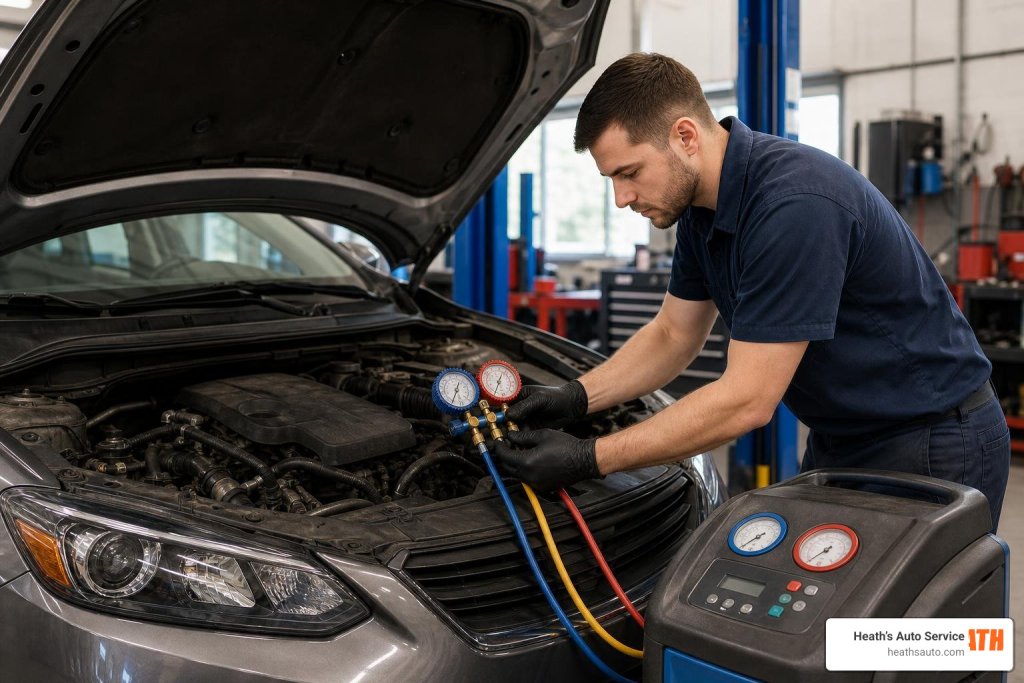
When you bring your vehicle to a reputable shop for car air conditioner repair near me, the process should always begin with an initial inspection and pressure test. Technicians connect a manifold gauge set to both the high-pressure and low-pressure sides of your system to observe how the pressures behave while the system is running.
Here is a breakdown of what a professional AC service includes compared to a basic recharge:
| Service Feature | Professional AC Recharge | Professional AC Repair |
|---|---|---|
| Primary Goal | Restore the correct level of refrigerant | Fix broken components and seal leaks |
| System Diagnostics | Basic pressure check | Full electrical, mechanical, and pressure diagnostic |
| Leak Detection | Visual inspection of accessible lines | UV dye testing, electronic sniffer, and vacuum hold test |
| Moisture Removal | System evacuation (pulling a vacuum) | Required whenever the system is opened for repairs |
| Component Replacement | None | Replacement of faulty compressor, condenser, evaporator, etc. |
| Warranty | Typically covers the recharge process | Comprehensive warranty on replaced parts and labor |
How Technicians Diagnose and Fix AC Compressor Issues
The compressor is the heart of your vehicle’s climate control. If your technician suspects a compressor issue, they will first test the compressor clutch to see if it is engaging electrically. They may also use a multimeter to check the electrical connector for proper voltage. If you want to dive deeper into the technical side, you can read our guide on how to tell if your car AC compressor is bad.
If a compressor fails internally, it often sheds tiny metallic particles throughout the entire system. If a technician simply bolts on a new compressor without flushing the system, those metal shavings will travel straight into the new unit and destroy it within minutes. A professional repair always involves flushing the condenser and evaporator, replacing the expansion valve or orifice tube, and installing a brand-new receiver-drier or accumulator to keep the system clean and dry.
Understanding Car AC Repair Costs in 2026
The cost of your repair depends heavily on the type of refrigerant your vehicle uses, the specific components that need replacement, and local labor rates.
Vehicles manufactured before 2016 primarily use R134a refrigerant, which is relatively inexpensive. However, most newer vehicles utilize R1234yf, an environmentally friendly refrigerant mandated by federal regulations. R1234yf requires specialized servicing equipment and costs significantly more per ounce, which impacts the total cost of a recharge.
For an accurate breakdown of what to expect to pay this year, check out our comprehensive analysis of car AC repair costs in 2026. Getting a professional diagnostic up front prevents you from wasting money on parts you don’t actually need.
Frequently Asked Questions About Auto AC Service
How often should my car’s AC be serviced?
While your engine oil needs to be changed every few thousand miles, your air conditioning is a sealed system that doesn’t require “fluid changes” in the traditional sense. However, most manufacturers recommend having your auto air conditioning service checked at least once a year, preferably in the spring before the summer heat hits.
A standard preventative maintenance check involves testing the system’s pressures, measuring the vent output temperature, and replacing the cabin air filter.
How do I select a reliable car air conditioner repair near me?
When searching for a trustworthy shop, look for businesses that employ ASE-certified technicians and offer a robust warranty on their work. A reliable shop will always provide a transparent, written estimate before starting any repairs and will gladly show you the failed parts.
Why is my car AC blowing cold only while driving?
If your air conditioning blows ice-cold when you are cruising down the highway but turns warm the moment you stop at a red light, you are likely dealing with an airflow issue across the condenser.
The condenser needs a constant stream of air to transfer heat out of the refrigerant. When the vehicle is moving, ram air does this naturally. But when you are idling, the system relies entirely on your radiator cooling fans. If a fan motor is failing, or if your condenser is blocked by road debris, leaves, or dirt, the refrigerant cannot cool down, causing the system pressures to spike and the AC to blow warm.
Conclusion
Don’t let a broken air conditioner turn your vehicle into an oven on wheels. Driving in the Arizona heat without a functioning climate control system isn’t just miserable—it can be downright dangerous.
Heath’s Auto Service In Chandler, AZ
At Heath’s Auto Service, our comprehensive range of services covers everything from routine maintenance to complex repairs. Our certified technicians are skilled in handling oil changes, brake inspections, engine diagnostics, tire rotations, and much more. Whether it’s a minor tune-up or a major overhaul, trust us to get you back on the road with confidence. Contact our team at Heath’s Auto Service today!
We stand behind our work with an industry-leading 3-year/36,000-mile nationwide warranty, offer same-day service to get you back on the road quickly, and provide free second opinions so you can make your repair decisions with complete confidence.