
What It Really Costs to Change a Catalytic Converter (And What Arizona Drivers Need to Know)
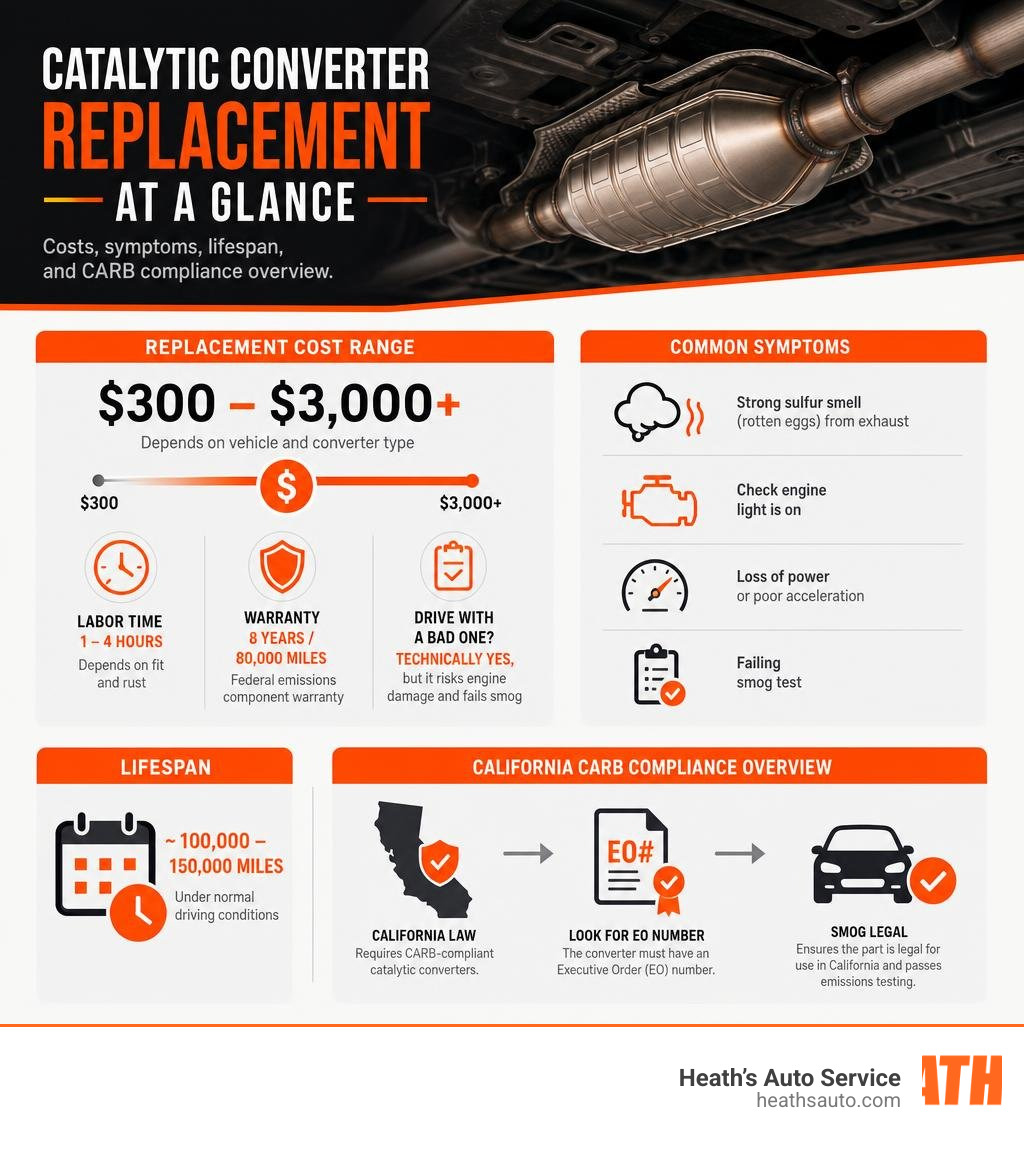
If you need to change a catalytic converter, here’s the short answer:
| Factor | Details |
|---|---|
| Average cost | $300 – $3,000+ depending on vehicle and converter type |
| Labor time | 1–4 hours depending on fit and rust |
| Lifespan | ~100,000–150,000 miles under normal conditions |
| Can you drive with a bad one? | Technically yes, but it risks engine damage and fails smog |
| Federal warranty | 8 years / 80,000 miles on emissions components |
| In California | Must use a CARB-compliant converter with an EO number |
Your catalytic converter is one of those parts you probably never think about — until it fails. And when it does, it makes itself known fast. The most common warning sign is a sharp sulfur smell, like rotten eggs, coming from your exhaust. Other times, your check engine light comes on, your car loses power, or you fail a smog test and don’t know why.
For Arizona drivers, an unexpected repair quote for $1,200 or more can feel like a gut punch — especially when you’re not sure if the diagnosis is even right.
This guide breaks down everything you need to know: what causes converter failure, how much replacement actually costs, what’s legal in your state, and how to avoid overpaying.
At Heath’s Auto Service, after years of helping Arizona drivers navigate exhaust system repairs — including hundreds of jobs to change catalytic converter units across all makes and models — our team has seen every variation of this repair done right and done wrong. Let’s make sure yours gets done right.
Why Catalytic Converters Fail and How to Diagnose Them
To understand why it costs what it does to change a catalytic converter, it helps to know what this component actually does. Tucked underneath your car as part of the exhaust system, the catalytic converter is a metal canister containing a ceramic honeycomb structure. This honeycomb is coated with precious metals: platinum, palladium, and rhodium.
As raw engine exhaust passes through, these metals act as catalysts, triggering a chemical reaction that converts highly toxic gases—like carbon monoxide, nitrogen oxides, and unburnt hydrocarbons—into harmless water vapor, carbon dioxide, and nitrogen. Because those precious metals are incredibly rare and currently trade at prices that sometimes rival or exceed gold per ounce, the raw material cost of a new converter is naturally high.
However, catalytic converters are incredibly durable. They are designed to last between 100,000 and 150,000 miles. In fact, they rarely fail on their own. When a converter dies prematurely, it is almost always the victim of an upstream engine problem.
The most common killers of catalytic converters include:
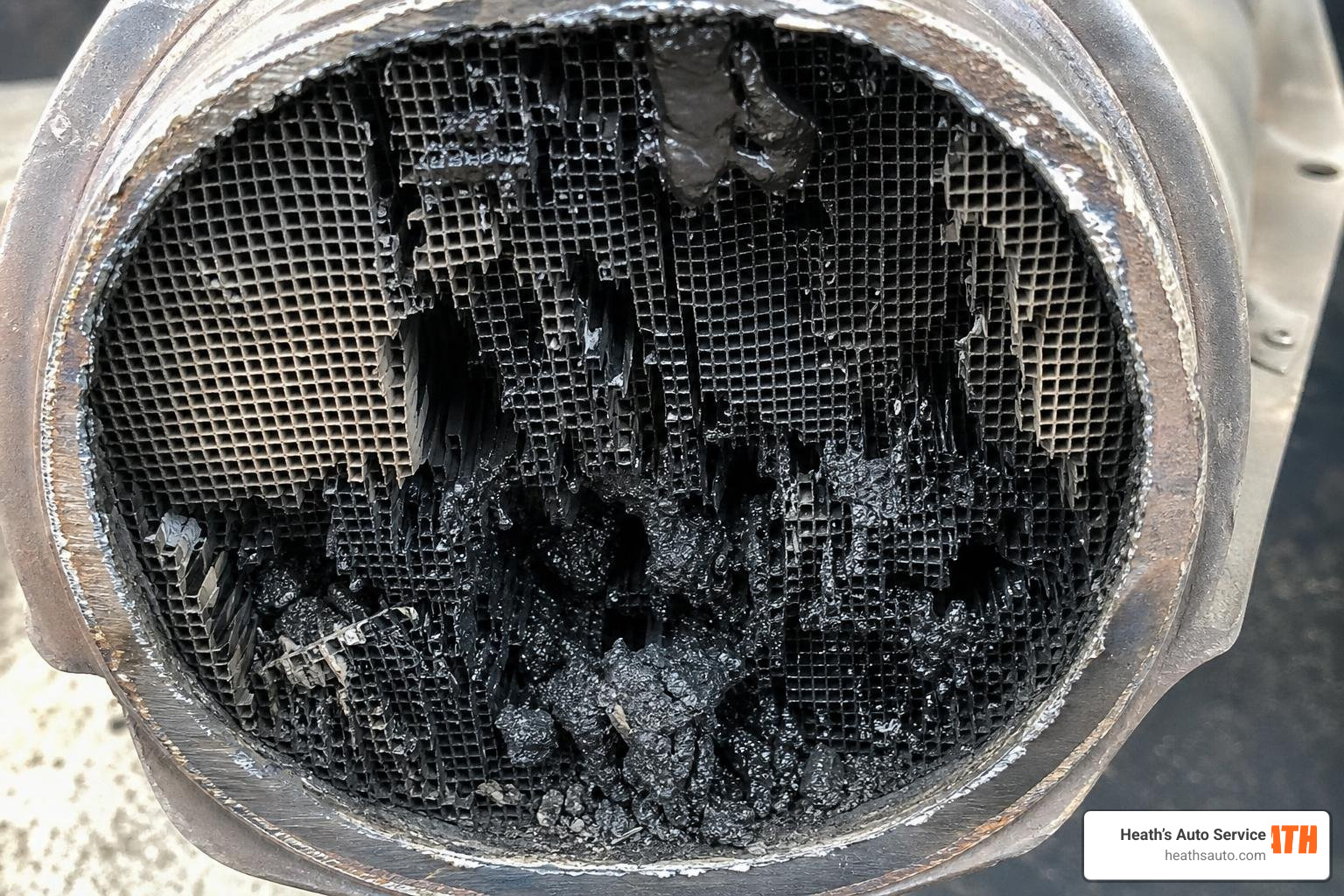
- Engine Misfires: When a spark plug or ignition coil fails, unburnt fuel escapes the combustion chamber and travels down the exhaust line. This raw fuel ignites inside the super-hot converter, melting the internal ceramic honeycomb structure.
- Oil or Coolant Contamination: Internal engine leaks, such as blown head gaskets, failing valve guide seals, or worn piston rings, allow engine oil or coolant to enter the combustion chamber. As these fluids burn, they leave behind chemical deposits that coat the precious metals inside the converter, “poisoning” it and preventing the necessary chemical reactions from occurring.
- Physical Damage: Because the converter is located underneath the vehicle, road debris, speed bumps, or off-road driving can dent the casing or crack the fragile ceramic interior.
Common Symptoms of a Failing Unit
When your vehicle’s converter begins to degrade, it leaves a trail of obvious clues. Here are the most frequent signs of a failing catalytic converter that you should watch out for:
- The Rotten Egg Smell: This is the classic symptom. When a converter fails, it can no longer properly process hydrogen sulfide in your exhaust, releasing a noxious sulfur smell that smells exactly like rotten eggs.
- Reduced Acceleration and Poor Engine Performance: If the ceramic honeycomb inside the converter melts or becomes clogged with carbon soot, it creates an exhaust bottleneck. This restriction prevents your engine from “breathing” out, leading to sluggish acceleration, poor throttle response, and a noticeable drop in fuel economy.
- An Illuminated Check Engine Light: Modern vehicles use downstream oxygen sensors to constantly monitor the efficiency of the converter. If the chemical conversion rate drops below a certain threshold, the computer will trigger the check engine light.
- Rattling Noises: If the internal ceramic honeycomb has fractured due to physical impact or thermal shock, you will likely hear a distinct metallic rattling sound from underneath your car, especially when idling or accelerating.
Diagnosing the Issue vs. O2 Sensors
Before you jump straight to replacing the converter, it is absolutely vital to get a professional diagnosis. At Heath’s Auto Service, we see many vehicles come in where another shop recommended a new converter, but the actual issue was a simple, inexpensive oxygen (O2) sensor or a minor exhaust leak.
When your check engine light illuminates, the onboard computer often stores a P0420 diagnostic trouble code (Catalyst System Efficiency Below Threshold). While this code can mean your converter is bad, it can also be triggered by:
- A lazy or completely failed oxygen sensor that is sending incorrect data to the engine computer.
- A small exhaust leak upstream of the converter, which draws extra oxygen into the exhaust stream and tricks the downstream O2 sensor.
- An engine running slightly out of fuel control (too rich or too lean).
Our ASE-certified technicians use professional diagnostic tools to analyze live data, checking if the front O2 sensor is switching rapidly and ensuring the rear O2 sensor is reading a steady, healthy voltage (typically between 650mV and 850mV). If you ever experience a flashing check engine light, this indicates an active, severe engine misfire that is dumping raw fuel into your exhaust. Pull over immediately to prevent destroying your converter in a matter of minutes!
When and How to Change Catalytic Converter Units
When a professional diagnosis confirms that the converter is indeed dead, it is time to plan the replacement. Depending on your vehicle’s design, the converter may be integrated directly into the exhaust manifold (bolted directly to the engine cylinder head) or it may be located further down the exhaust pipe under the cabin.

To ensure a successful repair that lasts, we follow a rigorous step-by-step installation guide. This process includes verifying that any underlying engine misfires, oil leaks, or coolant consumption issues are fully repaired before the new unit is bolted up. If you install a brand-new converter on an engine that is still burning oil or misfiring, the new unit will likely fail within a few thousand miles, and that failure will not be covered by the manufacturer’s warranty.
How Long Does It Take to Change Catalytic Converter Parts?
The exact labor time required to change catalytic converter components depends heavily on your vehicle’s make, model, and the style of the replacement part.
When planning your schedule, you can look at our installation time expectations to get a clearer picture:
- Direct-Fit Bolt-On Converters: These are pre-fabricated to match your vehicle’s exact exhaust geometry. If the bolts are accessible and not heavily rusted, a professional technician can typically complete this job in 1 to 2 hours.
- Universal-Fit Weld-In Converters: These require the technician to physically cut out the old converter from the exhaust pipe, align the new universal unit, and weld it securely into place. This process is more labor-intensive and usually takes 2 to 3 hours.
- Manifold-Integrated Converters: If your vehicle has a converter integrated into the exhaust manifold (common on many modern four-cylinder engines and V6/V8 models), the technician must remove heat shields, oxygen sensors, and potentially other engine bay components. This complex job can easily take 3 to 4+ hours.
Can You Change Catalytic Converter Components Yourself?
For the adventurous home mechanic, a DIY replacement might seem like a great way to save on labor costs. However, exhaust work is notorious for being physically demanding and highly frustrating.
Under-car components are constantly exposed to extreme heat cycles, road salt, and moisture, which leads to severe rust and corrosion. If you want to see what the process looks like in a real driveway, you can watch this DIY catalytic converter tutorial.
If you decide to tackle this yourself, keep these tips in mind:
- Soak Everything in Penetrating Oil: Spray all exhaust flange bolts with a high-quality penetrating oil several hours (or even a full day) before you start.
- Prepare for Rusted Studs: Exhaust studs frequently snap during removal. You will need a plan (and tools like a torch or extractor) to deal with broken hardware.
- Use Anti-Seize: Always apply high-temperature anti-seize compound to the threads of any new bolts and oxygen sensors to make future service easier.
- Never Use a Used Converter: It is actually a violation of federal law to install a used, untested catalytic converter sourced from a salvage yard or private seller.
Protecting Your Vehicle Against Theft
Because of the skyrocketing value of platinum, palladium, and rhodium, catalytic converter theft has become a massive headache for drivers. A skilled thief equipped with a portable battery-powered reciprocating saw can slide under a high-clearance vehicle and cut out a converter in less than 60 seconds.
If you walk out to your car, start it, and hear a deafening, tractor-like roar, you are likely experiencing the immediate problems after catalytic converter theft.
To protect your vehicle, consider the following preventative measures:
- Install a Protective Shield or Cage: Metal plates (often called “cat shields”) or steel cable cages can be bolted over the converter, making it incredibly difficult and time-consuming for a thief to cut through.
- Engrave Your VIN: Etching your vehicle identification number (VIN) or license plate number directly onto the metal casing of the converter can deter scrap dealers from purchasing it.
- Calibrate Your Car Alarm: Adjust your vehicle’s security system so that the alarm triggers upon detecting physical vibrations or tilting.
- Park Strategically: Whenever possible, park in a locked garage, a well-lit area, or close to walls and fences to restrict physical access underneath your vehicle. For more detailed protection strategies, check out the BAR catalytic converter theft guide.
Catalytic Converter Replacement Cost and Legal Compliance
When it comes to pricing, there is no one-size-fits-all number. The total cost to change catalytic converter components is driven by several distinct factors: the vehicle make and model, engine displacement, whether the part is an OEM (Original Equipment Manufacturer) or aftermarket unit, and regional emissions compliance laws.
Here is a general cost breakdown based on vehicle categories:
| Vehicle Type | Estimated Parts Cost | Estimated Labor Cost | Total Estimated Cost |
|---|---|---|---|
| Compact/Economy Cars | $300 – $800 | $100 – $250 | $400 – $1,050 |
| Mid-Size SUVs & Sedans | $600 – $1,200 | $150 – $350 | $750 – $1,550 |
| Full-Size Trucks & Large SUVs | $900 – $2,000 | $200 – $500 | $1,100 – $2,500 |
| Hybrid Vehicles (e.g., Toyota Prius) | $1,000 – $2,500 | $200 – $400 | $1,200 – $2,900 |
| Luxury & Performance Vehicles | $1,500 – $3,000+ | $300 – $600 | $1,800 – $3,600+ |
Why CARB-Compliant Converters Cost More
If you are researching parts online, you will quickly notice a massive price difference between “Federal/EPA” converters and “CARB-compliant” converters. CARB stands for the California Air Resources Board, which sets the strictest automotive emissions standards in the country.
CARB-compliant converters cost significantly more because they are engineered with a much higher concentration of precious metals inside the ceramic core. This allows them to convert pollutants more efficiently and last longer under demanding conditions. Furthermore, manufacturers must put these units through rigorous, expensive testing to receive an official Executive Order (EO) number. To understand the strict manufacturing and verification standards these parts must meet, you can read the CARB aftermarket catalytic converter guidelines.
Federal EPA vs. CARB Standards
While Arizona is a federal EPA state—meaning standard EPA-compliant catalytic converters are perfectly legal for vehicles registered here—there are scenarios where you might still need a CARB-compliant unit.
If your car was originally built as a “California Emissions” vehicle (which is very common, as many manufacturers build all their vehicles to California standards to simplify production), the engine computer is calibrated to expect the higher efficiency of a CARB-rated converter. Installing a cheaper federal EPA converter on a California-spec car can sometimes cause the check engine light to remain illuminated, even though the new converter is working perfectly by federal standards.
Additionally, several other states (known as Section 177 states) have adopted California’s strict standards. If you plan to move to or sell your vehicle in a state like California, Colorado, New York, or Oregon, having the correct, legally compliant converter is mandatory. You can review the national landscape of emissions rules via these catalytic converter replacement laws.
Legal Requirements and Smog Compliance
In Arizona, emissions testing requirements vary by county. For example, drivers in the Phoenix metropolitan area (Maricopa County) and Tucson (Pima County) must pass regular emissions checks to maintain their vehicle registration.
During an emissions test, technicians perform an OBDII system check to ensure there are no active emissions-related fault codes (like P0420) and that all readiness monitors are complete. They also perform a visual inspection to ensure the catalytic converter is physically present and has not been bypassed.
While Arizona does not require the strict Executive Order verification that California does under AB-1519 legislation (which criminalizes altering or possessing unmarked converters), it is still strictly illegal under federal law to bypass, remove, or render inoperative any functioning emissions control device on a road-going vehicle.
Frequently Asked Questions About Catalytic Converters
Can a catalytic converter be cleaned or repaired?
In most cases, no. If the converter has suffered physical damage, or if the internal ceramic honeycomb has melted due to an engine misfire, it cannot be repaired and must be replaced.
However, if the converter is simply “poisoned” by light carbon buildup or minor fuel deposits, over-the-counter exhaust system cleaners added to your fuel tank can sometimes help clean the surface of the precious metals and temporarily clear a check engine light. This is only a temporary fix and will not cure a physically melted or structurally failed converter.
Is it legal or safe to drive with a bad or missing converter?
It is neither legal nor safe. Driving with a completely missing converter (such as after a theft) will make your vehicle incredibly loud, which will quickly result in a noise violation ticket from local law enforcement.
Driving with a bad or clogged converter is highly dangerous for your vehicle. A clogged converter creates immense exhaust backpressure, which traps hot exhaust gases inside the engine combustion chambers. This can cause severe engine overheating, burned valves, blown head gaskets, and eventually complete engine failure. Furthermore, a leaking or missing converter allows dangerous carbon monoxide fumes to seep directly into the vehicle’s cabin.
Does insurance cover catalytic converter replacement?
Yes, but only under specific circumstances. If your catalytic converter is stolen or damaged in an accident, the replacement is typically covered under your auto insurance policy—provided you carry comprehensive coverage (for theft) or collision coverage (for accidents).
If the converter simply wears out due to age, high mileage, or engine neglect, insurance will not cover the cost of the repair.
Conclusion
Replacing a catalytic converter is a significant investment, but it is essential for keeping your vehicle running efficiently, protecting the environment, and passing local emissions tests. The key to avoiding unnecessary expenses is a precise, professional diagnosis to ensure you are fixing the root cause of the issue.
For a deeper dive into how this critical component functions, check out our guide on what is a catalytic converter, or stop by any of our locations today to let our friendly team keep your vehicle running smoothly and cleanly!
Heath’s Auto Service In Prescott, AZ
At Heath’s Auto Service, we take pride in being your one-stop destination for full-service auto and truck repair in Prescott, AZ. Our team of skilled technicians possesses a wealth of experience and knowledge, allowing us to confidently handle domestic, Asian, and European vehicles with precision and expertise. Contact our team today!