
High mileage white smoke is one of the most common — and most misunderstood — warning signs older vehicles send their owners. It can mean something as simple as morning condensation burning off, or something as serious as a blown head gasket threatening total engine failure.
Quick answer: What causes white smoke in high-mileage vehicles?
| Cause | Smoke Type | Urgency |
|---|---|---|
| Cold-start condensation | Thin, disappears in minutes | None — normal |
| Blown head gasket | Thick, sweet-smelling, persistent | High — stop driving |
| Cracked cylinder head or block | Thick, may overheat engine | Very high — tow it |
| Worn piston rings or valve seals | Blue-white, oil-burning smell | Moderate — schedule repair |
| Overfilled engine oil | White/grey, resolves after burning off | Low-moderate — monitor |
| Transmission fluid ingestion | Thick white, harsh shifts | Moderate-high — inspect soon |
| Faulty fuel injectors (diesel) | Grayish-white, rough idle | Moderate — service soon |
Not all white smoke is a crisis. But in a vehicle with over 100,000 miles, worn seals, degraded gaskets, and accumulated engine stress mean the odds of a serious cause go up significantly. Ignoring it can turn a $1,500 repair into an $8,000 engine replacement.
Identifying the Causes of High Mileage White Smoke
When an older vehicle starts puffing white exhaust, the first question is simple: is it steam, coolant, oil, or another fluid burning where it should not?
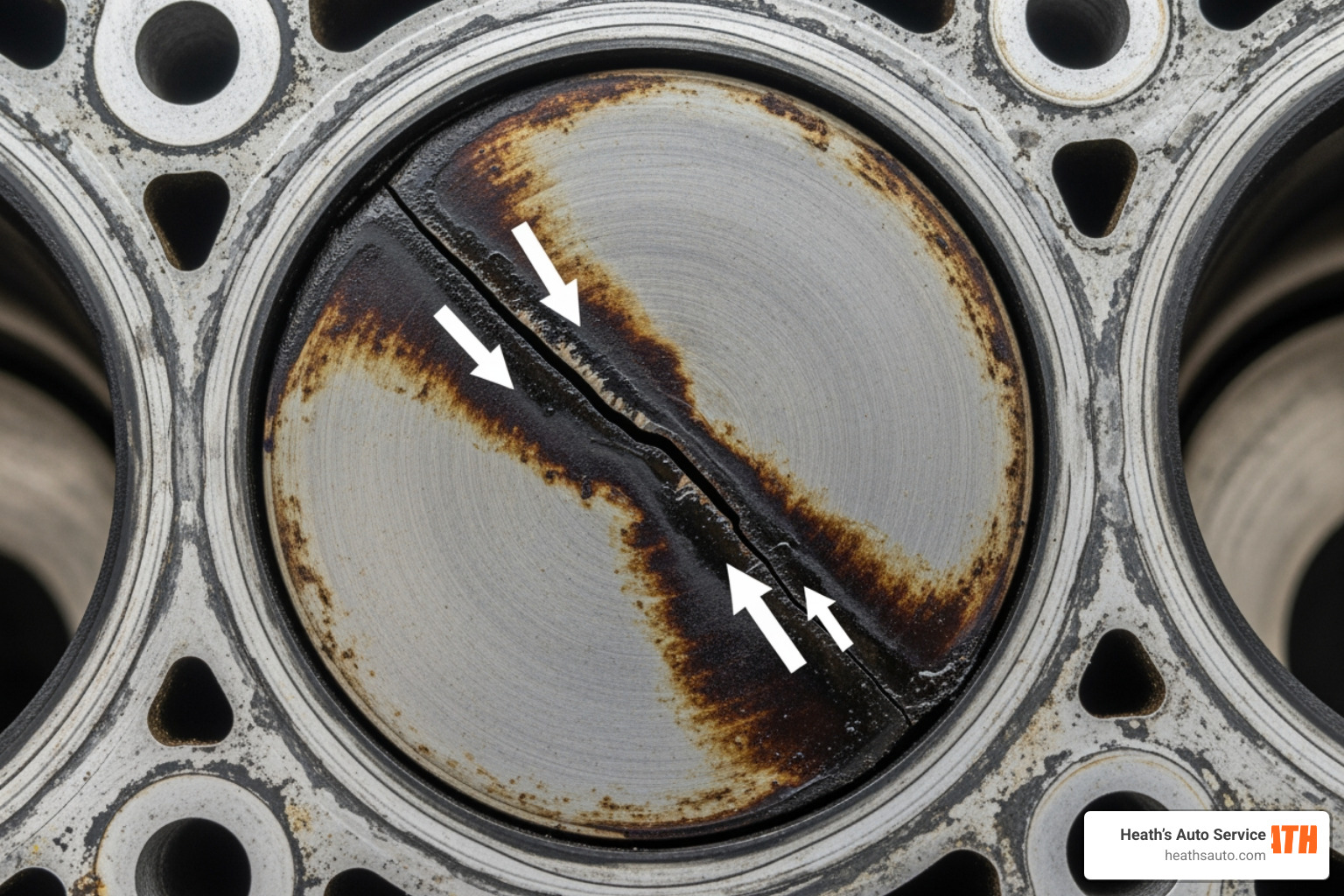
The most common serious cause is a coolant leak into the combustion chamber. That often happens because the head gasket has failed, but it can also come from a cracked cylinder head, a cracked engine block, or in some engines an intake manifold gasket leak. If you want a broader primer, our guide on why white smoke comes out of a car’s exhaust breaks down the basics.
In high-mileage engines, parts do not fail in isolation. Heat cycles, age, and wear all stack up. A vehicle with 120,000 to 200,000 miles has simply had more chances to overheat, more gasket shrinkage, and more internal wear.
Common causes of High Mileage White Smoke include:
- Coolant entering the cylinders from a blown head gasket
- Cracked cylinder head or engine block
- Intake manifold gasket leaks on engines known for coolant crossover issues
- Excess oil from overfilling, which can create white-gray smoke until it burns off
- Transmission fluid being pulled into the intake on older vacuum-modulated automatics
- Diesel injector or glow plug problems causing incomplete combustion and grayish-white smoke
A bad head gasket is common enough in older engines that we always keep it high on the suspect list. Typical repair costs often land around $1,500 to $3,000, while cracked heads or blocks can push total repairs into the $4,000 to $8,000 range.
One overlooked cause is transmission fluid ingestion. On some older vehicles, a failed vacuum modulator can let transmission fluid enter the intake manifold. The result can look like thick white smoke, sometimes paired with odd shifting. Less common, but very real.
Another one is fluid contamination after DIY service. We have seen vehicles overfilled with oil produce smoke for a few days and then settle down after the excess burns off. That does not automatically mean the engine has a blown gasket. It does mean the oil level should be corrected and the engine checked for foaming, misfire, or catalytic converter stress.
Condensation vs. Mechanical Failure in High Mileage White Smoke
This is the fork in the road.
If the smoke is thin, mostly shows up on a cold morning, and disappears in a few minutes, it is usually condensation. Water vapor is a normal byproduct of combustion, and when the exhaust system is cold, especially below about 40 degrees, you may see what looks like white smoke. Technically, it is steam.
Helpful clues that point to harmless condensation:
- The vapor is light and wispy
- It disappears quickly as the exhaust warms
- There is no sweet smell
- Coolant level stays steady
- The engine runs smoothly and does not overheat
Research on startup smoke in colder conditions consistently shows that brief vapor on first start is often normal. That lines up with what we see in Arizona too, especially in higher-elevation areas like Flagstaff and Prescott where mornings can be chilly.
Signs the smoke is not normal:
- It hangs in the air instead of disappearing
- It smells sweet or chemical-like
- It keeps coming after warm-up
- Coolant level drops without an external leak
- The engine shudders, idles rough, or loses power
A case involving a 2002 Toyota Highlander with about 102,000 miles showed white thick exhaust mainly on cold starts with intermittent shuddering. One possible explanation in situations like that is excess condensation from an engine not warming properly, sometimes because of a stuck-open thermostat. Another possibility is the very start of a coolant leak that is small enough to show up mainly after sitting overnight. That is why smoke behavior alone is not enough. Testing matters.
For more on the normal-vs-serious distinction, this outside explainer is useful: What Causes White Smoke from Your Exhaust and Is It Serious? – HiRide.
The Role of Engine Wear and Excess Oil
Mileage changes the odds.
Once an engine crosses 100,000 miles, wear in piston rings, cylinder walls, and valve stem seals becomes more common. Usually, worn rings and valve seals produce blue or blue-gray smoke because the engine is burning oil. But in the real world, older engines do not always read the color chart. Oil burning can look white-blue, especially in certain light or temperatures.
Our article on black smoke, blue smoke, and white smoke explains the differences, but here is the short version:
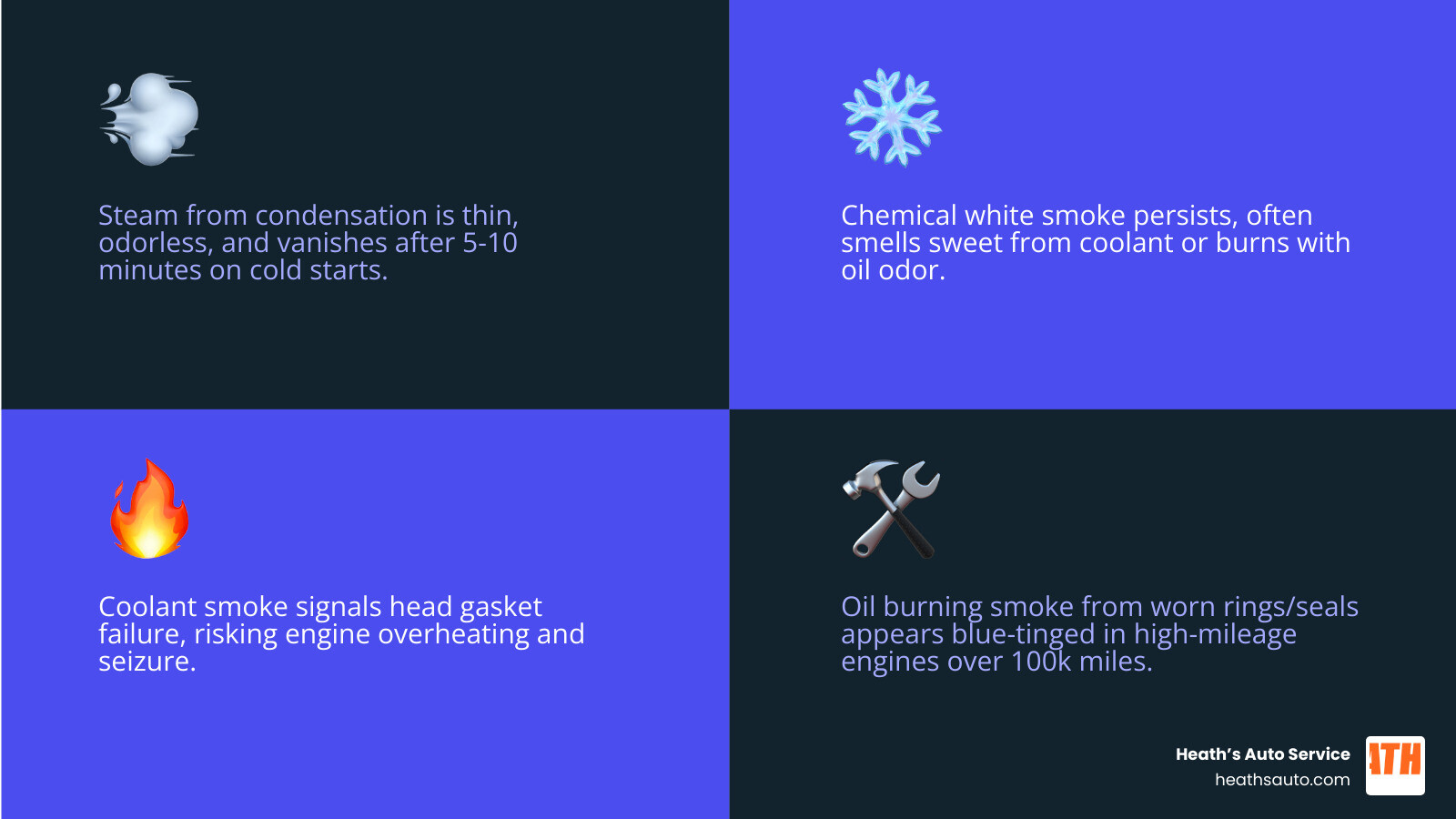
- Coolant burning usually gives thick white smoke and a sweet smell
- Oil burning usually gives blue-gray smoke and an oily smell
- Condensation gives thin white vapor with little or no odor
Excess oil can also cause confusion. If the crankcase is overfilled, the crankshaft can whip the oil into foam, which hurts lubrication and can push oil vapor into the intake through the PCV system. That can create white-gray smoke and sluggish performance. If the level is corrected early, the smoke may disappear after the excess burns off. If it was severe or prolonged, plugs, oxygen sensors, and the catalytic converter may still need inspection.
Engine wear can also make existing leaks worse:
- Higher blow-by increases crankcase pressure
- Old seals harden and leak
- Gaskets lose clamping force over time
- Cooling systems become less forgiving of minor overheating events
In plain English: age turns small problems into smoky problems faster.
Symptoms and Diagnostic Tests for Older Engines
White smoke alone is a clue. White smoke plus symptoms is a case file.
We get more concerned when High Mileage White Smoke comes with:
- Rough idle
- Misfire or shuddering
- Loss of power
- Poor fuel economy
- Low coolant level
- Overheating
- Sweet smell from the tailpipe
- Milky residue under the oil cap or on the dipstick
- Check engine light
A forum case involving a 2011 GMC Sierra 1500 V6 with 145,000 miles described a large plume of white smoke on startup, reduced power, and noticeably worse gas mileage. That symptom combo strongly suggests more than condensation. Poor mileage often happens because compression is down, combustion quality is poor, and the driver has to use more throttle to get the same response.
Another case involved a 2006 Mazda Tribute with 185,000 miles showing white smoke and rough running. That kind of roughness, especially with a sweet smell, often points toward coolant entering one or more cylinders.
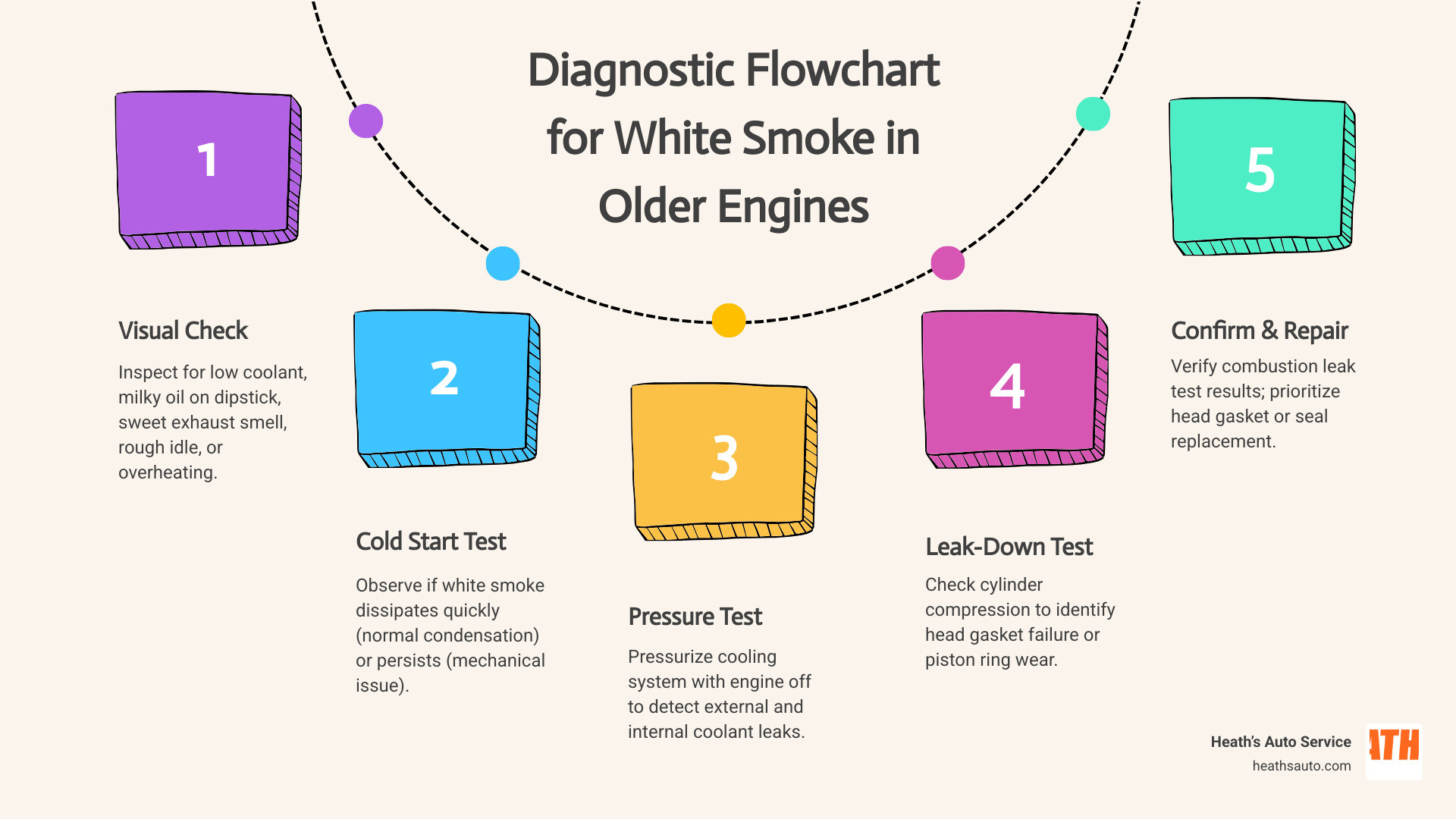
Here are the tests we recommend for older vehicles with persistent white smoke:
- Cooling system pressure test
- Pressurizes the cooling system with the engine off
- Helps reveal external leaks and some internal leaks
- Useful when coolant disappears but no puddle is visible
- Combustion leak test
- Checks for combustion gases in the coolant
- Often called a block test
- DIY kits are often around $30 to $50, while professional diagnosis is commonly about $100 to $150
- Compression test
- Measures cylinder sealing ability
- Low compression in one or more cylinders can support a gasket, valve, or ring problem
- Cylinder leak-down test
- More precise than a simple compression test
- Helps locate where pressure is escaping
- Oil inspection
- Look for a milky or chocolate-milk appearance
- Check under the oil cap too, not just the dipstick
- Scan for trouble codes
- Especially important when rough idle, misfire, or poor warm-up is present
- Cooling system codes can point to thermostat issues that mimic more serious smoke symptoms
High Mileage White Smoke in Specific Models
No model is guaranteed to fail, but patterns do show up.
A few researched examples illustrate how High Mileage White Smoke can look in the real world:
- 2011 GMC Sierra 1500 V6, 145,000 miles: heavy startup plume, power loss, poor fuel economy
- 2002 Toyota Highlander V6 3.0L, 102,000 miles: thick white smoke on cold starts, intermittent shuddering
- 2011 Chevrolet Silverado 2500 HD, 60,000 miles: white smoke on first start, then runs fine
- 2006 Mazda Tribute, 185,000 miles: white smoke, rough running, concern about fluid contamination
These examples do not mean those models are uniquely defective. They show how older trucks and SUVs often present the problem:
- V6 engines can be vulnerable to gasket and cooling-system issues
- Startup-only smoke may point to overnight coolant seepage into a cylinder
- Rough running pushes the diagnosis toward mechanical leakage, injector issues, or fluid contamination
- Fuel rail contamination or poor fuel delivery can add drivability complaints even if smoke has a separate cause
If you own a high-mileage GMC Sierra, Toyota Highlander, Silverado, Mazda Tribute, or a similar vehicle and the smoke is getting worse, do not guess. Patterns help, but testing confirms.
Diesel vs. Gasoline Engine Distinctions
Gas and diesel engines can both produce white smoke, but the causes are not always the same.
| Engine type | Common white smoke causes | Common extra clues |
|---|---|---|
| Gasoline | Coolant leak, head gasket, cracked head, intake gasket, condensation | Sweet smell, overheating, milky oil |
| Diesel | Faulty injectors, poor atomization, glow plug issues, timing problems, coolant leak | Rough cold starts, grayish-white smoke, diesel odor |
Diesels are more likely to make grayish-white smoke from fuel that is not burning completely. Bad injector spray patterns, weak glow plugs, timing issues, or soot buildup can all contribute. Our guide on white smoke from a diesel engine when accelerating goes deeper on that side of the diagnosis.
Gasoline engines, by contrast, more often point us toward coolant leaks when the smoke is thick and persistent. If it smells sweet, that is a major clue. If it is just on cold mornings and disappears quickly, that is a much friendlier clue.
Repair Costs and Safety: Is Your Engine at the End of the Road?
Here is the part nobody loves, but everybody needs.
Typical repair ranges for white smoke issues in high-mileage engines:
- Diagnosis: about $100 to $150
- Combustion leak test kit DIY: about $30 to $50
- Minor cooling system repair, cap or hose related: under $50 to a few hundred dollars
- Head gasket repair: typically $1,500 to $3,000
- Cracked cylinder head or block repair, or engine replacement: roughly $4,000 to $8,000
Can white smoke mean the engine is at the end of its life? Sometimes, yes. Especially if you have:
- Severe overheating
- Coolant in the oil
- Multiple low-compression cylinders
- Cracked block damage
- Repair costs greater than vehicle value
But mileage alone does not decide it. We have all heard the half-million-mile stories, and yes, some engines survive a very long time with careful maintenance. Still, relying on thicker oil as a smoke cure-all is not a universal fix. Oil viscosity changes should follow the engine’s condition and manufacturer requirements, not internet folklore and wishful thinking.
Safety-wise, here is our rule:
- Safe to drive briefly: thin vapor only on cold start, disappears quickly, no coolant loss, no drivability issues
- Drive only to a shop: mild persistent smoke, no overheating yet, no severe misfire
- Stop and tow: heavy smoke, overheating, low coolant, rough running, flashing check engine light, or repeated smoke after warm restart
Continuing to drive with coolant entering the cylinders can wash lubrication off cylinder walls, damage bearings, foul plugs, and destroy the catalytic converter. In worst cases, the engine can hydrolock or seize. That is not the kind of roadside surprise anybody wants.
For another overview of acceleration-related white smoke causes, see White Smoke From Exhaust When Accelerating? Here’s Why.
Frequently Asked Questions about High Mileage Exhaust
Is it safe to drive a high-mileage car with white smoke?
Sometimes, but only if you are confident it is normal condensation.
If the smoke is thin, appears only on cold starts, and disappears in a few minutes with no other symptoms, it is usually safe. If the smoke is thick, lingers, smells sweet, or comes with overheating, poor power, rough idle, or coolant loss, it is not safe to keep driving. At that point, repair urgency is high because continued operation can turn a repairable gasket problem into major engine damage.
Why does my car produce white smoke only on cold starts?
There are three common reasons:
- Normal condensation in the exhaust
- A small overnight coolant leak that pools in one cylinder
- A thermostat or warm-up issue that lets moisture build up in the exhaust longer than normal
That is why startup-only smoke can be either harmless or important. A researched Silverado case showed smoke on first start that cleared up afterward, which may happen with normal moisture or with coolant seeping into a cylinder after the engine sits. A stuck-open thermostat can also keep the engine too cool and increase visible vapor. If the smoke lasts more than a minute or two, or if coolant level drops, have it tested.
Can head gasket sealer fix white smoke in older cars?
Usually not for long.
Sealers sometimes mask a very minor leak for a short time, but they are rarely a permanent repair. They can also clog heater cores, radiators, and narrow cooling passages. In a high-mileage vehicle, that can create a second problem while you are trying to patch the first one. In most cases, professional diagnosis and proper repair are more cost-effective long term than pouring hope into the radiator.
Conclusion
High mileage white smoke can be harmless steam, or it can be your engine waving a very expensive white flag. The key is to look at the whole picture: how long the smoke lasts, how it smells, whether coolant is disappearing, and whether the vehicle is losing power, idling rough, or overheating.
If your vehicle is showing signs of High Mileage White Smoke, let us inspect it before a small issue becomes a major engine repair. Learn more here: More info about professional auto services.