
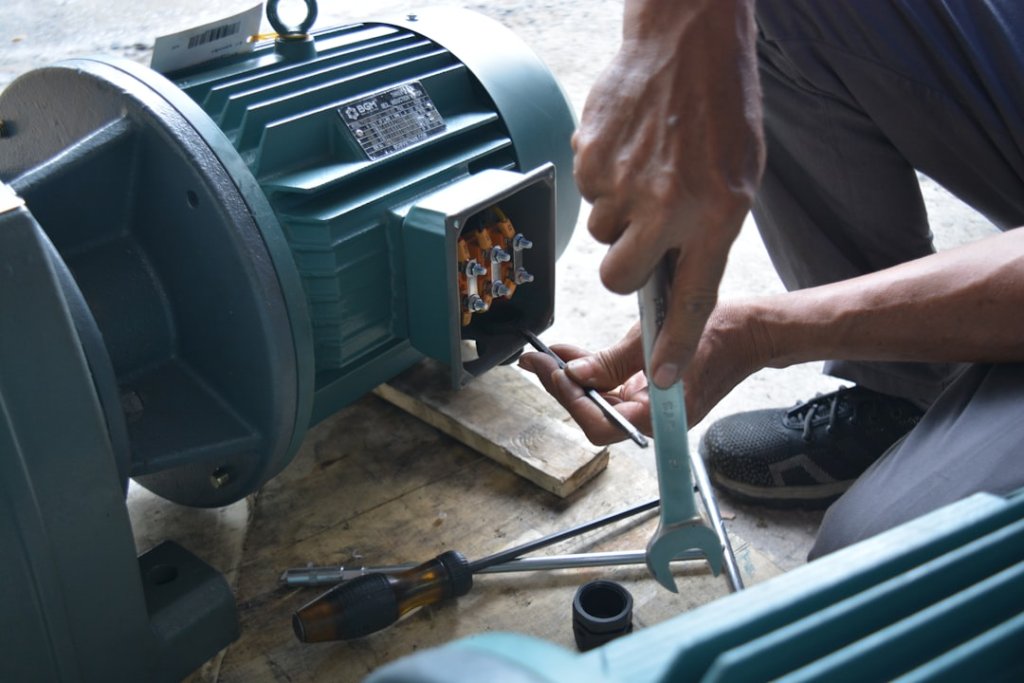
A Leaking Vacuum Pump Can Cost You More Than You Think
Vacuum pump leak repair is something many Arizona drivers face — often without warning, and usually at the worst possible time.
Here’s a quick answer if you just need the essentials:
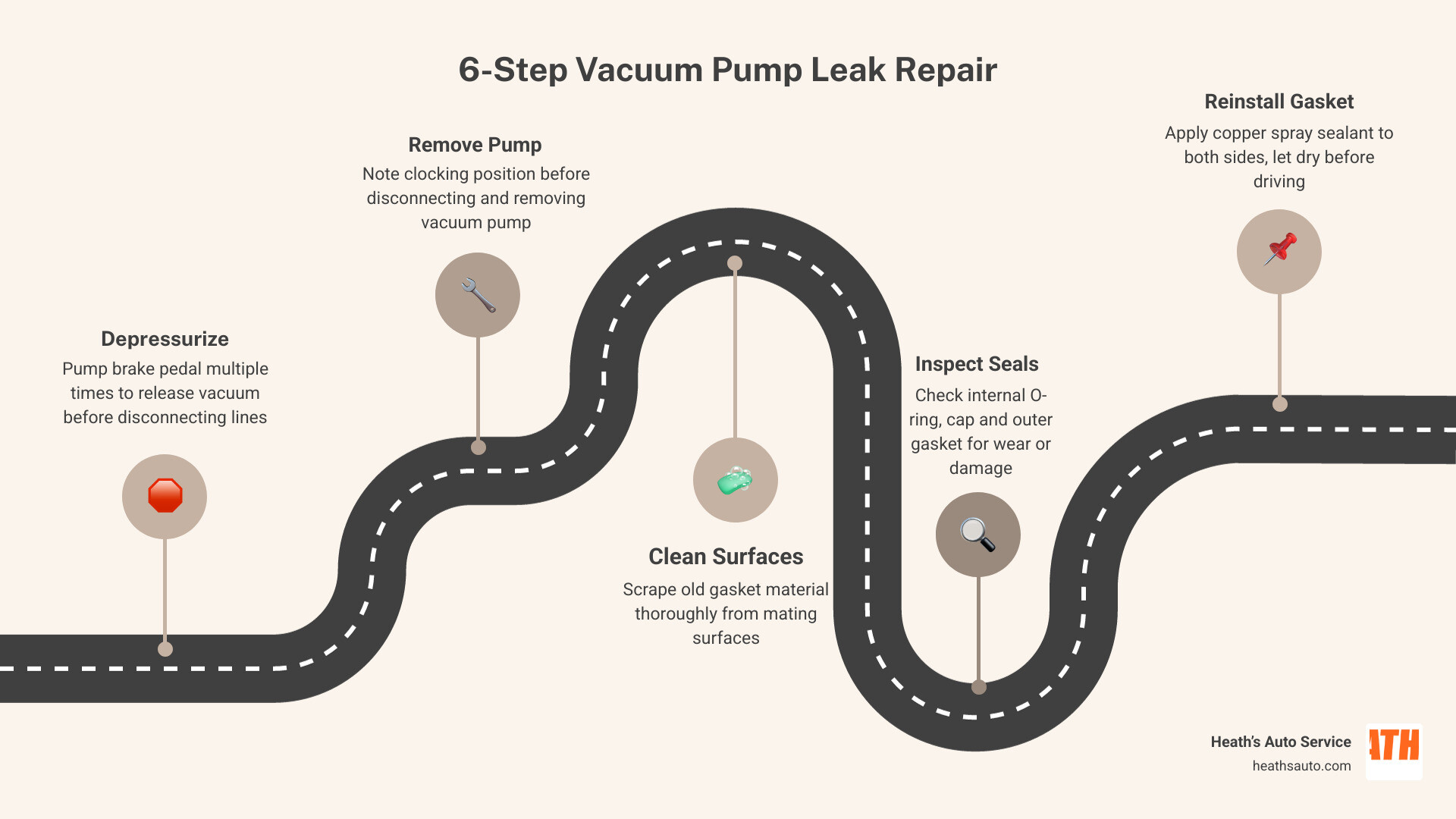
How to fix a vacuum pump leak in 6 steps:
- Depressurize — pump the brake pedal several times to release vacuum before disconnecting any lines
- Remove the pump — note the clocking position before taking it off
- Clean mating surfaces — scrape away old gasket material thoroughly
- Inspect seals and gasket — check the internal o-ring and cap for wear, not just the outer gasket
- Reinstall with new gasket — apply copper spray sealant to both sides and let it dry before driving
- Torque bolts correctly — tighten gradually in a rotational pattern to 15 ft-lbs (or 89 in-lb for some diesel applications)
A vacuum pump keeps your brake booster working and helps regulate crankcase pressure. When it leaks, you might notice a burnt oil smell, oil residue near your engine, or a brake pedal that feels softer than usual. Over 60% of these leaks come from worn seals or gaskets — and catching them early can save you hundreds of dollars.
The tricky part? Many drivers mistake a vacuum pump leak for a rear main seal leak or a valve cover issue. The oil travels before it becomes visible, which makes diagnosis harder than it looks.
Identifying the Causes of Vacuum Pump Oil Leaks
When we talk about vacuum pump leak repair, we first have to understand why these components fail in the first place. In 2026, many modern engines rely on mechanical vacuum pumps because smaller, turbocharged engines don’t produce enough natural manifold vacuum to power your brakes or emission controls.
Research indicates that over 60% of vacuum pump oil leaks are caused by worn seals or gaskets. These rubber components live in a brutal environment. They are subjected to constant heat cycles—especially in the Arizona desert where under-hood temperatures can soar—causing the rubber to harden and lose its elasticity. Once that seal becomes “brittle,” oil starts to seep out.
Other common causes include:
- PCV System Pressure: If your Positive Crankcase Ventilation (PCV) system is clogged, internal engine pressure builds up. This pressure seeks the path of least resistance, often forcing oil past the vacuum pump’s internal seals.
- Oil Contamination: Dirty or old oil can act as an abrasive, wearing down the internal rotor and housing. Statistics show that oil contamination and overfilling account for nearly 25% of all vacuum pump discharge issues.
- Mechanical Wear: Over time, the internal blades or “vanes” of the pump can wear down the housing, leading to internal leaks that eventually manifest as external drips.
If you are noticing oil spots on your driveway or a strange smell, you should check out these Signs Your Car’s Engine Has a Vacuum Leak to see if your symptoms match up. Accurate diagnosis is key because troubleshooting vacuum pump oil leaks requires distinguishing between a simple gasket failure and a total internal pump collapse.
Step-by-Step Guide to Vacuum Pump Leak Repair
Ready to get your hands dirty? Performing a vacuum pump leak repair is a task that requires patience and precision. If you’re tackling this as a DIY project, follow this systematic approach to ensure you don’t end up with a bigger leak than you started with.
1. Depressurization
Before you touch a single bolt, you must release the stored vacuum. If you disconnect the lines while the system is under vacuum, the sudden “bang” of depressurization can actually damage the internal seals of the pump. Pump your brake pedal 10 to 15 times with the engine off until the pedal feels firm.
2. Removal and Clocking
As you loosen the bolts, pay close attention to the “clocking” or orientation of the pump. On many engines, the pump is driven by the camshaft. If you don’t put it back in the exact same position, the drive “ears” won’t align, and you could break the pump (or the camshaft) when you tighten the bolts.
3. Surface Preparation
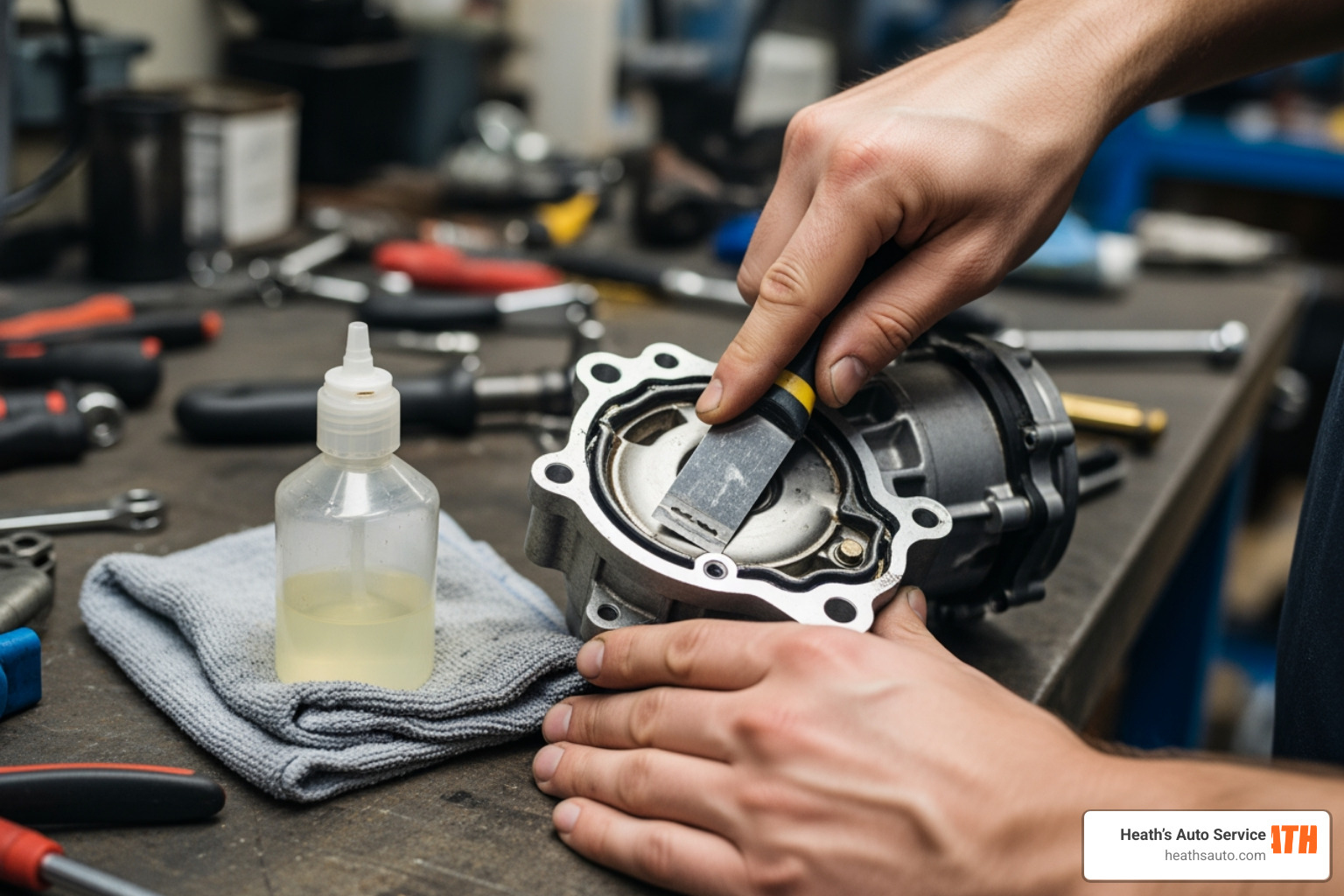
This is where most repairs fail. You must use a gasket scraper or a fresh razor blade to remove every microscopic bit of old gasket material. Use a lint-free cloth and brake cleaner to ensure the surface is “surgically” clean. Even a tiny speck of debris can prevent the new gasket from seating. For more on the technical side of this, read our Guide to Vacuum Leak Car Repair.
4. Gasket and Seal Inspection
Don’t just look at the big outer gasket. Many pumps have an internal cap o-ring. If that o-ring is flat or cracked, replacing the outer gasket won’t fix your leak. If you find metal shavings inside the pump during this stage, stop—you need a new pump, not just a seal.
5. Sealant and Reinstallation
While some gaskets are designed to be installed dry, many professionals use a light coating of copper spray sealant. This helps the gasket “tack” into place and fills in minor imperfections in the metal. Allow the sealant to become slightly tacky before joining the surfaces.
6. Torque Specifications
Tightening the bolts is a “Goldilocks” situation—not too loose, not too tight.
- General Automotive: Most small vacuum pumps require approximately 15 ft-lbs (20 Nm).
- Diesel/Heavy Duty: Some pumps, like those on the 6.7L Powerstroke, use a lighter spec of 89 in-lb.
Always use a torque wrench and tighten in a “star” or rotational pattern. This ensures even pressure across the seal. For more specific local help, you can look into Vacuum Leak Car Repair in Chandler AZ.
Essential Tools for Vacuum Pump Leak Repair
To do the job right, you’ll need:
- Wrench and Socket Set: (Usually 8mm to 13mm)
- Gasket Scraper: To clean mating surfaces without gouging the aluminum.
- Torque Wrench: Essential for preventing over-tightening.
- Brake Cleaner: To degrease the area.
- Blue Thread Locker: To ensure bolts don’t vibrate loose over time.
- Lint-Free Cloth: To prevent contamination.
Best Practices for a Successful Vacuum Pump Leak Repair
- Gradual Tightening: Never tighten one bolt all the way while the others are loose. Go in stages: hand tight, then 50% torque, then final torque.
- Vacuum Line Support: Use a bungee cord or zip tie to hold vacuum lines out of the way. Don’t let them dangle, as this can stress the plastic connectors.
- Oil Drainage: Before reinstalling the pump, turn the drive gear by hand to drain any excess oil. This prevents “hydro-locking” the pump on its first start.
- Thread Cleaning: Clean the bolt threads with a wire brush. Old Loctite or grit on the threads can give you a false torque reading.
Model-Specific Repair Differences: BMW, Audi, and Ford
Not all vacuum pump leak repairs are created equal. Depending on what you drive around Arizona, the “fun factor” of this repair varies wildly.

BMW (N20, N55, and N63 Engines)
BMW often mounts their vacuum pumps on the very back of the cylinder head, right against the firewall. This makes them incredibly difficult to see. Often, oil will drip from the pump directly onto the transmission bellhousing, leading owners to think they have a rear main seal leak. The good news? BMW pumps are often high-quality, and a simple gasket replacement usually does the trick.
Audi and VW (FSI and TSI Engines)
Audi engines are notorious for vacuum pump issues. In fact, forum data suggests that 70% of reported leaks on FSI engines eventually require a full pump replacement because the internal seals fail alongside the external ones. If you see oil pooling near the vacuum pump on your Audi, check the brake booster line—oil often “wicks” into the line, which can ruin your brake booster too.
Ford (6.7L Powerstroke)
On these diesel workhorses, the vacuum pump sits on the front of the engine. While access is better, the torque specs are much lower (89 in-lb). Because these engines vibrate significantly, using a blue thread locker is mandatory to prevent the bolts from backing out over time.
| Manufacturer | Common Leak Location | Repair vs. Replace |
|---|---|---|
| BMW | Rear of head / Firewall | Usually Reseal |
| Audi/VW | Side of head / Near PCV | Often Replace |
| Ford | Front of engine block | Reseal (with Loctite) |
| Fiat | Side of cylinder head | Replace (Internal seal risk) |
When to Replace vs. Reseal Your Vacuum Pump
This is the $500 question. Do you spend $20 on a gasket or $400 on a new pump?
Reseal if:
- The leak is clearly coming from the outer mounting surface.
- The pump is still making strong vacuum (brakes feel normal).
- The internal housing is smooth and free of scratches.
- The car has lower mileage (under 80k).
Replace if:
- You find oil inside the vacuum lines (this means internal seals have failed).
- You hear a “clacking” or “rumbling” sound from the pump.
- The brake pedal is hard to press, especially at idle.
- The pump has over 120,000 miles.
- You see metal shavings or “scoring” inside the pump housing.
A leaking water ring or mechanical pump that is ignored can lead to a catastrophic failure. If the pump seizes, it can snap the drive tang on your camshaft, leading to thousands of dollars in engine damage. It’s a classic case of “an ounce of prevention is worth a pound of cure.”
Frequently Asked Questions
What are the most common symptoms of a vacuum pump oil leak in 2026?
The most common sign is a burnt oil smell coming through your vents when you stop at a red light. Because many pumps are located near the exhaust manifold, the leaking oil drips onto the hot metal and smokes. You might also see oil residue on the top of the transmission or notice that your brake pedal feels “stiff” or “wooden” when you first start the car in the morning.
How does a clogged PCV system contribute to vacuum pump leaks?
Your engine needs to breathe. If the PCV valve or breather hoses are clogged, the crankcase becomes pressurized. This pressure pushes against the vacuum pump seals from the inside out. Even a brand-new seal won’t hold if the PCV system is forcing oil past it. We recommend inspecting your PCV system every 5 years or 60,000 miles to prevent this.
Can I drive my car while waiting for a vacuum pump leak repair?
While you can drive with a minor seep, it’s a gamble. If the leak worsens, oil can saturate your rubber coolant hoses, causing them to swell and burst. More importantly, if the pump fails completely, you lose your “power brakes.” Stopping a 4,000-pound vehicle without power assist requires immense leg strength and significantly increases your stopping distance. If you smell oil or notice brake changes, get a professional inspection immediately.
Conclusion
At Heath’s Auto Service, we know that vacuum pump leak repair isn’t just about stopping a mess on your driveway—it’s about keeping your vehicle safe and efficient. Whether you’re navigating the hills of Flagstaff or the heat of Scottsdale and Chandler, a healthy vacuum system is vital for your car’s performance.
Heath’s Auto Service In Chandler, AZ
At Heath’s Auto Service, our comprehensive range of services covers everything from routine maintenance to complex repairs. Our certified technicians are skilled in handling oil changes, brake inspections, engine diagnostics, tire rotations, and much more. Whether it’s a minor tune-up or a major overhaul, trust us to get you back on the road with confidence. Contact our team at Heath’s Auto Service today!