
When a Tune-Up Makes Things Worse: What’s Really Going On
Tune up stalling issues are one of the most frustrating things a driver can experience — you bring your car in running rough, pay for a service, and leave with a car that dies at every red light.
You’re not imagining it. And you’re not alone.
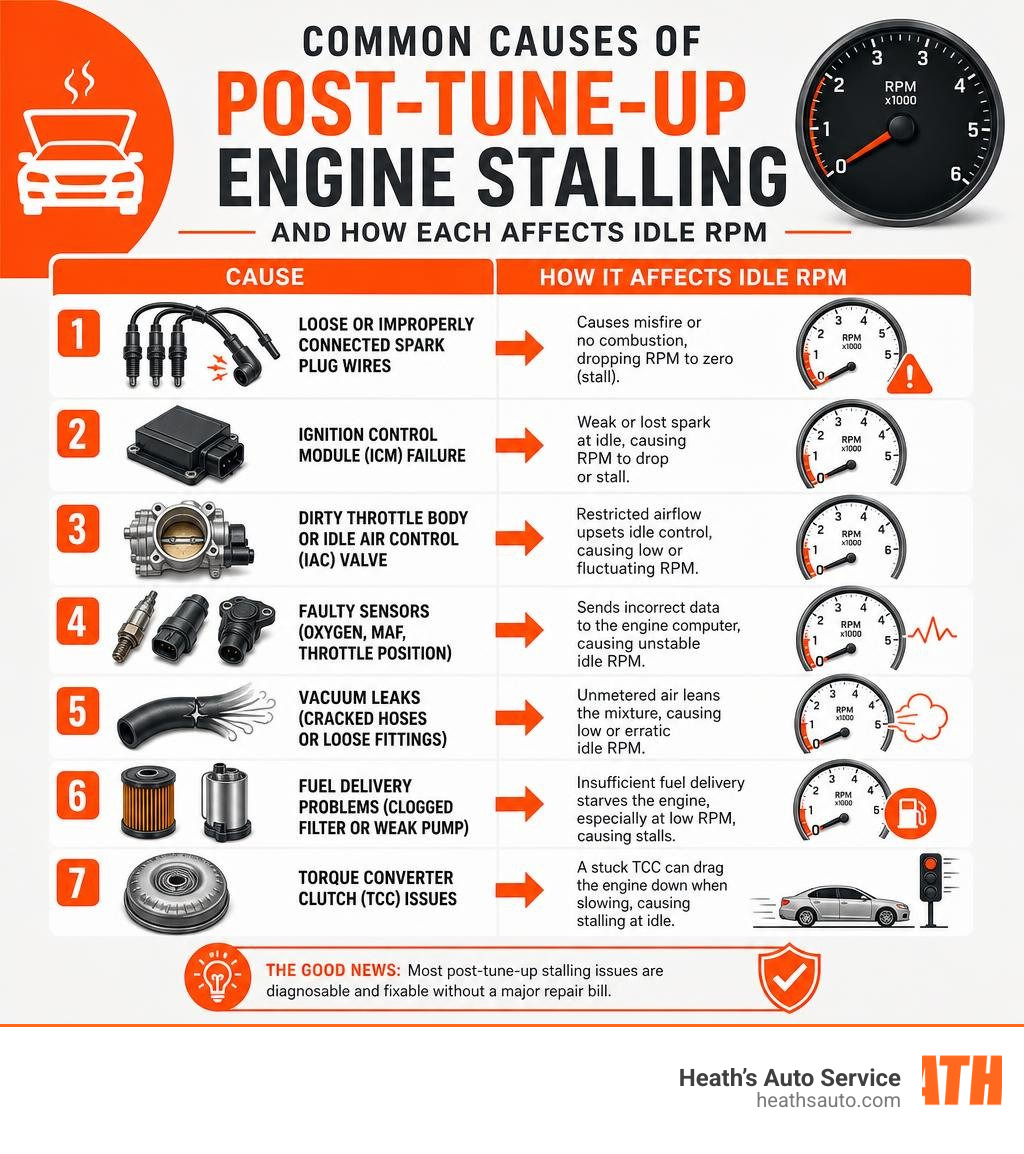
Here are the most common reasons a car stalls after a tune-up:
- Loose or improperly connected spark plug wires — a disconnected wire kills combustion instantly
- Ignition control module (ICM) failure — especially on older GM vehicles; heat and improper installation are the top culprits
- Dirty throttle body or idle air control (IAC) valve — carbon buildup blocks airflow at idle; nearly two-thirds of Ford stalling problems trace back here
- Faulty sensors — a bad oxygen sensor, mass airflow sensor, or throttle position sensor sends wrong data to the engine computer
- Vacuum leaks — cracked hoses or loose fittings let unmetered air in, throwing off the air-fuel mixture
- Fuel delivery problems — a clogged fuel filter or failing fuel pump starves the engine, especially at low RPM
- Torque converter clutch (TCC) issues — a stuck TCC in automatic transmissions causes stalls specifically when slowing to a stop
The good news: most of these are diagnosable and fixable without a major repair bill — if you know where to look.
At Heath’s Auto Service, we’ve spent years diagnosing tune up stalling issues across Arizona for drivers who were told their car was “fixed” — only to end up stranded again. In this guide, we’ll walk you through exactly how to find the root cause and what to do about it.
Related content about tune up stalling issues:
Common Causes of Tune Up Stalling Issues
When you pick your car up from a shop, you expect it to purr. But if it struggles to idle or dies at the first stoplight, it is highly likely that a simple installation oversight occurred during the service.
Even the most seasoned mechanics can make minor errors that trigger major tune up stalling issues. The most common culprits include:
- Loose Spark Plug Wires or Coil Boots: If a spark plug wire or coil-on-plug boot is not fully seated onto the terminal, it can vibrate loose. This creates an intermittent connection that drops spark entirely under the vibrations of idling, leading to a sudden stall.
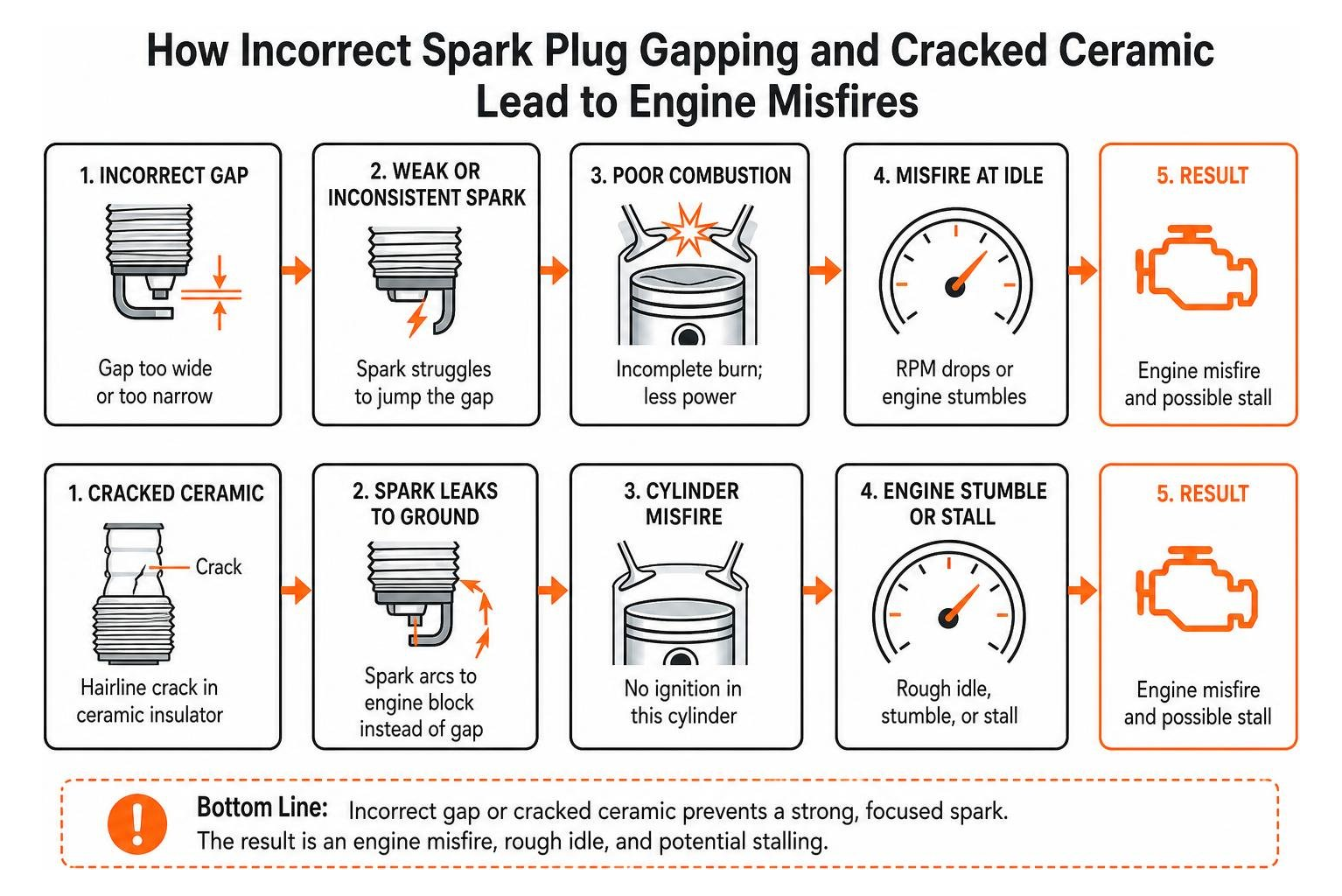
- Incorrect Spark Plug Gap: Modern engines are incredibly sensitive to spark plug gaps. If a plug was dropped during installation or gapped incorrectly, the cylinder pressure can “blow out” the spark, especially when the engine transitions from load to idle.
- Cracked Spark Plug Ceramic: Overtightening a spark plug or using a socket at an angle can hairline-crack the porcelain insulator. This allows the high-voltage spark to arc directly to the engine block instead of jumping the gap inside the cylinder.
Before you panicking about a blown engine, there are a few straightforward troubleshooting steps you can perform right in your driveway:
- Perform a Visual Inspection: Pop the hood with the engine off. Gently wiggle every spark plug wire, coil pack connector, and vacuum line to ensure they are firmly locked in place. It is surprisingly common to find a plastic connector tab that broke off during service, allowing a critical wire to wiggle loose.
- Look for Forgotten Tools or Disconnected Hoses: Check around the intake manifold. Did a technician accidentally leave a vacuum line disconnected while changing the air filter?
- Run an OBD-II Scan: Even if your dashboard “Check Engine” or “Service Engine Soon” light is not illuminated, there may be “pending codes” stored in the computer. A quick scan can pinpoint exactly which cylinder is misfiring or which sensor is reporting erratic data.
If you find yourself dealing with immediate issues right after a service, you might also be experiencing tune-up starting problems. Ensuring a detailed tune-up inspection was performed is the best way to prevent these errors from happening in the first place.
Ignition and Sensor Failures: Spark Plugs, ICM, and Electronic Controls
The modern combustion engine relies on a delicate balance of air, fuel, and spark. If any of these elements are disrupted by a faulty ignition component or a malfunctioning sensor, the engine will stall.
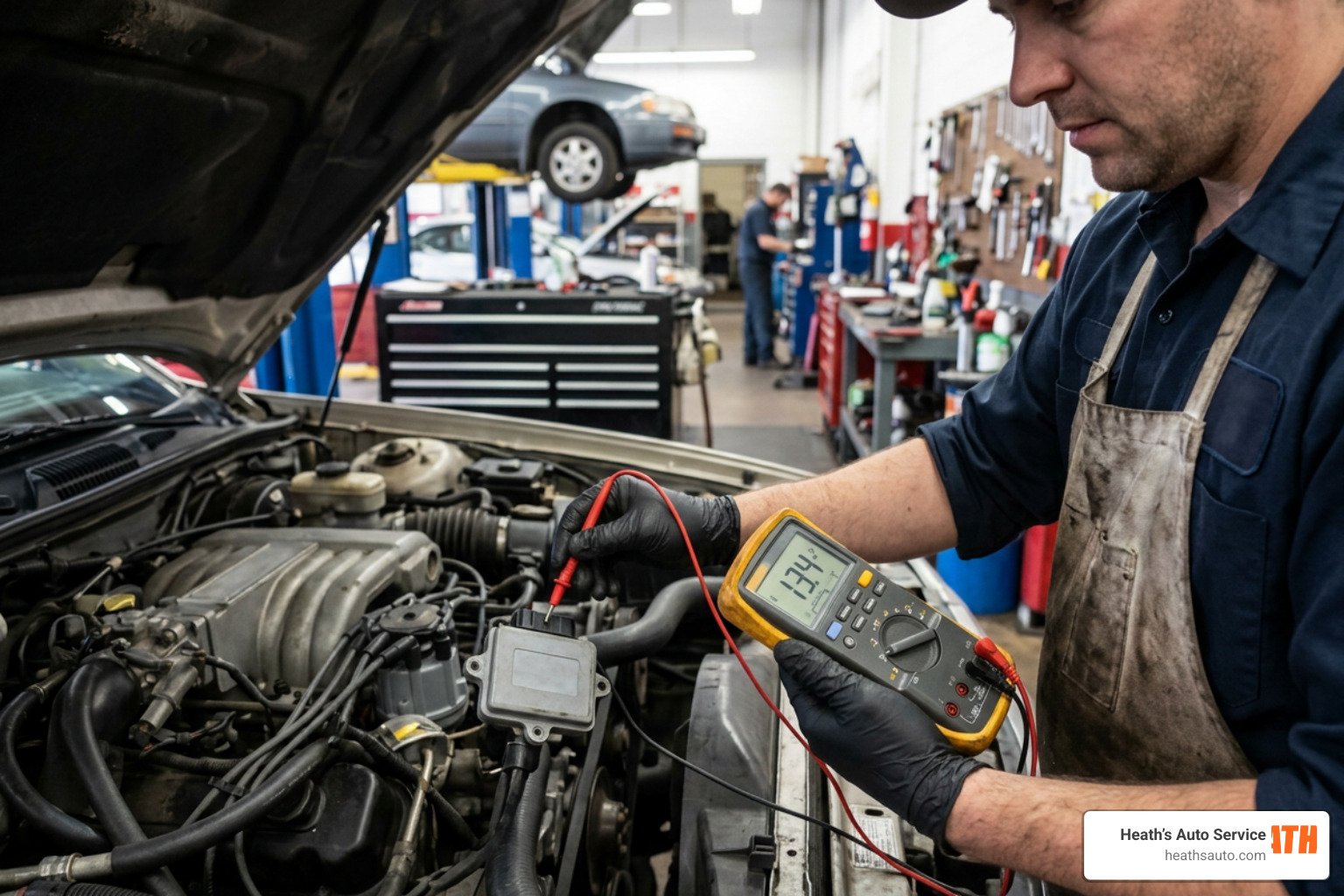
One classic culprit behind sudden stalling is a failing Ignition Control Module (ICM). The ICM is the electronic brain that tells the ignition coil exactly when to fire.
In many older vehicles, particularly 1980s and 1990s GM trucks, the ICM is mounted inside or directly underneath the distributor. This is one of the hottest environments in the entire engine bay. Because of this design, failing ICMs are a common cause of sudden engine shutdowns in these classic trucks.
When replacing an ICM during a tune-up, two critical materials must be used:
- Thermal Heat Sink Compound: This paste must be applied to the metal backing of the ICM before mounting. It transfers heat away from the module and into the distributor body. If a technician forgets this compound, or overtightens the mounting screws, which squeezes the paste out, the ICM will quickly overheat, break down internally, and cause the engine to shut down as soon as it reaches operating temperature.
- Dielectric Grease: This is used on the electrical connectors to prevent moisture intrusion and corrosion, ensuring a clean voltage signal.
Beyond the ignition module, dirty or faulty sensors are major contributors to post-tune-up stalls. Faulty oxygen sensors, mass airflow sensors, throttle position sensors, and ignition control modules are all common causes of stalling when stopping or idling.
- Mass Airflow (MAF) Sensor: This sensor measures the volume of air entering the engine. If a technician accidentally touched the delicate hot wires inside the MAF while replacing the air filter, or if oil from a freshly washed aftermarket air filter coated the sensor, it will miscalculate the air volume. This results in a severe lean or rich condition that stalls the engine at stops.
- Oxygen (O2) Sensor: The O2 sensor monitors exhaust gases to adjust the fuel trim. A sluggish or failing O2 sensor can send a flat voltage signal, causing the computer to dump too much or too little fuel at idle.
- Throttle Position Sensor (TPS): The TPS tells the computer how far open the throttle plate is. If it has a dead spot right at the idle position, the computer won’t realize your foot is off the gas, failing to command the correct idle air mixture.
If your vehicle exhibits these electrical gremlins, it can feel incredibly dangerous, especially if your car suddenly dies when driving. For a deeper look at how to systematically diagnose these issues, refer to this guide on Understanding Engine Stalling.
Diagnosing Ignition Control Module and Tune Up Stalling Issues
If your vehicle runs perfectly fine when cold but suddenly shuts down like someone turned off a light switch after 15 to 20 minutes of driving, you are likely dealing with a heat-sensitive ICM failure.
To diagnose this issue:
- Check for Spark Immediately After a Stall: Carry a spare spark plug or a spark tester. When the engine stalls and refuses to start, hook up the tester to a plug wire and crank the engine. If you see a weak, orange spark, or no spark at all, the ignition system is failing.
- Inspect the Distributor Cap and Rotor: During a tune-up, the distributor cap and rotor should always be replaced together. Check inside the cap for hairline cracks, moisture, or carbon tracking, which are black lines where the spark has short-circuited.
- Perform a Multimeter Test: Use a digital multimeter to test the primary and secondary resistance of the ignition coil. If the resistance values fall outside of factory specifications when the engine is hot, the coil is breaking down under heat soak and must be replaced.
Fuel Delivery, Vacuum Leaks, and Airflow Maintenance
Sometimes, tune up stalling issues have nothing to do with spark and everything to do with fuel and vacuum pressure.
During a tune-up, parts are moved, intake ducts are flexed, and fuel lines are disconnected. This physical handling can easily expose or create vacuum leaks and fuel delivery issues.
- Vacuum Leaks: Any air that enters the engine after the mass airflow sensor is considered “unmetered air.” Because the computer doesn’t know this air is there, it fails to inject enough fuel to match it. This creates a severe lean condition. At highway speeds, a small vacuum leak is barely noticeable. But at a red light, when the throttle plate is closed, that extra air completely disrupts the idle, causing the engine to hunt (RPMs bouncing up and down) and eventually stall. Common sources include cracked vacuum lines (which degrade rapidly in dry Arizona climates like Phoenix, Cottonwood, and Prescott) or an intake boot that wasn’t fully tightened after a filter change.
- Clogged Fuel Filter: If your vehicle has an external fuel filter that was replaced during the tune-up, ensure it was installed in the correct direction. Most filters are directional; installing one backward severely restricts fuel flow.
- Failing Fuel Pump: A weak fuel pump might manage to supply enough pressure to keep the car idling, but it will stall the moment you press the gas pedal to accelerate. Conversely, some failing pumps suffer from internal electrical resistance that worsens as they heat up, leading to a stall only after the vehicle has been running for a while.
To help you distinguish between these two fuel system issues, we have put together this comparison table:
| Symptom / Test | Low Fuel Pressure | Low Fuel Volume |
|---|---|---|
| Idle Behavior | Rough idle, immediate stalling at stops | Often idles smoothly |
| Acceleration | Extreme hesitation, popping backfire | Engine bogs down or dies at high RPM |
| Pressure Gauge Reading | Reads below factory spec (e.g., <30 PSI) | May read normal at idle, drops under load |
| Common Root Cause | Failing fuel pressure regulator, weak pump | Clogged fuel filter, pinched fuel line |
Additionally, never overlook your engine’s ground wires. During a tune-up, a technician may disconnect ground straps (battery to frame, cylinder head to firewall) to access spark plugs. If these grounds are left loose or dirty, the electrical circuit for the fuel pump or ignition system will lose continuity under engine torque, causing a sudden stall.
If your car is struggling specifically when you let your foot off the accelerator, you can find a step-by-step diagnostic guide on what to do when your Car Stalls at Idle.
Cleaning the Throttle Body and IAC to Resolve Tune Up Stalling Issues
If your engine stalls specifically when you come to a stop, the issue is almost certainly a restriction in idle airflow.
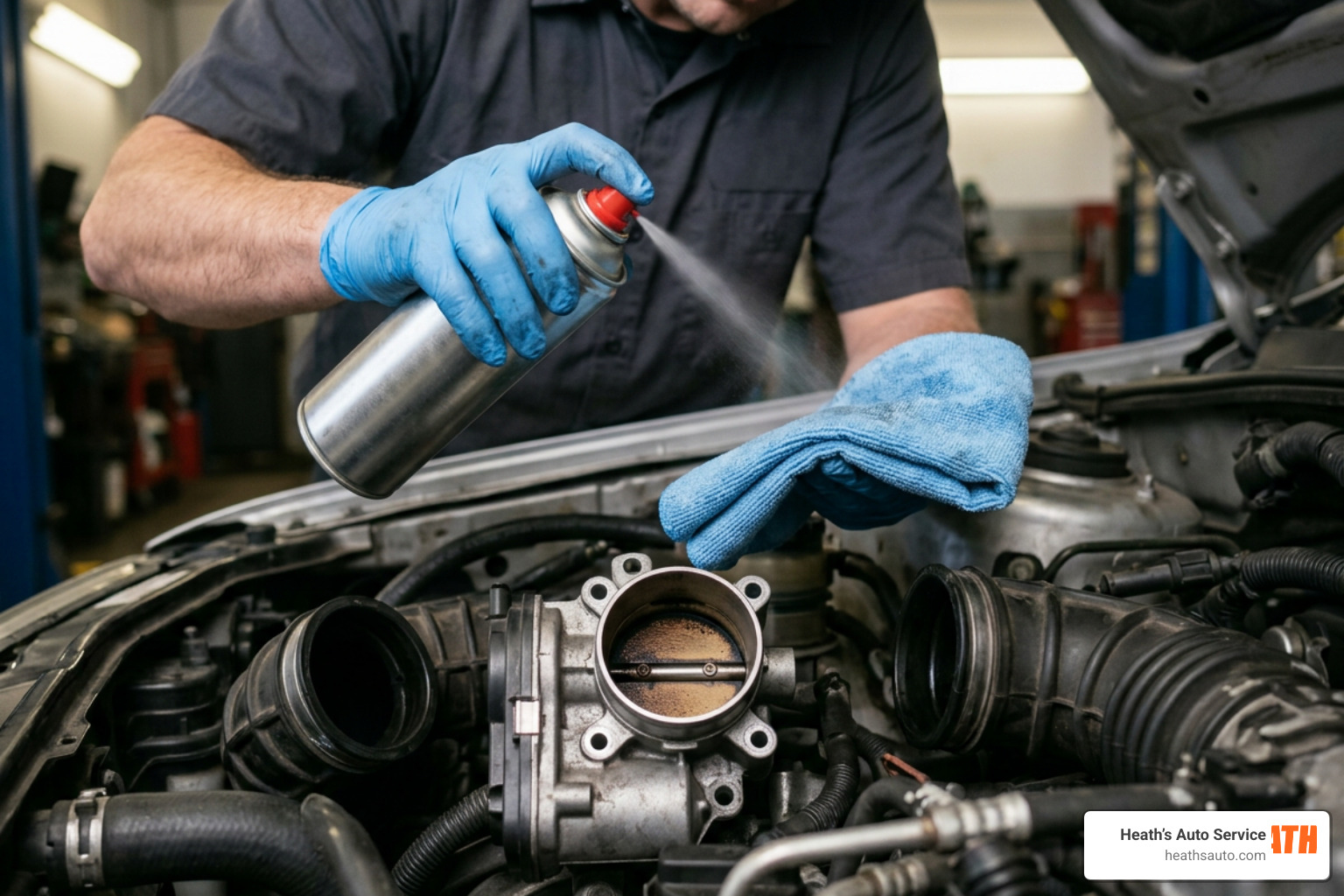
In older vehicles (typically pre-2010), the computer controls idle speed using an Idle Air Control (IAC) valve. This valve acts as a bypass passage, allowing a controlled amount of air around the closed throttle plate. In newer vehicles, the computer uses an electronic, drive-by-wire throttle body to slightly crack the throttle plate open at idle.
Over time, oil vapors and crankcase gases settle on the backside of the throttle plate, creating a thick, black carbon buildup.
- This carbon physically narrows the tiny air passages.
- Because the computer cannot “see” this physical restriction, it fails to compensate, resulting in an immediate stall when you release the gas pedal.
- In fact, dirty throttle bodies and idle air control valves account for nearly two-thirds of all stalling problems on Ford vehicles, especially at stops.
How to safely clean your throttle body and IAC valve:
- Disconnect the Battery: This prevents electrical shorts and resets the computer’s basic idle memory.
- Remove the Intake Duct: Locate the throttle body and spray a high-quality throttle body cleaner onto a clean microfiber cloth. Never spray cleaner directly into an electronic throttle body, as the liquid can seep past the throttle shaft and destroy the delicate internal electronics.
- Wipe Away Carbon: Gently hold the throttle plate open and wipe away all black carbon deposits from both sides of the plate and the throttle bore.
- Perform an Idle Relearn Procedure: Once reassembled, modern vehicles require an idle relearn. Start the engine and let it idle with all accessories (A/C, headlights) off for 10 minutes, then turn the A/C on max for another 5 minutes. This teaches the computer’s electronic throttle control how to stabilize the idle with the newly restored airflow.
Transmission Troubles: Stuck Torque Converter Clutches
Sometimes, a post-tune-up stall has absolutely nothing to do with the engine itself. Instead, the culprit lies within your automatic transmission.
Inside an automatic transmission, the torque converter acts as a fluid coupling between the engine and the gearbox. To maximize fuel economy at highway speeds, a solenoid engages the Torque Converter Clutch (TCC), which physically locks the engine’s output shaft directly to the transmission gears — just like releasing the clutch pedal on a manual transmission.
Under normal conditions, as you slow down and approach a stoplight, the computer commands the TCC solenoid to disengage, unlocking the clutch. However, if the TCC solenoid is stuck or clogged with debris, the clutch remains locked.
When you come to a complete stop, the transmission forces the engine’s RPMs down to zero, causing an immediate stall. It feels exactly like stopping a manual transmission car in fifth gear without pressing the clutch pedal.
This is a remarkably common issue on specific vehicles. For example, Ford extended the warranty on 2012-2016 Focus and Fiesta automatic transmissions to 7 years/100,000 miles due to widespread torque converter stalling complaints.
How to diagnose a TCC-related stall:
- The stall only occurs when you slow down to a complete stop.
- The engine restarts easily in Park or Neutral and idles perfectly.
- The Neutral Test: As you decelerate and approach a stop, shift the transmission into Neutral. If the vehicle rolls to a stop without stalling, your engine’s idle system is working perfectly, and you are dealing with a stuck torque converter clutch.
If your vehicle is exhibiting these exact symptoms, you can read more about the mechanical details in this article on Ford Engine Stalling at Stops.
When to Seek a Second Opinion for Post-Service Problems
If you brought your vehicle in for a routine tune-up and it now stalls, hesitates, or runs worse than before, you are facing a classic post-service dilemma.
Ideally, you should give the original shop an opportunity to correct the issue. However, if they insist “there are no codes, so nothing is wrong,” or if they attempt to charge you hundreds of dollars in diagnostic fees to fix a problem that did not exist before you walked through their doors, it is time to seek a second opinion.
When choosing a shop for a second opinion, look for these key indicators of professionalism:
- ASE-Certified Technicians: Ensure the shop employs technicians certified by the National Institute for Automotive Service Excellence (ASE), particularly in Engine Performance (A8).
- Symptom-Based Diagnostics: Avoid shops that simply plug in a code reader and suggest replacing whatever sensor is listed. True diagnostics involve road testing, checking fuel pressure under load, and analyzing live sensor data.
- Clear Warranties: A reputable shop stands behind their work with a nationwide warranty.
Frequently Asked Questions About Engine Stalling
Why does my car stall only when coming to a stop?
When you decelerate and come to a stop, your engine transitions from high RPM under load to its lowest operating speed (typically 600 to 800 RPM). During this transition, the computer must rapidly adjust the air-fuel mixture.
If your idle air control (IAC) valve is sticking, your throttle body is choked with carbon, or you have a vacuum leak, the engine cannot pull in enough air quickly enough to stabilize the RPM drop, causing it to plunge to zero and stall. Another common cause is a stuck torque converter clutch in your automatic transmission, which fails to unlock and drags the engine down to a stop.
Can a bad sensor cause stalling without triggering a check engine light?
Yes. A failing sensor can easily cause stalling without illuminating the check engine light. This typically happens in two scenarios:
- Pending Codes: The computer may detect erratic data but requires the fault to occur across multiple “drive cycles” before it officially triggers the dashboard light.
- Sluggish Performance: A sensor (like an oxygen sensor) can become lazy or slow to respond without completely failing. Because its electrical signals are still within “acceptable” parameters, the computer doesn’t realize the data is incorrect, leading to a stalling condition without storing a Diagnostic Trouble Code (DTC).
Is it safe to drive a vehicle that keeps stalling?
No, it is highly unsafe. When your engine stalls while you are driving or stopping, you instantly lose your power steering assist and your power brake booster.
This makes the steering wheel incredibly heavy to turn and the brake pedal extremely stiff to press down. If your engine dies in the middle of a busy Arizona intersection in Gilbert or Scottsdale, or while merging onto the highway in Flagstaff, you face an immediate collision risk. You should drive the vehicle only to a safe location or have it towed for immediate diagnosis.
Conclusion
Experiencing tune up stalling issues after paying for a preventative service is incredibly frustrating, but it is a highly solvable problem. Whether the issue is a simple loose spark plug wire, a heat-sensitive ignition control module, a carbon-choked throttle body, or a transmission torque converter clutch that refuses to disengage, getting an accurate diagnosis is the key to restoring your vehicle’s performance.
Heath’s Auto Service In Chandler, AZ
At Heath’s Auto Service, our comprehensive range of services covers everything from routine maintenance to complex repairs. Our certified technicians are skilled in handling oil changes, brake inspections, engine diagnostics, tire rotations, and much more. Whether it’s a minor tune-up or a major overhaul, trust us to get you back on the road with confidence. Contact our team at Heath’s Auto Service today!