
Is Your Car AC Struggling in the Arizona Heat?
Quick answer — here’s what to do if you need auto ac repair:
- Notice a problem — warm air, weak airflow, strange smells, or unusual noises from your vents
- Don’t ignore it — low refrigerant can quickly damage your compressor, turning a cheap fix into an expensive one
- Get a proper diagnosis first — before anyone adds refrigerant or replaces parts, a technician should test system pressure and check for leaks
- Repair leaks before recharging — a recharge without fixing the leak is money wasted; the refrigerant will just escape again
- Ask about refrigerant type — vehicles made before 2021 typically use R-134a; newer ones use R-1234yf, and the wrong type can cause damage
- Expect a fair price — a recharge typically runs $150–$250; a compressor replacement ranges from $800–$1,500 depending on your vehicle
When the Phoenix or Flagstaff summer heat hits, auto ac repair stops being a convenience and starts being a necessity. Arizona drivers know this better than anyone — interior temperatures can climb to dangerous levels within minutes of parking in the sun, and a system that was “blowing okay” in April can feel completely useless by June.
The frustrating part isn’t just the heat. It’s not knowing whether you’re looking at a $150 recharge or a $1,500 compressor replacement — and worrying that whoever you bring your car to will push you toward the more expensive option. That anxiety is real, and it’s exactly why understanding how your AC system works (and how repairs should go) can save you serious money.
Simple guide to auto ac repair:
How Your Car’s Air Conditioning System Actually Works

To avoid getting ripped off, you first need to understand that your car’s air conditioner does not actually “create” cold air. Instead, it takes the hot air inside your cabin, strips the heat and moisture out of it, and dumps that heat outside the vehicle.
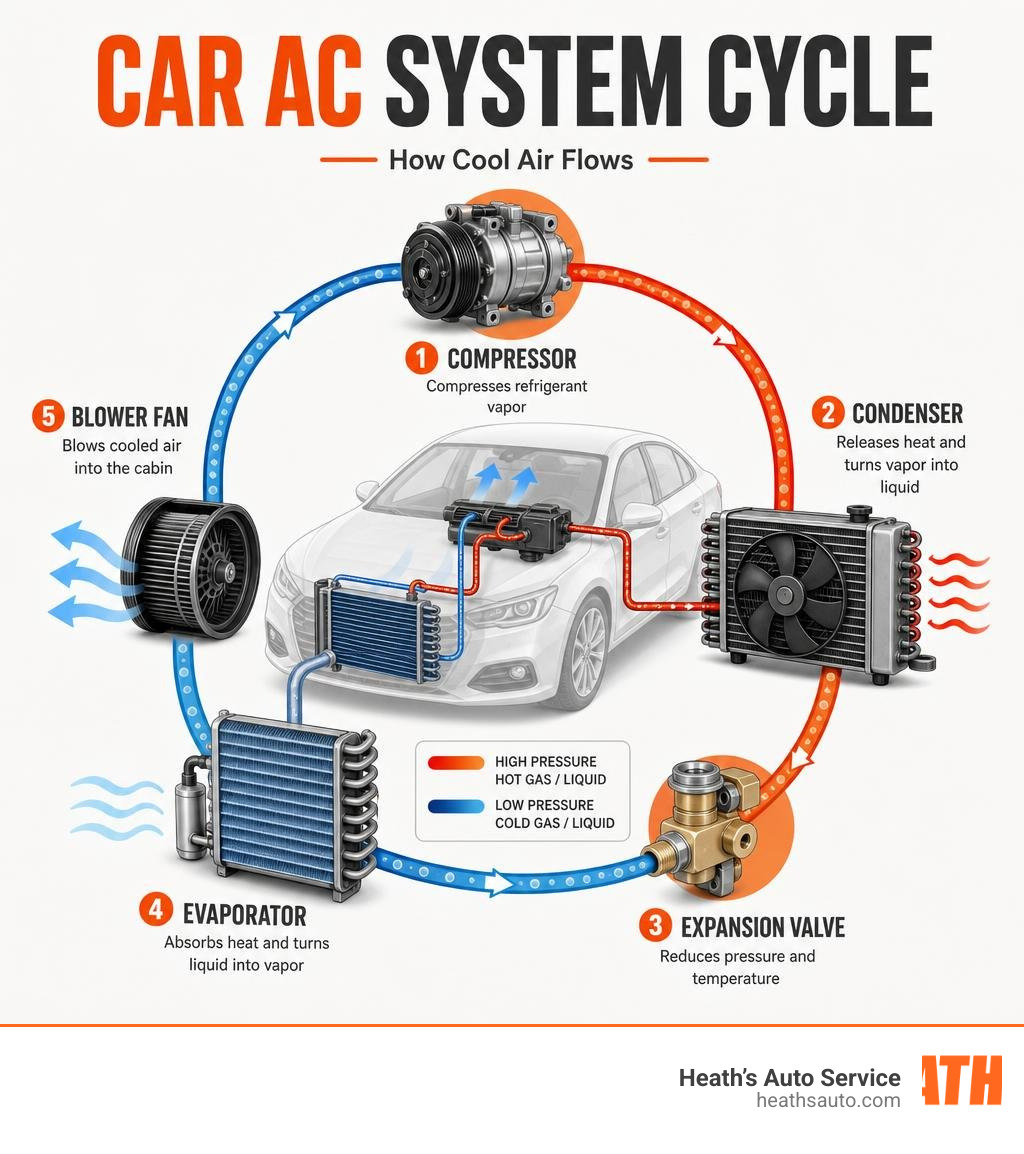
It accomplishes this through a closed-loop system that continuously circulates a specialized substance called refrigerant. This refrigerant transitions back and forth between a liquid and a gas state, absorbing and releasing heat as it goes.
Because it is a sealed system, the refrigerant should, in theory, last the lifetime of the vehicle. If your system is low on refrigerant, it means you have a leak. Simply adding more refrigerant without finding and fixing the leak is like trying to fill a bucket with a hole in the bottom.
Additionally, your AC doesn’t run on magic; it demands energy. The air conditioner receives energy from the alternator, which is powered directly by your car’s engine. This means your engine works a bit harder and consumes fuel to keep you cool. If you want to maximize your system’s output, check out our guide on How Can I Make My Cars A/C Cooler to optimize your cabin settings.
The Five Core Components of Your AC
Your vehicle’s climate control relies on five primary components working in perfect harmony:
- Compressor: Driven by an engine accessory belt, the compressor is the heart of the system. It pressurizes the refrigerant gas, turning it into a high-pressure, high-temperature gas and pumping it through the system.
- Condenser: Located right in front of your vehicle’s radiator, the condenser acts like a small radiator itself. As the hot, pressurized refrigerant gas flows through it, oncoming air cools it down, transforming it into a high-pressure liquid.
- Expansion Valve / Orifice Tube: This component acts as a gatekeeper. It restricts the flow of the high-pressure liquid refrigerant, allowing it to expand rapidly. This sudden drop in pressure causes the refrigerant’s temperature to plummet, turning it into a cold, low-pressure liquid.
- Evaporator: Tucked deep behind your dashboard, the evaporator is where the cooling magic happens. The cold liquid refrigerant flows through its coils.
- Blower Fan: The blower fan pushes warm cabin air across the freezing-cold evaporator coils. The refrigerant absorbs the heat from the air, and the newly cooled air is blown directly out of your dashboard vents. The warmed refrigerant then travels back to the compressor to start the cycle all over again.
Common Signs Your Car Needs Auto AC Repair

AC systems rarely fail without warning. Usually, they leave a trail of clues before they stop blowing cold air entirely. Recognizing these signs early can save you from a sweaty commute and prevent more extensive damage. If you are experiencing general heating or cooling failures, it is helpful to explore the common reasons behind an AC and Heat Not Working in Car to narrow down the culprit.
Keep an eye out for these five indicators:
- Weak Airflow: You turn the fan speed to maximum, but the air barely whispers out of the vents.
- Warm or Lukewarm Air: The air coming out of your vents is only slightly cooler than the outside temperature.
- Strange Noises: Squealing, grinding, or loud rattling noises when you turn the AC on usually point to a failing compressor clutch or a worn serpentine belt.
- Water Dripping Inside: If you notice water pooling on your passenger-side floor mat, your evaporator’s drain tube is likely clogged, causing condensation to overflow into the cabin.
- Foul Odors: A musty, moldy smell when the fan starts blowing indicates biological growth inside your dashboard.
Why Your AC is Blowing Warm Air
Blowing warm air is the single most common complaint we hear from Arizona drivers. If your system has transitioned from an icebox into a heater, several issues could be at play.
First and foremost is a refrigerant leak. Over time, rubber O-rings, hoses, and fittings can become loose, brittle, or cracked due to age and extreme engine bay heat. Once enough refrigerant escapes, the system loses the pressure required to trigger the compressor, leaving you with lukewarm air. For a detailed breakdown of how to address this specific issue, read our guide on Your Car AC Is Blowing Hot Air and Here Is How to Fix It.
Other culprits include a blocked or damaged condenser. Because the condenser sits at the very front of your vehicle, it can easily become clogged with road debris, leaves, or dirt, blocking the airflow needed to shed heat. Additionally, a failed cooling fan can prevent heat dissipation when your vehicle is idling, meaning your AC might only blow cold when you are actively driving down the highway.
Why Does My Car AC Smell Bad?
If your vents are blasting air that smells like a damp locker room, you aren’t alone. This unpleasant odor is typically caused by mildew or mold growth inside the dark, damp environment of your evaporator core, located just behind your dashboard. As moisture condenses on the evaporator during operation, it creates the perfect breeding ground for bacteria if it cannot drain properly.
A clogged cabin air filter is another common source of foul odors. This filter traps dust, pollen, and organic debris. When it becomes saturated and damp, it begins to smell. Regularly replacing your cabin air filter is crucial for peak AC performance, improved cabin air quality, and overall system longevity.
Demystifying the AC Recharge: What, When, and How
One of the most misunderstood services in the automotive world is the “AC recharge.” Many drivers believe that refrigerant is like engine oil or gasoline, something that naturally gets consumed and needs to be topped off periodically.
Let’s clear this up: a properly sealed AC system should never need a recharge. If your system is low on refrigerant, there is a leak that must be addressed.
A professional AC recharge is not a simple “top-off” from an aerosol can. It is a highly precise recover-vacuum-recharge procedure:
- Recovery: The technician uses a specialized machine to safely extract any remaining refrigerant from your vehicle without releasing it into the atmosphere.
- Vacuum: The machine pulls a deep vacuum on the system for 15 to 30 minutes. This boils off any moisture inside the lines (which can combine with refrigerant to create highly corrosive acid) and tests whether the system can hold a vacuum without leaking.
- Recharge: The technician refills the system with the exact weight of refrigerant specified by your vehicle’s manufacturer. Most standard passenger cars require between 28 and 32 ounces (about 2 to 3 standard 12-ounce cans) of refrigerant to operate correctly.
R-134a vs. R-1234yf Refrigerants
The automotive industry has transitioned between different types of refrigerants to meet evolving environmental regulations. Knowing which one your car uses is vital, as mixing them or using the wrong equipment will destroy your AC system. Refrigerant handling is also regulated, and the EPA provides information on Section 609 technician training and certification programs for motor vehicle air conditioning service.
| Feature | R-134a Refrigerant | R-1234yf Refrigerant |
|---|---|---|
| Primary Era | Vehicles manufactured from 1994 to 2020 | Most vehicles manufactured after 2021 |
| Environmental Impact | High Global Warming Potential (GWP) | Extremely low GWP; breaks down quickly |
| Flammability | Non-flammable | Mildly flammable (requires specialized handling) |
| Service Cost | Moderate ($150 – $250 typical recharge) | Higher due to expensive chemical formulation |
Technicians must use certified, dedicated recovery and charging machines for each specific refrigerant type to prevent cross-contamination.
How Often Should You Schedule Auto AC Repair and Maintenance?
While you shouldn’t need to recharge your system regularly, preventive maintenance is key to avoiding catastrophic failures. We recommend scheduling a professional AC system inspection every spring before the intense summer heat arrives.
Many manufacturers suggest a comprehensive AC inspection and recharge every three years to verify system pressures, check for microscopic leaks, and ensure the compressor oil is clean. Keeping up with this schedule protects your compressor from running dry, which is one of the most expensive automotive repairs you can face. To understand why this matters, read about The Importance of Regular AC Maintenance and Repair.
How Professional Technicians Diagnose and Fix AC Issues
When you bring your vehicle to an honest shop, they won’t guess at the problem. They will follow a systematic diagnostic process to pinpoint the exact root cause of your AC failure.
First, technicians connect a manifold gauge set to your system’s high-pressure and low-pressure service ports. By comparing these pressure readings to the manufacturer’s specifications under specific ambient temperatures, they can tell if the compressor is pumping correctly, if there is a restriction in the expansion valve, or if the system is undercharged.
To locate leaks, professionals rely on three primary tools:
- UV Dye: A fluorescent dye is injected into the system along with the refrigerant. Under a blacklight, any leak point will glow brightly, revealing the exact hose, seal, or component that has failed.
- Electronic Sniffers: These highly sensitive handheld devices can detect the chemical signature of escaping refrigerant gas, allowing technicians to find leaks hidden deep inside the dashboard or behind protective covers.
- Vacuum Decay Testing: Pulling a vacuum on the system and watching to see if the pressure rises over time confirms whether a leak is present.
If a major component like the compressor has suffered an internal mechanical failure, it often sheds tiny metal particles throughout the system. Simply putting a new compressor on will result in immediate failure as those metal shavings cycle back through. In these cases, a complete system flush is required, along with the replacement of the condenser, expansion valve, and the accumulator or receiver-drier.
If you are in northern Arizona and need comprehensive diagnostics, seeking out a professional, trusted local shop is the best way to ensure your system is accurately tested and repaired.
Understanding Car AC Repair Costs and Avoiding Upsells
One of the biggest fears drivers have is being quoted thousands of dollars for a repair they don’t actually need. Dealerships and less-reputable shops sometimes default to recommending a brand-new compressor or an entire system replacement when a simple $40 O-ring or a new relay would have solved the problem.
To avoid getting ripped off, always ask for a detailed written estimate that separates parts, labor, and diagnostic fees. If a shop recommends a major repair, ask them to show you the physical evidence — whether that is showing you the glowing UV dye at the leak site or demonstrating that the compressor clutch is physically seized.
If you want to know what to expect before you walk into a shop, review our breakdown on Car AC Repair Cost.
What Factors Affect the Cost of Auto AC Repair?
The cost of your repair depends heavily on which component has failed and how difficult it is to access.
- Minor Electrical / Controls: Replacing a blown fuse, an AC relay, or a faulty pressure switch is relatively inexpensive, usually running between $100 and $200.
- Refrigerant Recharge: A standard recover-vacuum-recharge service typically costs between $150 and $250 for R-134a systems, while R-1234yf systems will cost more due to the higher price of the gas.
- Compressor Replacement: Because the compressor is a complex mechanical pump, replacing it usually costs between $800 and $1,500, depending on the make and model of your vehicle.
- Evaporator Replacement: While the evaporator part itself isn’t incredibly expensive, it is buried deep behind your dashboard. Replacing it requires technicians to completely disassemble your dashboard, making labor the dominant cost. This repair can easily reach $1,200 to $2,000.
If you are looking for local services in our various service areas, Heath’s Auto Service offers convenient locations across Arizona to serve you. Whether you need assistance in the Verde Valley, the East Valley, or the Phoenix metro area, our professional teams in Flagstaff, Prescott, Gilbert, Scottsdale, Chandler, and Cottonwood are ready to help.
Preventive Maintenance Steps to Protect Your AC
You don’t have to wait for your AC to break down to take care of it. Following a few simple habits can extend the lifespan of your system components and keep your air blowing ice-cold for years:
- Replace Your Cabin Air Filter: Check and replace your cabin air filter every 12,000 to 15,000 miles, or more frequently if you drive on dusty Arizona dirt roads. A clogged filter restricts airflow, forcing your blower motor and compressor to work twice as hard.
- Run Your AC in the Winter: Many drivers never touch their AC button during the cooler winter months. However, running your AC for 10 minutes at least once a week during winter circulates the refrigerant and oil through the system. This keeps the rubber seals lubricated, preventing them from drying out, shrinking, and developing leaks.
- Keep the Condenser Clean: Regularly spray down the front of your car’s grille with a garden hose to wash away dead bugs, leaves, and dirt that have accumulated on the condenser. Unobstructed airflow is vital for efficient heat transfer.
For more practical tips on keeping your system running smoothly, check out our guide on Beat the Heat: The Importance of Auto AC Maintenance and Repair.
Frequently Asked Questions About Car AC Repair
Does running the car AC waste gas?
Technically, yes, but it is highly efficient. The AC compressor draws mechanical energy from the engine via an accessory belt, which increases the load on the engine and requires a small amount of extra fuel to operate. However, driving at highway speeds with your windows rolled down creates massive aerodynamic drag, which can actually waste more fuel than running the AC with the windows closed.
Can I recharge my car’s AC myself with a DIY kit?
We strongly advise against using DIY recharge kits from local auto parts stores. These cans usually feature cheap, inaccurate pressure gauges that only measure the low-pressure side of the system. Without knowing the high-side pressure, it is incredibly easy to overfill the system. Overfilling raises system pressure to dangerous levels, which can lock up your compressor, blow out seals, or permanently damage your system. Furthermore, DIY kits cannot pull a vacuum to remove moisture, meaning any corrosive acids inside your lines will continue to eat away at your system from the inside out.
Why does my AC blow cold on one side and warm on the other?
If you have dual-zone climate control and one side is freezing while the other is warm, the culprit is almost always a failing blend door actuator. This small electric motor controls the plastic doors inside your dashboard that mix hot and cold air to achieve your desired temperature. When the actuator fails or its plastic gears strip, the door gets stuck in one position, leaving you with uneven temperatures across the cabin.
Conclusion
Dealing with a broken car air conditioner in Arizona is never fun, but getting it fixed shouldn’t feel like a gamble. By understanding the basics of how your system works, recognizing the signs of trouble early, and knowing what to expect during a professional diagnosis, you can make informed decisions and protect your wallet.
Heath’s Auto Service in Cottonwood, AZ
At Heath’s Auto Service, our comprehensive range of services covers everything from routine maintenance to complex repairs. Whether it’s a minor tune-up or a major overhaul, trust us to get you back on the road with confidence. Contact our team at Heath’s Auto Service today!
We stand behind our work with our industry-leading 3-year/36,000-mile nationwide warranty, and our team of ASE-certified technicians is dedicated to providing same-day service to get you back on the road quickly. If you’ve been given an expensive estimate elsewhere and aren’t sure if you can trust it, bring it to us — we proudly offer free second opinions to ensure you get the honest service you deserve.