

Why a Shaking Steering Wheel When Braking Is a Warning You Shouldn’t Ignore
A shaking steering wheel when braking is one of the most common — and most misunderstood — car problems drivers face. It almost always points to something specific going wrong in your braking system, wheels, or suspension.
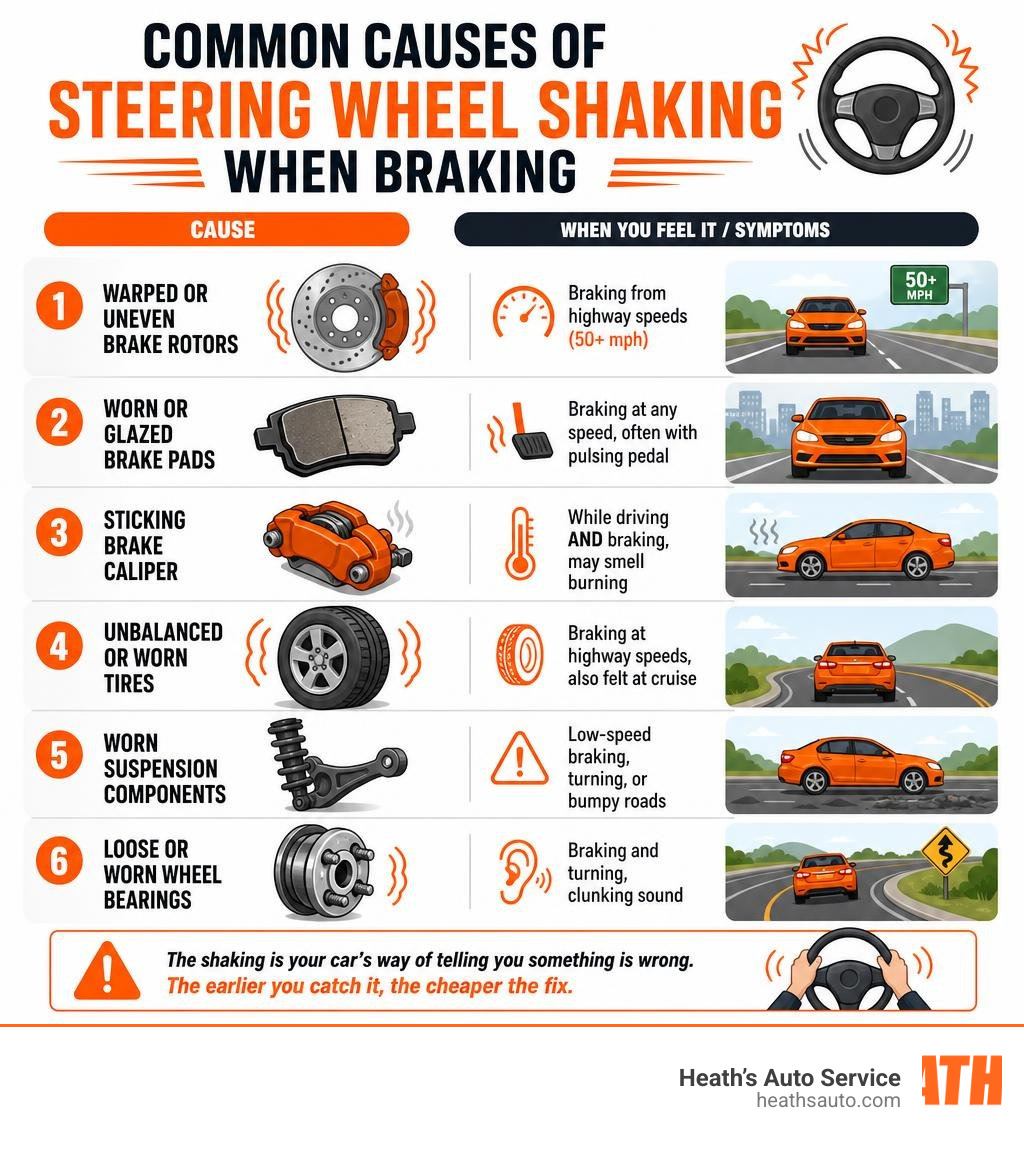
Here are the most common causes at a glance:
| Cause | When You Feel It |
|---|---|
| Warped or uneven brake rotors | Braking from highway speeds (50+ mph) |
| Worn or glazed brake pads | Braking at any speed, often with pulsing pedal |
| Sticking brake caliper | While driving AND braking, may smell burning |
| Unbalanced or worn tires | Braking at highway speeds, also felt at cruise |
| Worn suspension components | Low-speed braking, turning, or bumpy roads |
| Loose or worn wheel bearings | Braking and turning, clunking sound |
The shaking is your car’s way of telling you something is wrong. The earlier you catch it, the cheaper the fix.
At Heath’s Auto Service, our team has diagnosed hundreds of cases of shaking steering wheel when braking across our Arizona locations — from warped rotors on desert highway drivers to worn bushings on trucks hitting Prescott mountain roads. In the sections below, we’ll walk you through exactly how to identify the cause and what to do about it.
Shaking steering wheel when braking word guide:
What causes a shaking steering wheel when braking?

When your steering wheel begins to oscillate rapidly as you press the brake pedal, it is rarely a single isolated component acting up without reason. Instead, it is usually the result of a breakdown in the harmony of your front-end assembly.
To understand why this happens, we have to look at how your front wheels are put together. Most modern vehicles use a disc brake system. When you step on the brake pedal, hydraulic fluid forces the brake calipers to close. This squeezes the brake pads against the flat, metal brake rotors that spin along with your wheels. The resulting friction slows your vehicle down.
If any part of this system is uneven, damaged, or worn out, that friction becomes inconsistent. This inconsistency travels up through your steering rack, steering column, and directly into your hands.
The primary culprits behind a shaking steering wheel when braking include:
- Warped or uneven brake rotors: The absolute most common cause of steering wheel vibrations during braking.
- Worn or glazed brake pads: When pads wear down past their usable limit or overheat to the point of glazing, they lose their ability to grip the rotor evenly.
- Sticking brake calipers: If a caliper slide pin or piston seizes, the pad will drag against the rotor, causing extreme heat build-up and localized rotor wear.
- Worn wheel bearings: A loose or worn wheel bearing allows the entire wheel and hub assembly to wobble, a motion that is amplified when braking forces are applied.
- Degraded suspension bushings: Bushings act as the cushions of your suspension. When they fail, the control arms can move excessively, allowing the wheels to shimmy under load.
- Out-of-balance or unevenly worn tires: While tire issues usually cause vibrations at steady speeds, they can drastically amplify any minor braking vibrations.
If you are trying to understand the broader picture of front-end vibrations, you can Learn more about why your steering wheel is shaking to help narrow down the root cause.
How to tell if warped rotors are causing your shaking steering wheel when braking
When mechanics refer to “warped rotors,” they are usually describing a condition known as Disc Thickness Variation (DTV) or excessive lateral runout. Contrary to popular belief, cast iron brake rotors rarely bend like a vinyl record under normal driving conditions. Instead, they develop uneven wear patterns or uneven pad material deposits.
This process begins with lateral runout — a tiny wobble in the rotor as it spins. If a rotor is not seated perfectly flush against the wheel hub (often due to rust, dirt, or incorrect lug nut torque), it will wobble slightly back and forth. As you drive without touching the brakes, the brake pads will occasionally brush against the high spots of this wobbling rotor. Over thousands of miles, this off-brake contact wears down those specific spots, making the rotor thinner in some areas than others.
When you eventually step on the brakes, the pads squeeze against a disc that is, for example, 24mm thick in one spot and 23.95mm thick in another. This difference of just a few microns is enough to push the caliper pistons in and out rapidly, sending a hydraulic pulse back through the brake pedal and shaking your steering wheel.
Another major factor is metallurgy. Under extreme heat — such as descending the steep mountain passes around Flagstaff or Prescott — the friction between the pads and rotors can exceed 650°C (1,200°F). At these temperatures, the cast iron can undergo a structural change, converting into a super-hard crystalline compound called cementite. These “hot spots” are much harder than the surrounding iron. As the rest of the rotor wears down naturally, the cementite spots do not, leading to severe thickness variation that cannot easily be machined out.
For a deeper technical dive into how these forces interact to ruin your driving experience, check out this comprehensive Guide to diagnosing brake judder.
Why suspension wear mimics a shaking steering wheel when braking
Your vehicle’s suspension is designed to keep your tires firmly planted on the road while absorbing bumps. However, it also plays a critical role in keeping your steering stable when you slow down.
When you apply the brakes, a massive amount of forward force is transferred through your front tires and into your suspension components. Specifically, your lower control arms and their rubber bushings bear the brunt of this force. Over time, these rubber bushings dry out, crack, and tear. This is especially true in the dry, hot climates of Arizona cities like Scottsdale and Chandler, where high ambient heat accelerates rubber degradation.
Once a control arm bushing degrades, it can no longer hold the wheel assembly in its proper position under load. When you hit the brakes, the wheels are pulled backward. If one side has more play than the other, it causes a rapid shift in dynamic toe (the angle at which the front tires point toward or away from each other). This sudden toe change causes the front wheels to fight each other for traction, resulting in a violent shimmy that travels directly up the steering wheel.
Worn ball joints and loose tie rod ends can cause a similar effect. Because these joints connect your steering rack to your wheel knuckles, any play in them will allow the wheels to wobble back and forth when subjected to the high friction of braking.
If you notice a vibration that seems to occur even when you aren’t moving fast, reading up on Why your steering wheel shakes at low speeds can help you determine if your suspension is the true culprit.
Sticking brake calipers and dry guide pins
Your brake calipers rely on a floating design to apply even pressure to both sides of the rotor. To achieve this, the caliper body slides back and forth on metal guide pins. These guide pins must remain clean and lubricated with high-temperature silicone or ceramic grease to move freely.
If a rubber boot tears, moisture and road grime will enter the guide pin channel. This causes the pin to rust and seize. When this happens, the caliper can no longer center itself over the rotor. Instead of squeezing evenly from both sides, the caliper will apply pressure unevenly, forcing the rotor to flex slightly every time you step on the pedal. This uneven application of force is a direct trigger for severe steering vibrations.
Furthermore, a stuck caliper slide pin or a seized caliper piston will prevent the brake pads from retracting fully when you release the brake pedal. The pad will continue to drag against the rotor as you drive, generating immense thermal energy. This localized overheating quickly warps the rotor, glaze the brake pads, and can even boil your brake fluid.
You will often recognize a sticking caliper by a burning smell after driving, a vehicle that pulls to one side, or a vibration that gets progressively worse the longer you drive. To understand just how dangerous this condition can be, read about The scary reason your steering wheel shakes when you hit the brakes.
How to diagnose the source of your braking vibration
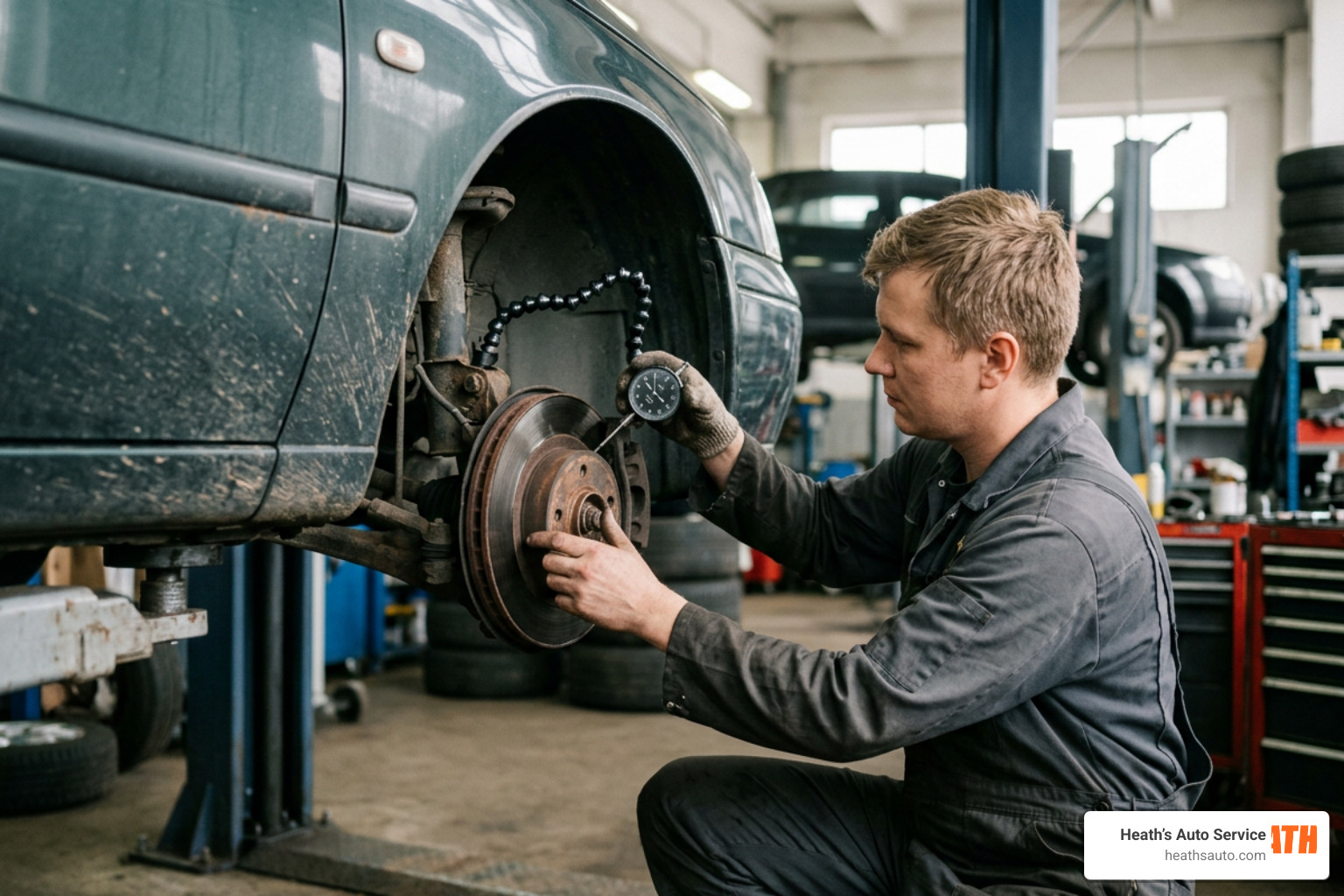
Diagnosing the exact source of a front-end vibration requires a systematic, step-by-step approach. You don’t want to throw money at new brakes if your real problem is a bent wheel or a torn suspension bushing.
Here is a quick diagnostic symptom comparison to help you pinpoint the issue:
| Symptom | Likely Cause | Next Step |
|---|---|---|
| Shaking felt only when pressing the brake pedal | Warped rotors or worn brake pads | Measure rotor runout with a dial indicator |
| Shaking felt at 55–70 mph, regardless of braking | Out-of-balance or flat-spotted tires | Visit a shop for a professional tire balance |
| Shaking accompanied by a rhythmic growling noise that changes when turning | Worn wheel bearing | Jack up the car and check for wheel play |
| Shaking at low speeds when braking on bumpy roads | Worn suspension bushings or ball joints | Inspect control arm bushings with a flashlight |
| Steering wheel shakes and car pulls hard to one side when braking | Seized caliper or collapsed brake hose | Check caliper slide pins and pad wear symmetry |
Our professional diagnostic process always begins with a road test to evaluate the frequency and behavior of the shake. Next, we lift the vehicle to perform a physical inspection of the steering linkage, suspension bushings, and tires. Finally, we use specialized measuring tools to check the brake components directly.
Identifying front brake issues vs tire or suspension problems
To narrow down the source of the shake, pay close attention to when and where you feel the vibration.
If the vibration is isolated to the steering wheel and occurs strictly when you apply the brakes, the issue is almost certainly in your front brakes. Because your front wheels are directly connected to your steering rack, any runout or thickness variation in the front rotors will translate into an immediate steering wheel shimmy. If your rear rotors are warped, you will generally feel the vibration in your seat or through the brake pedal itself, rather than the steering wheel.
Tire issues, on the other hand, behave differently. An out-of-balance tire or a bent rim will cause a constant vibration at highway speeds (typically between 55 and 75 mph) whether you are stepping on the brakes or not. If you have both an unbalanced tire and worn suspension bushings, the braking force can amplify this baseline tire vibration, making it feel like a severe brake issue.
To check for suspension play at home, you can safely jack up the front of your car and support it on jack stands. Grab one of your front tires at the 9 o’clock and 3 o’clock positions and wiggle it back and forth. Any noticeable clicking or play indicates a worn tie rod end or steering gear issue. Next, grab the tire at the 12 o’clock and 6 o’clock positions and wiggle it. Play here typically points to a failing wheel bearing or a worn ball joint.
Testing for warped rotors vs tire imbalance
If you want to prove beyond a doubt that your rotors are the cause of your shaking steering wheel when braking, you must measure their lateral runout and thickness variation.
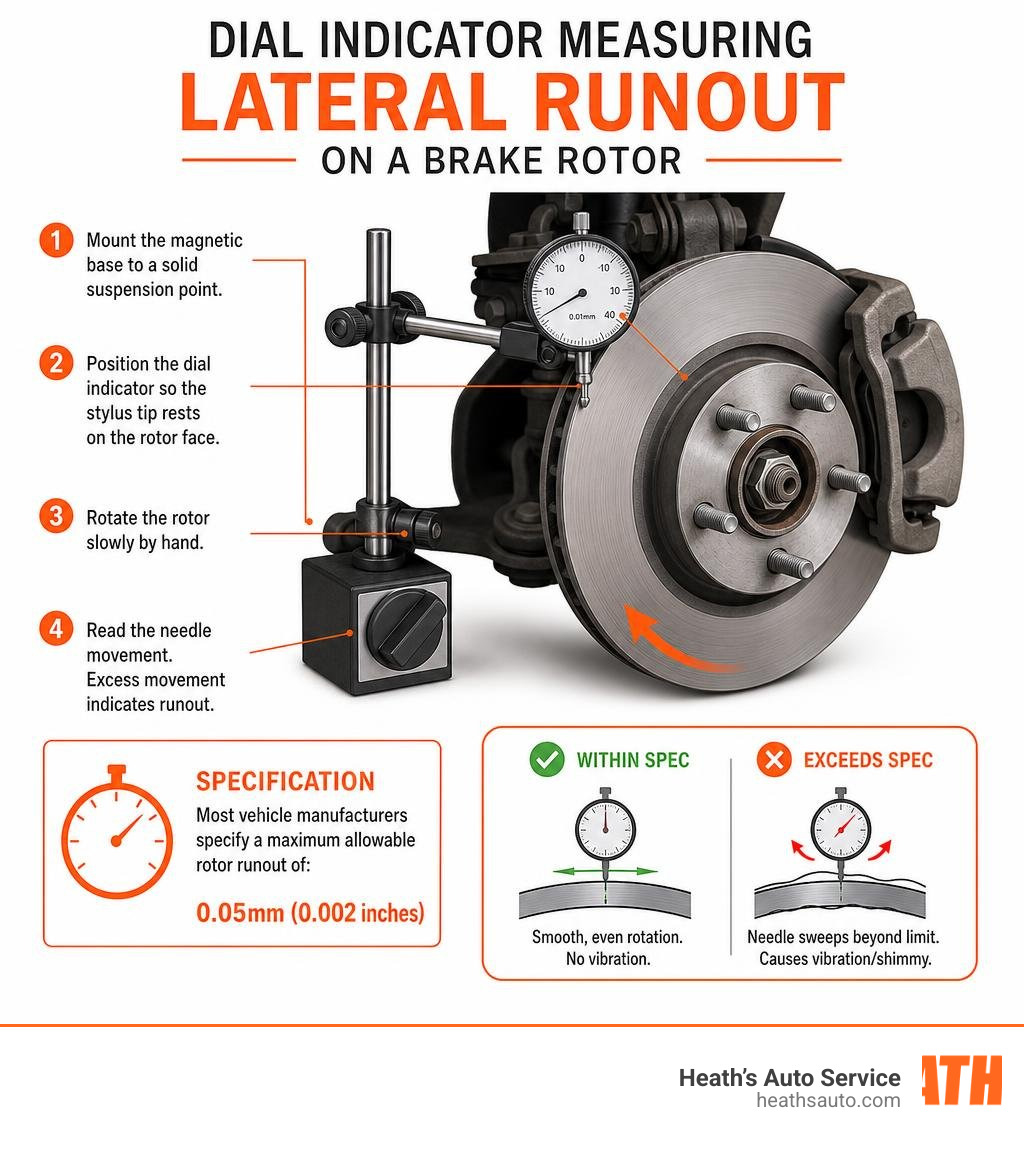
Professional shops use a tool called a dial indicator. We mount the magnetic base of the dial indicator to a solid suspension point (like the steering knuckle) and place the indicator’s stylus tip against the face of the brake rotor. As we slowly rotate the rotor by hand, the dial measures any microscopic lateral movement.
- Most vehicle manufacturers specify a maximum allowable rotor runout of just 0.05mm (0.002 inches).
- If the needle sweeps beyond this limit, the rotor is not spinning true and will cause a vibration under braking.
To check for tire imbalance, a technician must mount your wheel on a specialized balancing machine. This machine spins the tire at high speeds to locate heavy spots. It then guides the technician on where to apply small, lead-free counterweights to balance the weight distribution.
If you want to understand the mechanical differences between a true warped rotor and simple tire wear, you can read more via this My Honest Mechanic Brake Warp Article.
Recommended fixes for each common cause
Once you have diagnosed the root cause of the vibration, you can proceed with the correct repair:
- For Warped or Uneven Rotors: The best fix is to replace the rotors. While some shops offer rotor resurfacing (machining them flat on a lathe), this removes metal and makes the rotor thinner. Thinner rotors have less thermal mass, meaning they will overheat and warp again much faster.
- For Worn or Glazed Pads: Replace the brake pads. Always clean the caliper bracket hardware and apply high-temperature brake grease to the contact points where the pads slide.
- For Sticking Calipers: Replace the caliper if the piston is seized. If the issue is simply dry guide pins, they can be removed, cleaned of rust, lubricated with high-quality silicone grease, and reinstalled with new rubber boots.
- For Out-of-Balance Tires: Have a professional tire shop balance your wheels. We recommend having your tires balanced every 6,000 to 8,000 miles to prevent uneven wear.
- For Worn Suspension Components: Replace degraded control arm bushings, ball joints, or tie rod ends. Note: Any time you replace suspension or steering components, you must perform a professional wheel alignment afterward to prevent rapid tire wear.
To keep your vehicle stopping smoothly and safely, refer to our guide on How Often Should You Replace Your Brakes.
Should you replace rotors and pads at the same time?
Yes, you should always replace your brake pads and rotors at the same time. While it may be tempting to save a few dollars by slapping new pads onto old, uneven rotors (or vice versa), this is a false economy that will cost you more in the long run.
Brake pads and rotors are designed to wear together. When you install new brake pads, they have a perfectly flat friction surface. If you press those flat pads against an old rotor that has microscopic grooves, ridges, or thickness variations, the new pads will only make contact with the high spots of the rotor. This drastically reduces your stopping power and causes localized hot spots that can quickly ruin your new pads.
Furthermore, new pads must go through a process called bedding-in. During bedding-in, you perform a series of controlled, moderate stops to transfer a thin, even layer of friction material from the brake pad onto the fresh metal surface of the rotor. This “adherent friction” layer is what allows your brakes to operate smoothly and quietly. You cannot achieve a proper transfer layer on a dirty, worn, or previously glazed rotor.
For a detailed breakdown of what to expect when planning this service, check out our guide on Brake Replacement Cost.
Cost breakdown: Brakes vs tires and suspension
The cost to resolve a shaking steering wheel when braking depends heavily on which components have failed. Here is a general estimate of what you can expect to pay for various repairs:
- Front Brake Pad and Rotor Replacement: Typically ranges from $350 to $650 per axle, depending on your vehicle’s make and model. This includes new premium pads, new rotors, and labor.
- Caliper Replacement: If a caliper is seized, expect to add $150 to $300 per caliper to your brake job.
- Tire Balancing: A simple wheel balance is very affordable, usually costing between $50 and $100 for all four wheels.
- Four-Wheel Alignment: Essential after suspension work or to fix steering pull, typically costing $100 to $150.
- Suspension Bushing or Control Arm Replacement: Because suspension work can be labor-intensive, replacing control arms or bushings can range from $300 to $800 per side.
Ignoring a minor shake to save money now will ultimately cost you more. The constant vibration from warped rotors acts like a hammer on your front end, rapidly wearing out your wheel bearings, tie rod ends, and steering rack.
To learn more about how minor steering wheel vibrations can escalate into massive repair bills, read Don’t Let a Shaking Steering Wheel Ruin Your Need for Speed.
Frequently Asked Questions about braking vibrations
Is it safe to drive with a shaking steering wheel when braking, and for how long?
While you can technically drive with a mild steering wheel shake for a short period, it is not safe to ignore. Any vibration in your steering system reduces your tire’s contact limit with the road, which can increase your emergency stopping distance by up to 10 to 15 feet when stopping from 60 mph.
Over time, the shaking will also cause accelerated wear on your steering linkage, tie rod ends, and suspension bushings, turning a simple brake job into an expensive steering system rebuild. We recommend having any braking vibration inspected within a week of its first appearance.
What are the warning signs that I should stop driving immediately?
You should pull over safely and call for a tow if you experience any of the following:
- A loud metal-on-metal grinding noise when you press the brakes (indicating your pads are completely gone and you are damaging your calipers).
- The vehicle pulls violently to one side when braking.
- Your brake pedal feels soft, spongy, or sinks all the way to the floorboard.
- The red brake warning light or ABS light illuminates on your dashboard.
How often should I have my brakes and tires inspected?
To prevent steering wheel shaking before it starts, we recommend having your brakes and tires inspected every 6 months or 6,000 miles (typically during every oil change). Regular tire rotations and digital brake inspections allow technicians to catch uneven pad wear, torn caliper boots, or early tire cupping before they develop into noticeable vibrations.
Conclusion
A shaking steering wheel when braking is more than just an annoying distraction — it is a direct compromise to your vehicle’s safety and handling. Whether your vehicle is suffering from heat-damaged rotors, worn control arm bushings, or out-of-balance tires, getting a professional diagnosis is the fastest way to restore your peace of mind on the road.
Heath’s Auto Service In Scottsdale, AZ
At Heath’s Auto Service, we offer a comprehensive range of services and repairs to meet all your automotive needs. Our highly skilled technicians are equipped with the latest tools and technology to ensure your vehicle is serviced to the highest standards. Contact our team today!