

How Much Does a Car Tune-Up Cost? (Quick Answer for 2026)
Understanding car tune up cost is something every driver needs — especially before handing over their keys and getting hit with a surprise bill.
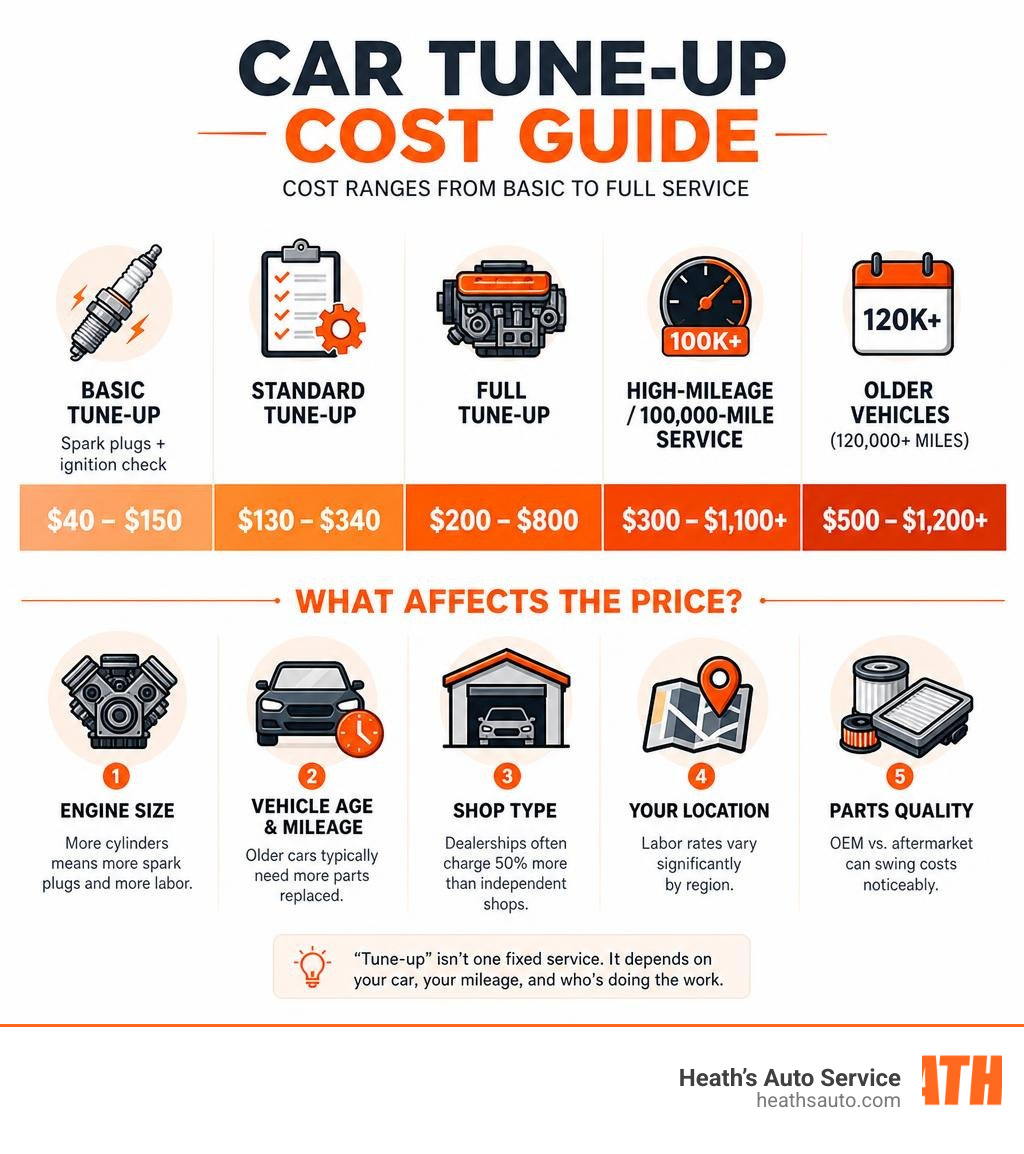
Here’s a fast breakdown so you can gauge what’s fair:
| Service Level | Typical Cost Range |
|---|---|
| Basic tune-up (spark plugs + ignition check) | $40 – $150 |
| Standard tune-up | $130 – $340 |
| Full tune-up | $200 – $800 |
| High-mileage / 100,000-mile service | $300 – $1,100+ |
| Older vehicles (120,000+ miles) | $500 – $1,200+ |
What moves the price up or down?
- Engine size — more cylinders means more spark plugs and more labor
- Vehicle age and mileage — older cars typically need more parts replaced
- Shop type — dealerships often charge 50% more than independent shops
- Your location — labor rates vary significantly by region
- Parts quality — OEM vs. aftermarket can swing costs noticeably
The wide range exists because “tune-up” isn’t one fixed service. It means different things depending on your car, your mileage, and who’s doing the work. That’s exactly what this guide breaks down.
At Heath’s Auto Service, we have years of hands-on experience helping Arizona drivers understand and manage their car tune up cost across our locations in Flagstaff, Scottsdale, Cottonwood, and Prescott. In the sections ahead, we’ll walk you through everything — from what a modern tune-up actually includes to how to avoid overpaying.
What is a Modern Car Tune-Up?

When people talk about a “tune-up,” they are often using a catch-all term for preventive engine maintenance. In the broadest sense, a tune-up is designed to restore engine performance, boost fuel efficiency, and catch minor issues before they turn into catastrophic engine failures.
Historically, this meant adjusting mechanical parts to make the engine run in perfect harmony. Today, a tune-up focuses on replacing wear-and-tear components that directly impact your vehicle’s combustion process.
The most critical elements of a tune-up revolve around the ignition system and the filtration systems. Over time, your engine’s spark plugs degrade, filters clog, and electrical connections weaken. By systematically inspecting and replacing these parts, we ensure your engine gets the correct mixture of air, fuel, and spark.
For a complete look at how this fits into your overall car care plan, check out A Guide to General Auto Repair Services.
Traditional vs. Modern Engine Maintenance
To understand why the car tune up cost can feel a bit mysterious, we have to look at how cars have changed.
Decades ago, cars relied on carburetors, mechanical distributors, and points. A mechanic had to physically adjust the carburetor’s air-fuel mixture and set the ignition timing by hand. These older vehicles required a tune-up as often as every 5,000 to 12,000 miles.
Today, those mechanical systems have been entirely replaced by electronic ignition and highly sophisticated computer networks. Modern vehicles use onboard diagnostics (OBD-II) and computer scanners to monitor engine performance in real-time. The computer automatically adjusts the fuel injection and spark timing thousands of times per second.
Because of this digital evolution, modern tune-ups are less about fine-tuning mechanical adjustments and more about replacing long-life components when they finally wear out.
Core Components of a Standard Service
When you bring your car in for a standard tune-up in 2026, the service typically includes:
- Spark Plugs: The heart of the ignition system. They provide the spark that ignites the air-fuel mixture in your engine cylinders.
- Engine Air Filter: This keeps dirt, dust, and road debris out of your engine. A clogged filter starves the engine of oxygen, hurting your fuel economy. You can read more about this in our guide on How Often to Change Your Air Filter in Your Car.
- Fuel Filter: This prevents dirt and rust in your fuel tank from reaching your engine’s sensitive fuel injectors.
- PCV Valve: The Positive Crankcase Ventilation valve routes escape gases back into the combustion chamber. If it sticks, it can cause oil leaks and rough idling.
- Oxygen Sensor & Ignition Coils: While not always replaced during every tune-up, we inspect these to ensure your engine is firing cleanly. On older pre-2000 vehicles, this list would also include replacing the distributor cap and rotor.
Understanding Your Car Tune Up Cost
Because every vehicle has a unique design and service history, there is no single flat rate for a tune-up. The level of service your car needs is the primary driver of the final price.
| Service Level | Est. Parts Cost | Est. Labor Cost | Total Average Cost |
|---|---|---|---|
| Basic Service | $20 – $50 | $30 – $100 | $50 – $150 |
| Standard Service | $50 – $120 | $80 – $220 | $130 – $340 |
| Full / Comprehensive | $100 – $300 | $150 – $500 | $250 – $800 |
| High-Mileage (100k+) | $200 – $500 | $250 – $600 | $450 – $1,100+ |
For more national context on these price ranges, you can review the Tune-Up Cost Guide – How Much is a Tune-Up? – AutoZone.
Basic Car Tune Up Cost Breakdown
A basic tune-up is highly targeted. It generally consists of replacing the spark plugs and performing a visual inspection of the ignition wires and coils.
If you drive a standard four-cylinder commuter car, a basic service is relatively inexpensive. The parts themselves are affordable, and a professional mechanic can typically complete the job in under an hour.
However, even basic services can vary based on the type of spark plugs your car requires. Older copper plugs are cheap but wear out fast, whereas modern iridium and platinum plugs cost more upfront but last much longer. For a detailed breakdown of these components, see our guide on Spark Plug Replacement Costs in 2026.
Full and 100,000-Mile Car Tune Up Cost Factors
Once a vehicle crosses the 100,000-mile threshold, a tune-up becomes a much more comprehensive event. At this stage, we aren’t just looking at spark plugs. A full high-mileage tune-up frequently includes:
- Replacing the spark plugs and ignition coils
- Replacing the engine air filter and cabin air filter
- Flushing vital fluids (coolant, brake fluid, transmission fluid)
- Inspecting and replacing worn serpentine belts or the timing belt
- Cleaning the fuel injectors and throttle body
Because of the sheer volume of parts and the hours of labor required to perform these deep-system flushes and replacements, a 100,000-mile service can easily range from $450 to $1,100+. Dealerships will often push this price even higher.
If you are looking for local pricing trends in northern Arizona, check out our regional guide on Car Tune Up Costs in Cottonwood AZ 2026.
Key Factors That Influence the Price of a Tune-Up

If you have ever wondered why your neighbor paid $150 for a tune-up while your bill came out to $450, it usually comes down to a few very specific cost drivers. To get a broader look at how these factors interact, you can check out the comprehensive breakdown on How Much Does a Tune-Up Cost? – Jerry.
Vehicle Make, Model, and Engine Complexity
The physical design of your engine is the single biggest factor in your car tune up cost:
- Cylinder Count: A 4-cylinder engine only has four spark plugs. A V6 has six, and a V8 has eight. More cylinders mean more parts and more labor time.
- Engine Layout (Buried Plugs): In many inline-4 engines, the spark plugs sit right on top of the engine, easily accessible. In many V6 and V8 engines—especially in modern SUVs and minivans—the rear bank of spark plugs is buried underneath the intake manifold. A mechanic might have to spend two hours just removing engine components to reach the plugs, which heavily drives up labor costs.
- Luxury and European Vehicles: BMW, Mercedes-Benz, and Audi vehicles often require specialized diagnostic software and proprietary parts, pushing service costs into the $500 to $1,200 range.
Service Provider Type: Dealership vs. Independent Shop vs. DIY
Where you take your vehicle will make a massive difference in your final invoice:
- Dealerships: Dealerships have the highest labor rates (often 50% higher than independent shops) and exclusively use Original Equipment Manufacturer (OEM) parts. While OEM parts offer guaranteed fitment, they come with a premium price tag.
- Independent Shops: Independent auto repair shops (like us!) offer the best balance of quality and value. We employ ASE-certified technicians and can offer both high-quality aftermarket parts and OEM parts, saving you 30% to 50% compared to dealer prices.
- DIY (Do-It-Yourself): If you are mechanically inclined, replacing your own spark plugs and air filters can save you a bundle on labor. However, modern engines are packed with fragile sensors, plastic clips, and complex wiring harnesses. One wrong turn of a wrench can strip an aluminum cylinder head or crack an ignition coil, turning a $100 DIY project into a $1,500 professional repair.
When and How Often Should You Get a Tune-Up?
The old advice of getting a tune-up every year or two simply doesn’t apply to modern vehicles. To keep your car running smoothly without throwing money away on premature maintenance, you need to align your service with your specific vehicle’s needs.
You can read our complete breakdown on this topic in How Often to Get a Tune Up.
Warning Signs Your Vehicle Needs Attention
Sometimes your car will tell you it needs help long before you hit your next mileage milestone. Keep an eye and ear out for these common warning signs:
- Rough Idling: If your car shakes, vibrates, or feels like it’s struggling to stay running while sitting at a red light in Scottsdale or Gilbert, you likely have a dirty filter or a failing spark plug.
- Engine Misfires: A misfire feels like a sudden hesitation, jerking, or sputtering when you step on the gas pedal.
- Check Engine Light: Modern engine computers are incredibly sensitive. If a spark plug fails to ignite properly, the computer will instantly throw a misfire code and illuminate your check engine light.
- Poor Acceleration: If your car feels sluggish or heavy when trying to merge onto the highway, restricted airflow or weak spark is often to blame.
Recommended Intervals for Older vs. Newer Cars
Service intervals are heavily dictated by the technology under the hood:
- Older Vehicles (Pre-2000): These cars often rely on copper spark plugs that wear down quickly. They typically need a tune-up every 30,000 to 50,000 miles.
- Modern Vehicles: Most cars built in the last 15 years utilize high-performance platinum or iridium spark plugs. These advanced materials can easily last 60,000 to 100,000 miles before needing replacement.
To make sure you never miss a vital service, we recommend keeping a close eye on your specific Car Maintenance Schedule.
Frequently Asked Questions About Car Tune-Ups
Is a tune-up the same as an oil change?
No, they are entirely different services. An oil change is a frequent maintenance task (typically performed every 5,000 to 10,000 miles) that involves draining old engine oil and replacing the oil filter to keep the engine lubricated. A tune-up is a less frequent, deeper service that focuses on the ignition system, air-fuel delivery, and engine diagnostics.
To learn why keeping up with your oil is so critical, read about The Importance of Regular Oil Change Services for Your Vehicle.
Can a tune-up fix a check engine light?
Yes, but only if the light is being triggered by a component addressed during a tune-up. If your check engine light is on because of a cylinder misfire (common codes P0300 through P0308), replacing worn spark plugs or a bad ignition coil will solve the problem. However, if the light is on due to an evaporative emissions leak or a transmission fault, a standard tune-up will not fix it. A professional diagnostic scan with an OBD-II reader is always the first step.
Is a tune-up worth the investment?
Absolutely. Spending $200 to $400 on a professional tune-up can save you thousands of dollars down the road. Worn-out spark plugs cause incomplete combustion, which dumps raw fuel into your exhaust system. This quickly destroys your catalytic converter—a repair that easily costs $1,500 to $3,000. Furthermore, restoring your engine’s efficiency can improve your fuel economy by up to 10% to 20%, putting money back in your pocket at the pump.
Conclusion
Managing your car tune up cost doesn’t have to be a stressful guessing game. By understanding what your specific vehicle requires and recognizing the early warning signs of engine wear, you can make smart, budget-friendly decisions for your car’s longevity.
Heath’s Auto Service In Flagstaff, AZ
At Heath’s Auto Service, our commitment to the community is built on a foundation of expert diagnostics and honest communication. We don’t just want to fix your car; we want to make sure you feel safe every time you turn the key. If you’re looking for our Flagstaff Location, you’ll find a team of professionals ready to treat your vehicle like it was our own.