
What Does It Really Cost to Replace a Cat Converter in 2026?
The cost to replace cat converter on most vehicles in 2026 falls somewhere between $900 and $3,500 — but the number on your quote can look very different depending on your car, your state, and the type of part used.
Here’s a quick breakdown before we get into the details:
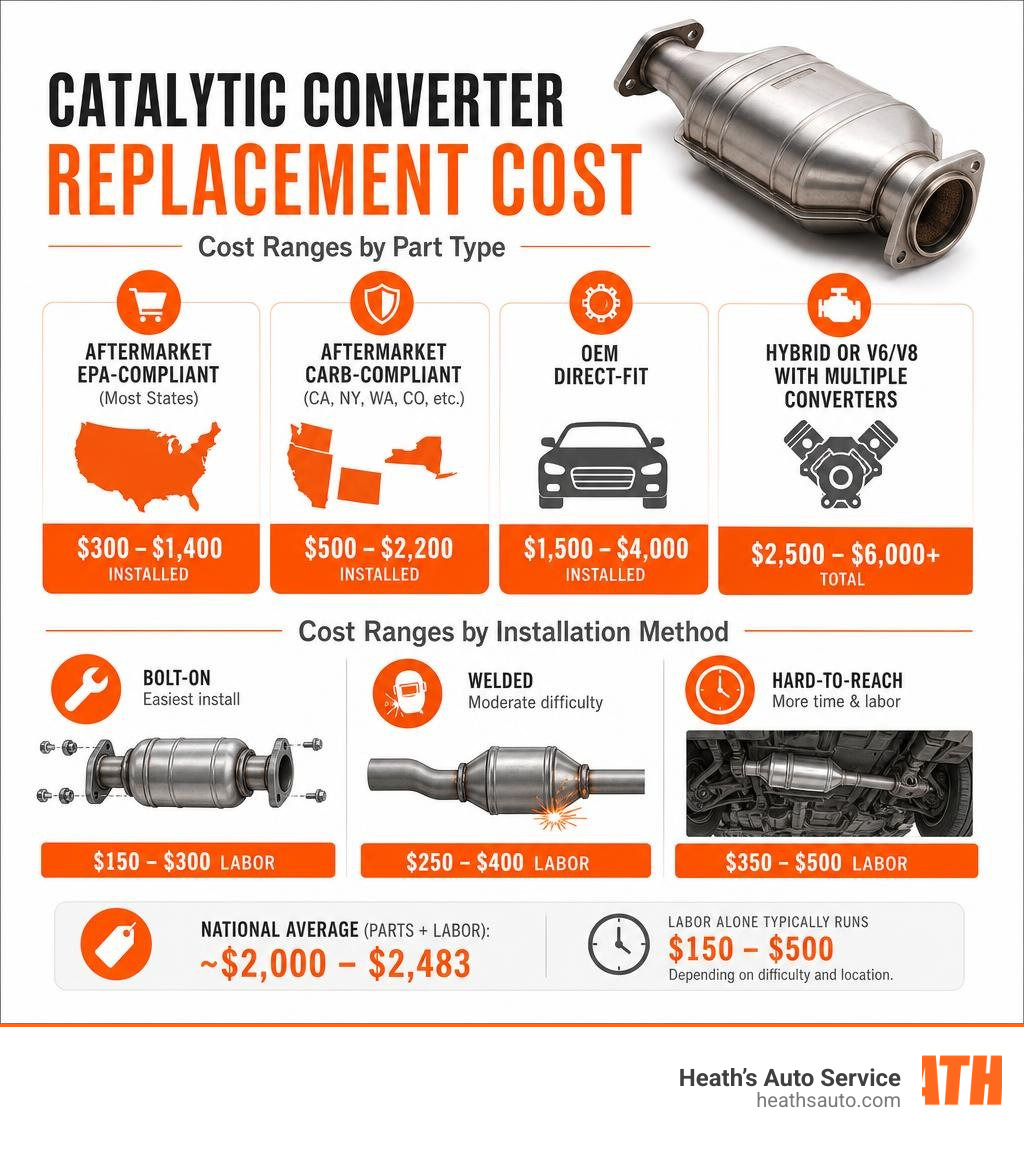
| Scenario | Estimated Total Cost |
|---|---|
| Aftermarket EPA-compliant (most states) | $300 – $1,400 installed |
| Aftermarket CARB-compliant (CA, NY, WA, CO, etc.) | $500 – $2,200 installed |
| OEM direct-fit replacement | $1,500 – $4,000 installed |
| Hybrid or V6/V8 with multiple converters | $2,500 – $6,000+ total |
| National average (parts + labor) | ~$2,000 – $2,483 |
Labor alone typically runs $150 to $500, depending on how hard the converter is to reach and whether it’s bolted or welded in place.
If your quote is way above or below these ranges, there’s usually a reason — and it’s worth understanding why before you sign anything.
At Heath’s Auto Service, after years of diagnosing and replacing catalytic converters across Arizona, our team has seen how the cost to replace cat converter can vary wildly based on vehicle type, part choice, and shop. In the sections below, we’ll walk you through exactly what drives those numbers — so you can make a confident, informed decision.
Cost to replace cat converter terms to learn:
What is the Average Cost to Replace Cat Converter in 2026?
When you sit down to look at a professional repair estimate, the total average cost to replace cat converter units in 2026 typically sits between $2,164 and $2,483. While that might cause some immediate chest pain, understanding how that number is divided can help demystify the bill.
According to national data from RepairPal, the bulk of this expense lies in the part itself:
- Parts Cost: $1,950 to $2,169
- Labor Cost: $214 to $314
Looking at broader market trends, the average price tag for this repair ranges from $945 to $3,416, with a median cost of $2,180. Over the last five years, prices have climbed by about 17.7% due to the rising costs of raw materials and manufacturing.
At our shops, we know that spending thousands of dollars on an exhaust part is never how you want to spend your week. If you want to understand why these parts have become so expensive and how the technology has evolved, check out The Ultimate Guide to Catalytic Converter Replacement Cost for a deeper dive into the mechanics of emissions pricing.
OEM vs. Aftermarket: How Part Types Affect the Cost to Replace Cat Converter
The single biggest decision that will dictate your final bill is the type of replacement converter you choose. You generally have three main routes to go: OEM, direct-fit aftermarket, or universal aftermarket.
- OEM (Original Equipment Manufacturer) Parts: These are built by your vehicle’s manufacturer. They are guaranteed to fit perfectly, clear your check engine light, and last for another 100,000 to 150,000 miles. However, they are incredibly expensive, often running between $1,500 and $4,000 for the part alone.
- Aftermarket Direct-Fit Parts: These are manufactured by third-party brands to match your vehicle’s exact specifications. If you live in Arizona, you can use EPA-compliant aftermarket parts, which cost significantly less ($300 to $1,400 installed).
- Universal Aftermarket Parts: These are generic converters designed to work on a wide variety of vehicles. They are the cheapest option upfront (often $200 to $300 for the part), but they require the technician to cut out your old unit and weld the new one in place, which raises labor costs.
- CARB-Compliant Aftermarket Parts: If your vehicle was originally manufactured to meet California emissions standards, or if you plan to register it in a CARB-governed state, you must buy a CARB-compliant part. These contain a higher concentration of precious metals and cost about 40% to 80% more than standard EPA parts.
| Part Tier | Average Part Cost | Labor Complexity | Best Suited For |
|---|---|---|---|
| OEM Direct-Fit | $1,500 – $3,500+ | Low (Bolt-on) | Newer cars, luxury vehicles, maximum longevity |
| Aftermarket EPA Direct-Fit | $300 – $900 | Low (Bolt-on) | Out-of-warranty daily drivers in Arizona |
| Aftermarket CARB Direct-Fit | $500 – $1,600 | Low (Bolt-on) | Vehicles requiring strict emissions compliance |
| Universal Aftermarket | $150 – $400 | High (Requires welding) | Older budget vehicles, discontinued models |
To get a more tailored estimate based on your specific vehicle and location, you can try using the Catalytic Converter Replacement Cost Calculator to see how these tiers shake out for your car.
How to Evaluate Your Repair Quote
When a shop hands you an estimate, don’t just look at the bottom line. A fair, professional quote should be fully itemized so you know exactly where your hard-earned money is going. Here is what you should look for:
- Diagnostic Fee: Typically ranges from $50 to $150. This covers the technician’s time to connect diagnostic scanners, perform backpressure tests, and verify that the converter is actually the problem.
- The Converter Part: The quote should clearly state whether they are installing an OEM, direct-fit aftermarket, or universal unit.
- Hardware and Gaskets: Replacing a converter usually requires new gaskets, bolts, and flanges ($20 to $100) to prevent exhaust leaks.
- Labor Hours: Look at the hourly rate and the estimated time. A standard bolt-on job should take 1 to 2 hours, whereas welded or manifold-integrated units take longer.
- Shop Fees and Taxes: These cover hazardous waste disposal, rags, solvents, and local taxes ($15 to $50).
If a quote seems suspiciously low, the shop might be using a cheap, non-compliant universal converter that will trigger your check engine light again in three months. If it’s exceptionally high, make sure they aren’t unnecessarily adding parts you don’t need.
Key Factors That Drive Catalytic Converter Replacement Costs
Not all cars are created equal, and neither are their exhaust systems. Several physical and mechanical factors can cause your repair bill to skyrocket.
- Vehicle Make and Model: Luxury European brands (like BMW or Lexus) and hybrid vehicles (like the Toyota Prius) have incredibly expensive converters. Conversely, domestic trucks and simple economy cars tend to have more affordable parts.
- Engine Design and Number of Converters: A simple inline-four engine only has one catalytic converter. However, V6 and V8 engines have two separate cylinder banks, meaning they often have two, three, or even four converters. If you have a V8 Ford F-150, replacing the entire system can easily double or triple your parts costs.
- Rust and Age: Vehicles that have spent time in snowy climates or damp environments often have severe rust on the exhaust system. When bolts are seized and flanges are rusted solid, a simple bolt-on job turns into a battle of torches, air hammers, and custom welding.

Additionally, upstream engine problems can cause issues that look like a bad converter. For instance, a cracked exhaust manifold can leak air, tricking your oxygen sensors and throwing codes. If you suspect your exhaust system has leaks elsewhere, read about how the following problems are caused by a leaking exhaust manifold to make sure you’re fixing the actual root cause.
Labor Rates and Installation Complexity
While parts make up the lion’s share of the bill, labor rates and the time required for the physical swap play a major role.
In most independent shops, labor rates range from $100 to $200 per hour, while dealerships can charge $200 to $300+ per hour. A straightforward, bolt-on replacement on a modern, rust-free car typically takes about 1.5 to 2 hours.
However, if your catalytic converter is integrated directly into the exhaust manifold (a common design in modern compact cars to help the catalyst heat up faster), the technician has to disassemble parts of the engine bay just to access it. This can easily push the labor time to 3 or 4 hours. For a complete look at what to expect timeline-wise, check out our guide on how long does it take to install a catalytic converter.
Cleaning vs. Replacing: When Can You Save Money?
Before you write a massive check for a brand-new converter, it is always worth asking: Can this thing be saved?
If your check engine light is on but the vehicle is still running fine, the catalyst inside might simply be coated in soot, carbon, or light oil residue. In these cases, trying a high-quality chemical cleaning additive (like Cataclean or CRC) for $30 to $50 is a smart first step. It works in about 15% to 25% of mild contamination cases.
To determine if cleaning is a viable option, a technician will perform a backpressure test:
- Under 1.5 PSI (at 2,500 RPM): The converter is not physically blocked. A chemical clean or a hard highway drive (known as an “Italian tune-up”) may successfully clear the catalyst.
- Above 3.0 PSI: The internal ceramic honeycomb has likely melted, shattered, or become severely clogged. At this stage, cleaning will do nothing, and the unit must be replaced.
If you are looking for temporary or budget-friendly ways to address a failing emissions system before committing to a full replacement, take a look at our guide on catalytic converter alternatives: cheap fixes before you replace the cat.
Recognizing the Signs of a Failing Catalytic Converter
How do you know if your converter is actually on its deathbed? Watch out for these classic warning signs:
- The Dreaded P0420/P0430 Code: This is the most common indicator. It means your car’s computer has detected that the converter’s oxygen storage capacity has dropped below a safe threshold. You can learn more about diagnosing this in our article on the P0420 Code: When Your Check Engine Light Is On.
- Rotten Egg Smell: If you notice a strong sulfur smell coming from your exhaust, it means the converter is failing to properly process hydrogen sulfide in the fuel.
- Rattling Noise: If the ceramic honeycomb structure inside the metal shell shatters, it will rattle like a can of spray paint when the vehicle is idling or accelerating.
- Loss of Performance: A severely clogged converter acts like a plug in your engine’s throat, causing sluggish acceleration, poor fuel economy, or stalling.
If you want to see a full list of physical symptoms and learn how to spot a failing unit early, read our slug failing catalytic converter signs guide.
Theft, Insurance, and Legal Implications
If you’ve turned on your car in the morning and heard a deafening roar like a NASCAR stock car, you already know the nightmare of catalytic converter theft.
Thieves target converters because of the precious metals inside: platinum, palladium, and rhodium. Rhodium, in particular, has seen extreme price spikes over the last several years, occasionally trading for over $10,000 per ounce. Because a thief can slide under a car and cut a converter out in under two minutes with a battery-powered saw, vehicles with high ground clearance (like trucks and SUVs) and hybrids (which contain higher concentrations of precious metals) are prime targets.
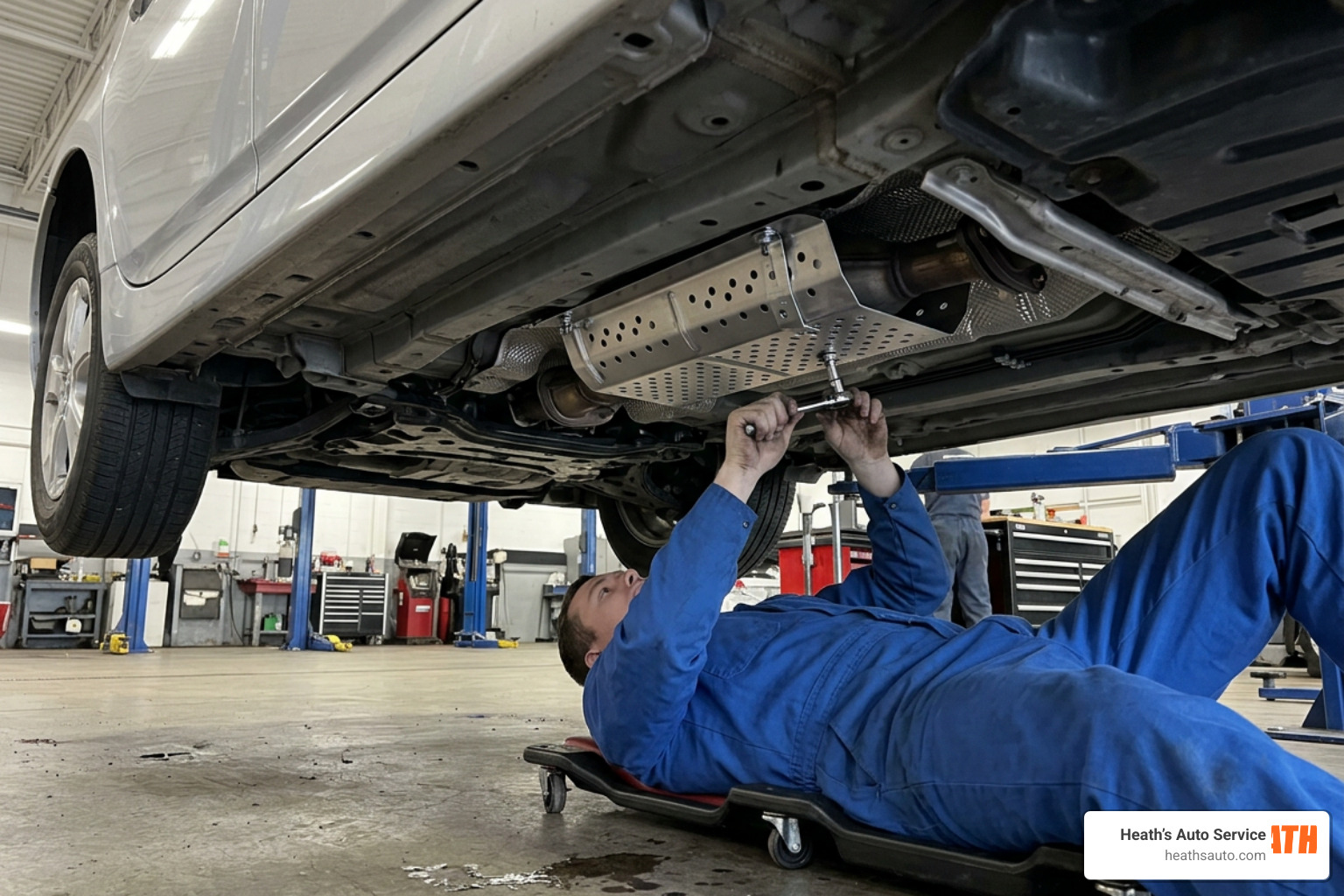
Installing a metal shield or a security cage (like a CatClamp) for $150 to $300 is a highly effective way to protect your vehicle and avoid a massive surprise bill.
Does Insurance or Warranty Cover the Cost to Replace Cat Converter?
If your converter fails due to normal wear and tear, standard auto insurance will not cover it. However, if your converter is stolen, it is a completely different story:
- Comprehensive Insurance: If you carry comprehensive coverage on your policy, insurance will typically cover the cost of the replacement, minus your deductible. That a theft claim might also require replacing cut exhaust pipes or damaged oxygen sensors, which can drive the total repair bill higher.
- Federal Emissions Warranty: Under federal law, major emissions control components (including the catalytic converter) are covered by the manufacturer for 8 years or 80,000 miles (whichever comes first). If your vehicle is within this window and the converter fails naturally, the dealer must replace it for free.
- Extended Warranties: Some aftermarket extended warranties cover emissions components, but you must read the fine print carefully, as many exclude exhaust piping and catalytic converters.
Legal and Emissions Compliance Standards
It can be tempting to look for cheap shortcuts, but bypassing your emissions system is a legal minefield.
Under federal EPA regulations, it is illegal to remove, bypass, or “hollow out” a catalytic converter on any vehicle driven on public roads. Doing so will trigger a permanent check engine light, cause your vehicle to fail standard emissions testing, and can result in thousands of dollars in fines.
While Arizona doesn’t follow California’s ultra-strict CARB rules statewide, vehicles registered in certain areas (like metro Phoenix or Tucson) must still pass regular emissions testing to maintain registration. Using an unapproved or non-compliant converter will result in an automatic inspection failure.
Frequently Asked Questions About Catalytic Converter Costs
Can I drive with a bad catalytic converter?
It depends on how it failed. If it’s simply throwing a mild efficiency code (like P0420) but isn’t physically blocked, you can usually drive it for a short period. However, if the converter is clogged or melted, it will restrict exhaust flow. This causes heat to back up into the engine, which can lead to severe engine damage, blown gaskets, or even engine failure.
Why are catalytic converters so expensive?
The cost is driven entirely by the precious metals inside (platinum, palladium, and rhodium) which act as the catalyst to scrub harmful gases. Because these metals are incredibly rare and difficult to mine, their market prices are exceptionally high, which directly inflates the manufacturing cost of the part.
Can I install a used catalytic converter?
No. Federal EPA law strictly prohibits auto repair shops from installing used or salvage catalytic converters unless they meet highly specific, documented testing criteria (which is incredibly rare). Used converters almost always fail within a few months anyway, making them a poor investment.
Conclusion
Facing a catalytic converter replacement can certainly bring on some serious sticker shock. But by understanding the difference between OEM and aftermarket parts, recognizing the early signs of failure, and acting quickly, you can keep your repair costs as manageable as possible.
If your check engine light is on or you suspect your exhaust system needs attention, don’t wait for a small issue to turn into an expensive engine repair. Stop by one of our local shops or schedule an appointment with us today!
Heath’s Auto Service In Gilbert, AZ
We stand behind our work with a 3-year/36,000-mile nationwide warranty and offer free second opinions if you’ve been told you need a major repair elsewhere. Don’t spend another day melting in traffic.
At Heath’s Auto Service, our comprehensive range of services covers everything from routine maintenance to complex repairs. Our certified technicians are skilled in handling brake inspections, tire rotations, and much more. Whether it’s a minor tune-up or a major overhaul, trust us to get you back on the road with confidence. Contact our team at Heath’s Auto Service today!