
What Is the Average Car Battery Exchange Price in 2026?
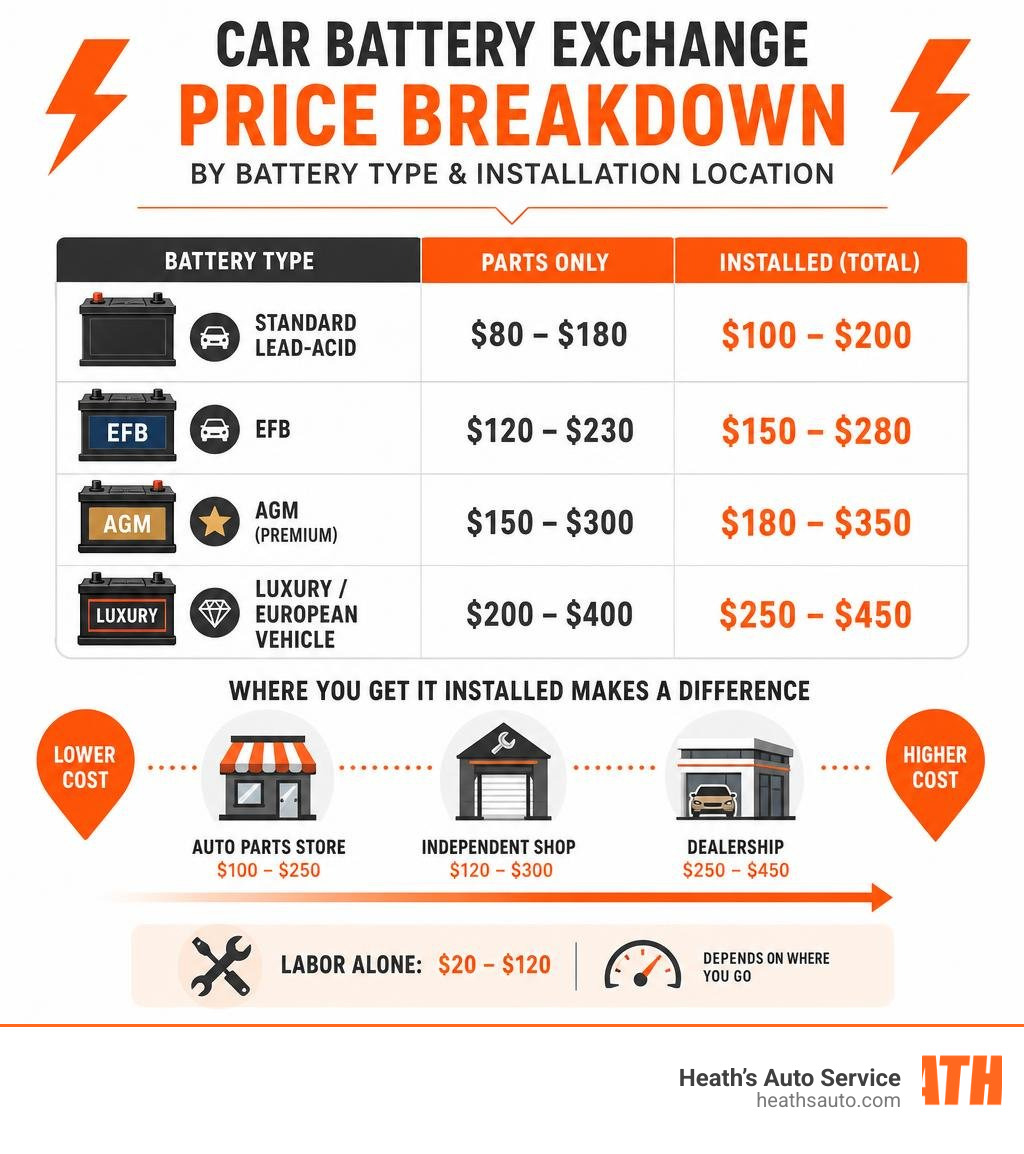
The car battery exchange price in 2026 typically falls within these ranges, depending on battery type and where you get it installed:
| Battery Type | Parts Only | Installed (Total) |
|---|---|---|
| Standard Lead-Acid | $80 – $180 | $100 – $200 |
| EFB | $120 – $230 | $150 – $280 |
| AGM (Premium) | $150 – $300 | $180 – $350 |
| Luxury/European Vehicle | $200 – $400 | $250 – $450 |
Quick answers:
- Most drivers pay $150 to $250 installed at an auto parts store or independent shop
- Dealerships charge more — often $250 to $450 for the same battery
- Labor alone runs $20 to $120 depending on where you go
- The national average sits around $175, but prices vary by region
Few car problems hit harder than turning your key on a busy morning and hearing nothing but a weak click. One moment you’re heading to work, the next you’re stuck in a parking lot searching for a jump start. And when the tow truck finally arrives, the repair quote can feel just as shocking as the dead battery itself.
Arizona drivers face this problem more than most. The desert heat is actually harder on batteries than cold weather — silently draining capacity until the battery fails without warning, often at the worst possible time.
Before you pay whatever the first shop quotes you, it pays to understand what a fair price actually looks like. Prices for the same battery job can swing from $100 to over $450 depending on battery type, vehicle, and where you take it.
Understanding the Average Car Battery Exchange Price in 2026
When budgeting for a replacement, it helps to understand that the national average of $175 is just a baseline. Where you live plays a massive role in how much you will pay for parts and labor.
Here in Arizona, our local pricing is highly competitive, but our unique environmental conditions mean we must select durable, high-quality batteries that can withstand extreme heat. This necessity can slightly shift the upfront cost, though it saves you from frequent early replacements. To get a complete picture of what to expect, check out our breakdown of More details on car battery costs in 2026.

Battery Types and How They Impact Your Replacement Cost
Not all car batteries are built the same way. The chemical design inside the plastic casing directly dictates how much power the battery can deliver, how well it handles extreme temperatures, and—most importantly—how much it will cost you at the counter.
Standard Lead-Acid Car Battery Exchange Price
Traditional flooded lead-acid batteries have been the automotive industry standard for decades. They are the most budget-friendly option, with parts generally costing between $80 and $180. If you drive an older vehicle with basic electrical needs, a standard lead-acid battery is usually all you need.
However, these batteries are highly susceptible to climate extremes. In moderate climates, they can last up to five or six years. But in hot desert climates like ours, their lifespan is drastically cut short. You can dive deeper into the chemistry and longevity of these options with this resource on More info on how long a car battery lasts on average.
Premium AGM and EFB Car Battery Exchange Price
Modern vehicles equipped with advanced electronics, start-stop engine systems, and heavy safety tech demand far more power than standard flooded batteries can provide. This is where Enhanced Flooded Batteries (EFB) and Absorbed Glass Mat (AGM) batteries come in.
- EFB (Enhanced Flooded Batteries): Positioned as an entry-level start-stop battery, an EFB costs between $120 and $230 for the part alone. They offer improved cyclic durability compared to standard batteries.
- AGM (Absorbed Glass Mat) Batteries: These are the gold standard for modern luxury and high-demand vehicles. AGM batteries use a fiberglass mat separator to absorb the electrolyte, making them completely spill-proof, highly vibration-resistant, and capable of recharging up to five times faster than standard batteries. They typically cost between $150 and $300 for the part, with total installed prices ranging from $180 to $350 or more.
If your vehicle came from the factory with an AGM battery, you must replace it with another AGM battery. Down-grading to a standard flooded battery to save a few bucks will cause the new battery to fail prematurely—often within a matter of months—because your vehicle’s smart charging system is specifically calibrated for AGM chemistry. You can read a complete breakdown of these specifications in the Car Battery Replacement Cost 2026: Full Pricing Guide | Ecostify.
Furthermore, because our Arizona climate is so brutal on electrical systems, investing in an AGM battery can actually be a smart cost-saving measure over time, even for vehicles that don’t strictly require it. To understand why, Learn how extreme heat drains a car battery.
EV and Hybrid Auxiliary Batteries vs. Traction Packs
It is a common misconception that electric vehicles (EVs) and hybrids don’t have standard car batteries. While they do rely on massive, high-voltage “traction” battery packs to drive the wheels, they still use a smaller 12-volt auxiliary battery to power the onboard computers, safety systems, headlights, and door locks.
Replacing a hybrid or EV 12-volt auxiliary battery is very similar to replacing a standard car battery, usually costing between $150 and $300.
Replacing the actual high-voltage traction pack, however, is a completely different story. Out-of-warranty EV battery pack replacements can range from $5,000 to over $22,000 depending on the vehicle manufacturer and pack size. The good news is that these traction packs are incredibly robust and rarely fail. Under federal law, all EVs sold in the U.S. come with a minimum 8-year/100,000-mile warranty covering the traction battery.
| Battery Category | Average Parts Cost | Average Lifespan (AZ Climate) | Primary Benefit |
|---|---|---|---|
| Standard Flooded | $80 – $180 | 2 – 3 Years | Lowest upfront cost |
| EFB | $120 – $230 | 3 – 4 Years | Better cycling for entry start-stop |
| AGM | $150 – $300 | 4 – 5 Years | Superior power, heat & vibration resistance |
| EV/Hybrid 12V Aux | $150 – $300 | 3 – 4 Years | Powers critical computer standby systems |
| EV Traction Pack | $5,000 – $22,000 | 10 – 15 Years | Propels the vehicle (covered by long warranty) |
Key Factors That Determine Your Final Bill
Have you ever wondered why two people driving different cars can walk into the same shop and walk out with completely different bills for a battery exchange? Several hidden variables dictate the final price.
Vehicle Make, Model, and Battery Specifications
The physical size, terminal placement, and power requirements of your battery are determined by your vehicle’s “group size.” A compact sedan requires a much smaller battery than a heavy-duty diesel truck, which might require two high-CCA (Cold Cranking Amps) batteries to start.
Additionally, vehicle engineering plays a massive role in labor costs. In many modern cars, the battery is no longer easily accessible under the hood. It may be tucked away inside the trunk, hidden beneath the rear passenger seat, or buried behind the inner fender liner. Accessing these batteries requires extra time and labor, which naturally drives up the final bill.
If you take your vehicle to a brand dealership for this service, you will likely pay premium labor rates. You can review these cost differences in our guide on More info on dealership battery replacement costs.
Furthermore, many modern European luxury vehicles (such as BMW, Audi, and Mercedes-Benz) require “battery registration” or coding after installation. This process tells the engine control module (ECM) that a new battery has been installed so it can reset its charging algorithms. Skipping this step will cause the alternator to overcharge the new battery, destroying it in short order. This specialized computer programming requires professional diagnostic tools, adding to the installation cost.
Professional Installation vs. DIY Replacement
If you are mechanically inclined, replacing your own battery can save you some money on labor. However, before you roll up your sleeves, there are a few things to keep in mind:
- The Core Charge: When you buy a new battery, the retailer will charge you a temporary “core fee” (usually $10 to $25). To get this money back, you must bring your old battery back to the store so it can be safely and legally recycled. Lead-acid batteries are nearly 100% recyclable, making this an essential environmental step.
- Memory Savers: Modern cars are essentially driving computers. If you completely disconnect the battery without a “memory saver” device plugged into your OBD-II port, you may lose your radio presets, clock settings, and power window calibrations. Worse, your engine computer might reset its learned driving values, causing the car to idle roughly for a few days until it relearns.
- Safety Precautions: Batteries contain highly corrosive sulfuric acid and can release explosive hydrogen gas. Always wear safety glasses and gloves, and remember to disconnect the negative (black) cable first, followed by the positive (red) cable. When installing the new battery, reverse the order: positive first, then negative.
If you decide that handling acid and resetting computer modules isn’t how you want to spend your Saturday, professional installation is highly recommended. To help you plan your day, you can Learn how long it takes to replace a car battery.
Frequently Asked Questions About Car Battery Replacement
How long do car batteries usually last?
On average, a car battery will last between three and five years. However, if you live in Arizona, you must grade on a curve. Our extreme summer heat accelerates the chemical reactions inside the battery, leading to internal corrosion and rapid water loss. In the desert, it is highly common for a standard battery to fail in just two to three years.
Because of this, we recommend having your battery professionally tested every six months once it passes its second birthday. To learn more about how our local environment impacts your vehicle, Learn how long car batteries last in Arizona.
What are the warning signs of a failing battery?
Your car will almost always try to warn you before its battery dies completely. Keep an eye out for these red flags:
- Slow Engine Crank: When you turn the key, the engine drags or takes longer than usual to start.
- Dimming Lights: Your headlights or interior cabin lights look weak when the engine is idling but brighten when you rev the gas.
- Corrosion Buildup: A white, blue, or green powdery substance covering the metal battery terminals.
- Swollen Battery Case: Extreme heat can cause the plastic sides of the battery to bloat or swell.
- The Battery Warning Light: A dashboard light shaped like a small battery remains illuminated while driving.
If you have already jump-started your vehicle but find that it dies again the moment you turn it off, you are likely dealing with a battery that can no longer hold a charge, or a failing alternator. For a detailed troubleshooting guide on this exact scenario, read our advice on what to do when I’ve Jump Started My Battery But It Won’t Hold a Charge.
Where can I get the best deals and warranties?
To get the most value out of your car battery exchange price, look for retailers or repair shops that bundle free digital battery testing with your purchase. Additionally, pay close attention to the warranty. A standard mid-range battery should come with a 3-year free replacement warranty. Avoid cheap, refurbished, or “value-brand” batteries that only offer a 1-year warranty—they rarely survive their first Arizona summer.
For a broader look at how to navigate these retail options and find the sweet spot between price and reliability, you can consult this guide on Car Battery Replacement Cost — What You Should Actually Pay – Budget Seniors.
Our team at Heath’s Auto Service also offers a specialized service designed to make this process seamless. To learn more about how we can help, check out Why You Need to Try Our New Battery Battery Swap Battery Charge Service.
Conclusion
A dead battery doesn’t have to ruin your day or empty your wallet. By understanding the average car battery exchange price and selecting the right battery chemistry for your vehicle and climate, you can make an informed, stress-free decision.
If your vehicle is starting to crank slowly, or if you simply want to make sure your battery is ready to tackle the upcoming season, stop by one of our shops today for a quick test. And if you are wondering how to schedule your day around a replacement, Find out how long it takes to replace a battery in a car so you can get back on the road with total confidence.
Heath’s Auto Service in Cottonwood, AZ
At Heath’s Auto Service, our comprehensive range of services covers everything from routine maintenance to complex repairs. Whether it’s a minor tune-up or a major overhaul, trust us to get you back on the road with confidence. Contact our team at Heath’s Auto Service today!