

Is a Detailed Tune Up Inspection Worth Paying For in Arizona?
A detailed tune up inspection is one of the most misunderstood services in auto repair — and one of the most important for keeping your car running well and avoiding expensive breakdowns.
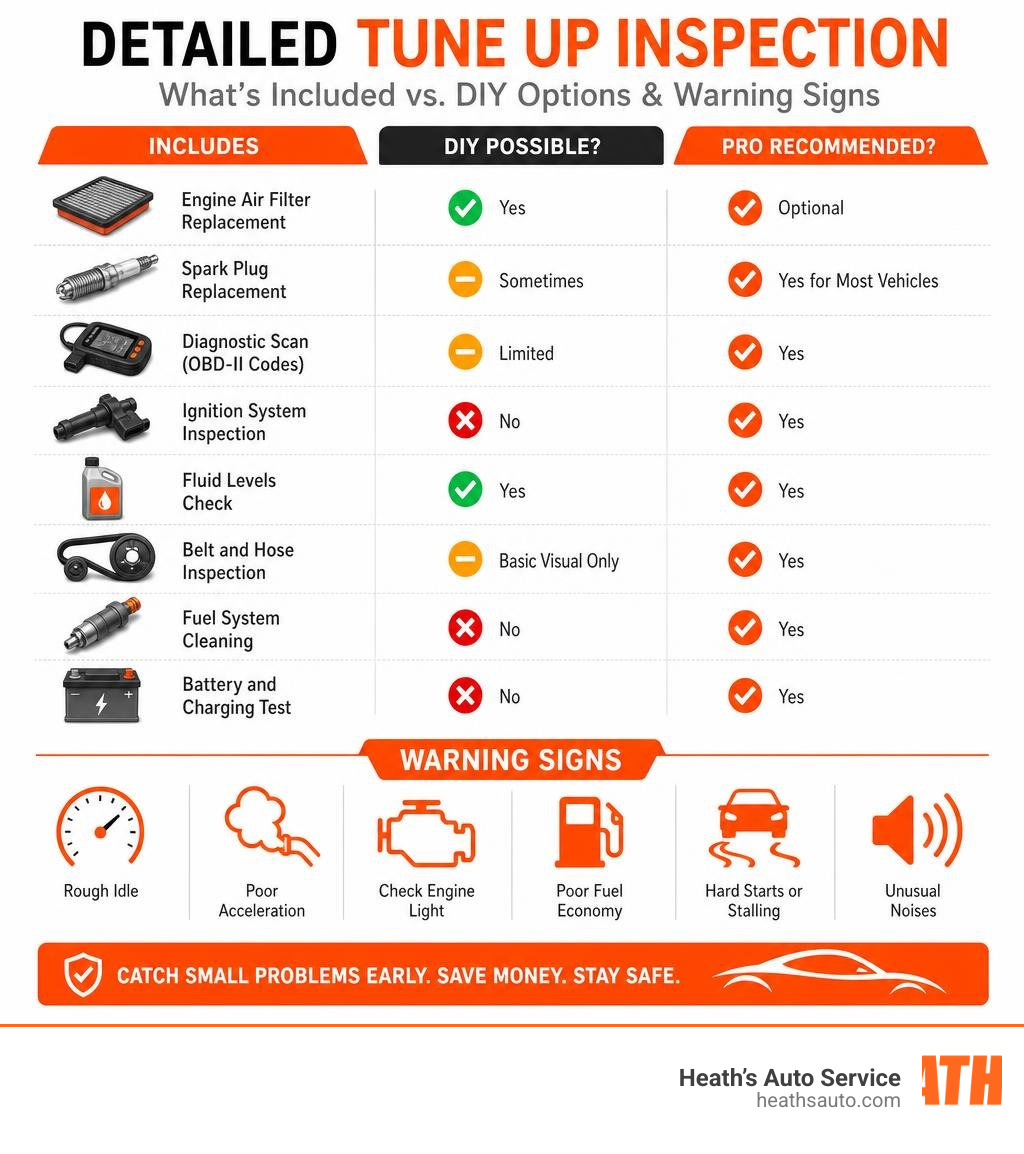
Quick answer: Here’s what a detailed tune up inspection typically includes and whether you need a pro:
| Service Item | DIY Possible? | Pro Recommended? |
|---|---|---|
| Engine air filter replacement | Yes | Optional |
| Spark plug replacement | Sometimes | Yes for most vehicles |
| Diagnostic scan (OBD-II codes) | Limited | Yes |
| Ignition system inspection | No | Yes |
| Fluid levels check | Yes | Yes |
| Belt and hose inspection | Basic visual only | Yes |
| Fuel system cleaning | No | Yes |
| Battery and charging test | No | Yes |
For modern vehicles, a professional inspection catches problems that a home check simply cannot — especially anything tied to your car’s computer systems and sensors.
Most drivers notice something is off — a rough idle, sluggish acceleration, or a check engine light — but aren’t sure if it warrants a full inspection or just an oil change. The honest answer depends on your vehicle’s age, mileage, and driving conditions (Arizona heat alone accelerates wear faster than most people realize).
At Heath’s Auto Service, we’ve spent years helping Arizona drivers get clear, honest answers about their vehicles — including whether a detailed tune up inspection is the right next step or an unnecessary expense. Let’s break it all down so you can make a confident decision.
Detailed tune up inspection terms made easy:
What is a Modern Detailed Tune Up Inspection?
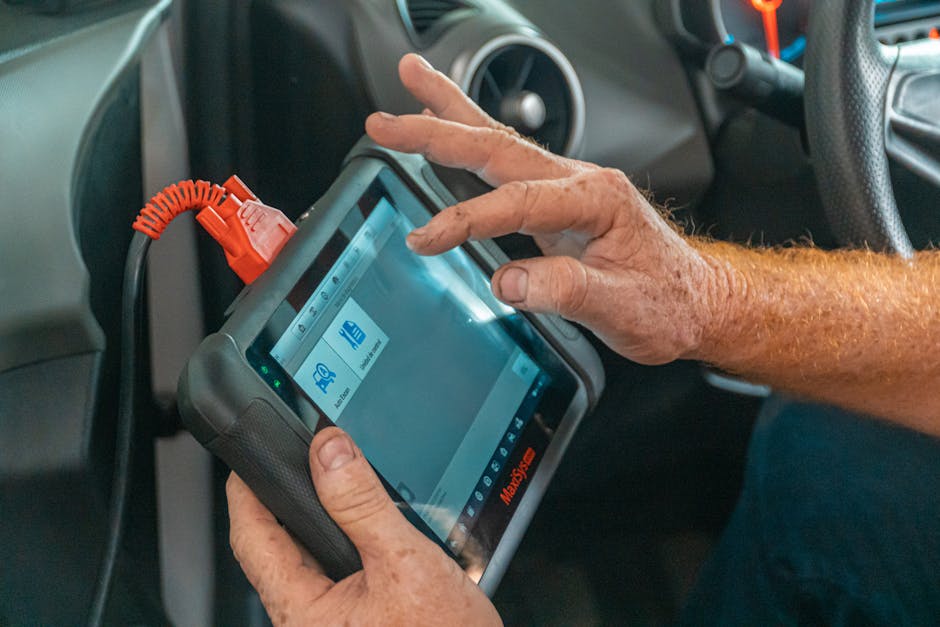
When people talk about a “tune-up,” they often picture a mechanic in greasy overalls adjusting a carburetor with a screwdriver. But in June 2026, the automotive landscape looks vastly different. Today, a detailed tune up inspection is a highly technical, multi-point evaluation of your vehicle’s engine health, ignition efficiency, and computerized control systems.
Instead of manual tweaks, modern tune-ups rely heavily on digital precision. When you bring your car in for a comprehensive inspection, technicians don’t just swap out parts blindly. They perform a deep-dive analysis of your engine’s primary systems. This includes examining the spark plugs for wear patterns, testing the ignition coils for proper voltage delivery, inspecting the fuel injectors for carbon buildup, and running full engine diagnostics to read live sensor data.
To keep your car running reliably, it helps to understand how these parts fit into your overall car maintenance schedule. Catching a failing ignition coil or a clogged fuel filter early prevents those components from straining other parts of your powertrain, saving you from much larger repair bills down the road.
The Evolution of the Tune-Up: Carburetors vs. Computers
The term “tune-up” has stuck around, but the physical work has evolved completely. In older vehicles, a tune-up meant physically adjusting the distributor points, setting the ignition timing, and tuning the carburetor to achieve the perfect air-fuel mixture. If you didn’t do this every year, your car would start chugging gas and idling like a lawnmower.
Modern vehicles have replaced these mechanical systems with advanced engine control units (ECUs), electronic ignition systems, and highly sensitive onboard diagnostics (OBD-II). Today, your car’s computer constantly monitors and adjusts the ignition timing and fuel delivery in real-time based on live sensor data.
Because of this, a modern tune-up is less about manual adjustments and more about diagnostic scans, sensor verification, and replacing high-tech wear items. The computer can compensate for worn parts up to a certain point, but eventually, physical wear catches up, causing performance issues that require a professional touch.
Key Components Checked During a Detailed Tune Up Inspection
A thorough inspection must go beyond a simple visual check under the hood. A professional-grade checklist is extensive, ensuring every system that contributes to combustion and engine efficiency is performing optimally.
Key components checked include:
- The Ignition System: Spark plugs, ignition coils, spark plug wires, and boot connections. Technicians inspect spark plug electrodes for wear, ash accumulation, or oil fouling, which can indicate internal engine issues.
- The Filtration System: The engine air filter, fuel filter, and PCV (Positive Crankcase Ventilation) valve.
- Belts and Hoses: Serpentine belts, tensioners, and radiator/heater hoses are checked for cracking, dry rot, glazing, or soft spots.
- Fluids: Inspection of engine oil, coolant, brake fluid, power steering fluid, and transmission fluid for both level and contamination.
- Battery and Charging System: Testing the battery’s cold cranking amps (CCA), alternator output, and starter draw.
For a closer look at what goes into a standard maintenance checklist, you can review this Car Tune-Up Checklist – What is a Tune-Up? – AutoZone to see how individual components wear out over time.
DIY vs. Professional: Weighing Your Options

With so many auto parts stores offering replacement spark plugs and basic OBD-II code readers, it is tempting to think you can handle a detailed tune up inspection entirely in your driveway. While taking the DIY route can save you some upfront labor costs, it also comes with limitations, specialized tool requirements, and safety risks.
If you lack experience, working around high-voltage ignition systems or trying to interpret complex diagnostic data can lead to mistakes. A single cross-threaded spark plug can damage your engine’s cylinder head threads, turning a simple maintenance task into a multi-thousand-dollar repair.
To help you decide which path makes sense for your vehicle, here is a breakdown of what can realistically be accomplished at home versus what requires a professional facility:
| Capability / Task | DIY (Home Garage) | Professional (Heath’s Auto Service) |
|---|---|---|
| Diagnostic Depth | Basic code reading (generic OBD-II) | Full-module scanning, live sensor stream, and waveform analysis |
| Specialized Tools | Standard hand tools, basic socket sets | Oscilloscopes, fuel pressure gauges, ignition testers |
| Engine Air Filter | Yes (simple drop-in) | Yes (included in multi-point check) |
| Spark Plug Replacement | Possible on inline engines; difficult on V6/V8s | Yes, using factory torque specs and OE-matching materials |
| Fuel System Cleaning | Pour-in tank additives only | Multi-step direct fuel injection and throttle body cleaning |
| Safety & Warranty | No warranty on labor; risk of component damage | 3-year/36,000-mile nationwide warranty on parts and labor |
What You Can Safely Do at Home
If you enjoy turning a wrench, there are several preventative maintenance tasks you can safely tackle in your driveway to keep your car running clean:
- Engine and Cabin Air Filters: On most vehicles, replacing these filters requires no tools or only basic clips. Replacing a dirty engine air filter ensures your engine gets plenty of clean air, while a fresh cabin filter keeps the air inside your passenger compartment free of dust and pollen.
- Fluid Level Checks: Regularly pulling your oil dipstick, checking the coolant reservoir level, and inspecting the windshield washer fluid are simple ways to stay ahead of leaks.
- Visual Inspections: You can easily inspect your serpentine belt for obvious cracks or look under the vehicle for any active fluid drips.
Why a Professional Detailed Tune Up Inspection is Crucial
While replacing an air filter is simple, diagnosing a subtle engine misfire or a drop in fuel economy is not. Professional technicians use advanced diagnostic equipment—such as digital oscilloscopes, high-end scan tools, and ignition waveform analyzers—to see exactly what is happening inside your engine’s combustion chambers.
For example, a basic home code reader might tell you that you have a “Cylinder 3 Misfire.” However, it won’t tell you why. Is it a failing ignition coil, a clogged fuel injector, a worn spark plug, or a loss of compression?
A professional technician can analyze the ignition waveform to see if the coil is charging and discharging correctly, test the fuel injector’s pulse width, and pinpoint the exact root cause. This advanced troubleshooting prevents you from wasting money on parts you don’t need. If you want to make sure your vehicle starts reliably every time, learning how to avoid starting problems through professional diagnostics is the smartest approach.
When Your Car Needs a Tune-Up: Signs, Intervals, and Costs
Knowing when to schedule a detailed tune up inspection is key to maintaining your vehicle’s performance and fuel efficiency. If you wait until your car stalls in the middle of a busy intersection, you have waited too long.
Paying attention to how your car drives and understanding the unique demands of our local climate will help you catch minor wear before it turns into a major breakdown. If you want to dive deeper into why regular maintenance keeps your vehicle driving beautifully, read about the importance of regular auto maintenance for a smooth ride.
Warning Signs and Recommended Intervals
Your car is excellent at communicating when it needs attention. Keep an eye out for these common warning signs:
- The Check Engine Light: If this light is flashing or staying illuminated, your car’s computer has detected a performance issue.
- Rough Idle: If your car shakes, vibrates, or feels like it wants to die when stopped at a red light.
- Sluggish Acceleration: A noticeable hesitation or lack of power when you press the gas pedal.
- Decreased Fuel Economy: If you find yourself visiting the gas station more frequently without changes in your driving habits.
- Unusual Noises: Knocking, pinging, or squealing sounds coming from under the hood.
How often should you get an inspection? The answer depends heavily on your vehicle’s age and where you drive:
- Older Vehicles: Cars with traditional, non-electronic ignition systems should receive a tune-up every 10,000 to 12,000 miles or once a year.
- Modern Vehicles: Newer cars equipped with electronic ignitions and long-life iridium or platinum spark plugs can go anywhere from 25,000 to 100,000 miles before needing replacement parts.
However, driving conditions play a massive role. In Arizona, our extreme summer heat, dust, and stop-and-go traffic in cities like Scottsdale, Chandler, and Gilbert put extra stress on ignition coils, batteries, and filters. If you frequently drive in these conditions, or climb steep mountain passes around Flagstaff and Prescott, you should have your vehicle inspected more frequently. You can understand how often to get a tune-up based on your specific driving habits.
Standard Tune-Up vs. Major Service vs. Oil Change
Many drivers confuse these three common services, but they serve different purposes:
- Oil Change: This is your most frequent service. It focuses purely on engine lubrication. It involves draining old motor oil, replacing the oil filter, and topping off basic fluids. According to Kelley Blue Book data, the estimated total cost for a standard oil change ranges from $145 to $173.
- Standard Tune-Up: This service focuses on engine performance and the ignition system. It typically includes replacing spark plugs, inspecting ignition coils and wires, cleaning the fuel system, and running a complete computer diagnostic scan. A basic service can cost $500 or less, while a more comprehensive service on premium or complex vehicles can run $800+ depending on the parts and labor required.
- Major Service: Often scheduled at 30k, 60k, or 90k-mile intervals, this is a comprehensive bumper-to-bumper service. It includes everything in a tune-up plus full fluid flushes (coolant, transmission, brakes), timing belt replacement (typically needed between 60,000 and 100,000 miles), suspension inspections, and wheel alignments.
To plan your car care budget, check out the complete guide to car tune-up costs and review car tune-up costs for 2025 and beyond to see what to expect for your specific make and model.
Frequently Asked Questions about Tune-Up Inspections
How long does a detailed tune-up inspection take?
A professional detailed tune up inspection typically takes between two to four hours. The exact duration depends on the complexity of your vehicle’s engine bay and the extent of maintenance required. For example, replacing spark plugs on an inline 4-cylinder engine is relatively quick, whereas a V6 or V8 engine may require removing intake manifolds to access the rear spark plugs, which naturally takes more time.
Can a dirty air filter really affect my fuel economy?
On older, carbureted engines, a clogged engine air filter can restrict airflow so severely that it reduces fuel economy by 2% to 6%, and up to 14% in extreme cases. On modern, fuel-injected engines, the onboard computer is smart enough to detect the restricted airflow and adjust the fuel delivery to keep the mixture balanced. While this prevents a massive drop in MPG, a clogged filter on a modern car will still cause a noticeable loss of power, sluggish acceleration, and engine strain.
What is the difference between a standard service and a tune-up?
A standard service (like an oil change or minor inspection) is focused on routine lubrication and general safety checks. A tune-up is a targeted service designed specifically to optimize engine combustion, restore lost horsepower, improve fuel efficiency, and ensure the ignition system is firing with perfect timing.
Conclusion
Investing in a detailed tune up inspection is one of the smartest ways to protect your vehicle, maximize your fuel economy, and enjoy a smooth, reliable ride. While basic tasks like swapping an air filter can be handled at home, the computerized complexity of modern engines means a professional inspection is well worth the investment.
Heath’s Auto Service In Scottsdale, AZ
At Heath’s Auto Service, we offer a comprehensive range of services and repairs to meet all your automotive needs. Our highly skilled technicians are equipped with the latest tools and technology to ensure your vehicle is serviced to the highest standards. Contact our team today!